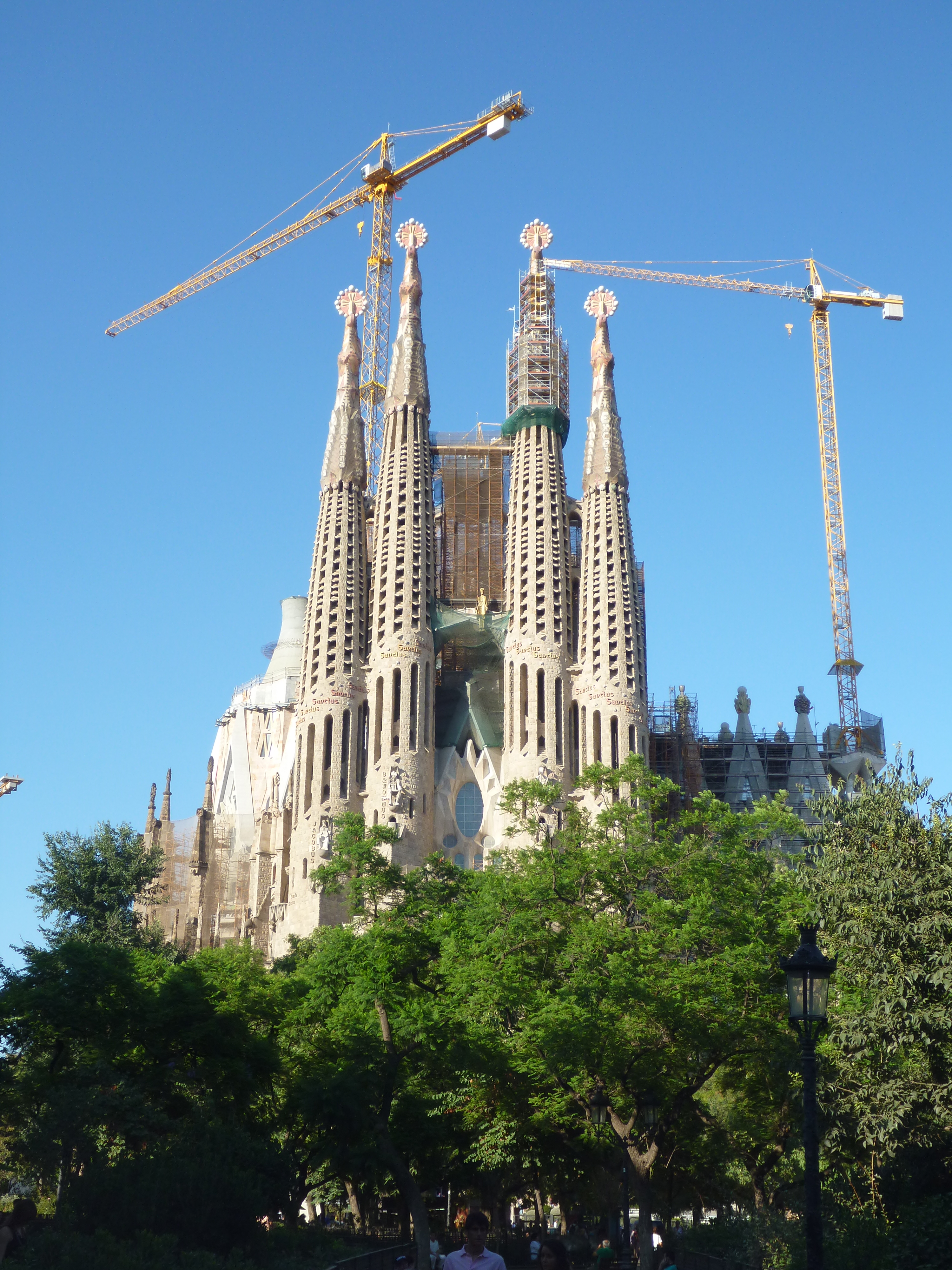
La Sagrada Familia
Gaudí's nature-inspired basilica, under construction since 1882 and expected to be complete by 2030. A masterpiece that treats a church building like a forest of stone and light.
You have one day. One day to understand a city that has been building itself for two thousand years, that speaks a language Spain once tried to kill, that produced the most original architect in history, and that still believes the Mediterranean is the centre of the world.
This walk will take you from Gaudí's impossible basilica through the Modernisme palaces of Passeig de Gràcia, down Barcelona's most famous boulevard, into the Gothic labyrinth of the old city, through two very different churches — one for bishops, one for dock workers — and into a park that was once a fortress designed to keep Barcelona quiet.
You'll cover two thousand years in about two and a half hours. You'll see buildings that look like dragons, a market that's been feeding the city since the 13th century, a mosaic by Joan Miró hiding under your feet, and a waterfall designed by a young Gaudí before anyone knew his name.
Barcelona refuses to be just one thing. Medieval and modern. Sacred and secular. Catalan and cosmopolitan. Planned and chaotic. This walk shows you all of it.
Let's start with the building everyone comes to see.
Welcome to Barcelona. And welcome to the Sagrada Familia—the building that will define how you understand this city.
Look up. Really look up. You're standing in front of Antoni Gaudí's unfinished masterpiece, a basilica that started construction in 1882 under architect Francisco de Paula del Villar. But Gaudí took over in 1883, and he tore up the plans. He redesigned everything. For the last 12 years of his life, he didn't just design this building—he lived here, on the site, obsessed with getting it right.
Gaudí was a man who believed architecture should study nature. Walk inside—if you can—and look at the columns. They're not classical pillars. They're tree branches. They split and divide and redistribute weight the way a forest distributes the load of snow. The stone looks organic. It doesn't look built. It looks grown.
You're looking at two different facades. The Nativity Facade, on the east side, is Gaudí's own work—completed in his lifetime. It's lyrical, detailed, almost overcrowded with meaning. The Passion Facade on the west is by Josep Maria Subirachs, and it's controversial. It's angular and stark, like jagged bones. Some people love it. Some people think it breaks Gaudí's vision. That tension—that's Barcelona too.
The light inside is stunning. The stained glass is colored warm on the east side—reds, oranges—so in the morning, when you're looking toward the sunrise, you get morning warmth. The west side is cool blues and greens. The light changes all day. Gaudí was obsessed with how light moves through sacred space.
Gaudí died in 1926—hit by a tram—and he's buried in the crypt below your feet. He never saw the building complete. Neither have we. The construction continues. They expect it finished around 2026 to 2030. The central tower, the Tower of Jesus Christ, will be 172.5 meters tall. The tallest church in Europe.
This building gets about 4.5 million visitors a year. It's the most visited building in Spain. It's a UNESCO World Heritage Site. And it's not even finished. That's how powerful it is.
Here's what Gaudí discovered: you don't have to choose between sacred and secular, between nature and architecture, between finished and unfinished. A building can be all of these at once. That refusal to be just one thing—that's the spirit of Barcelona.
Casa Batlló
That is stop one, in the walk itself. The remaining 10 stops, the map and the route between them open with one free account.
Continue the walkThe written walk is free.
Thank you! Your report has been submitted.
Report an issue
Help us improve by reporting any issues you notice.