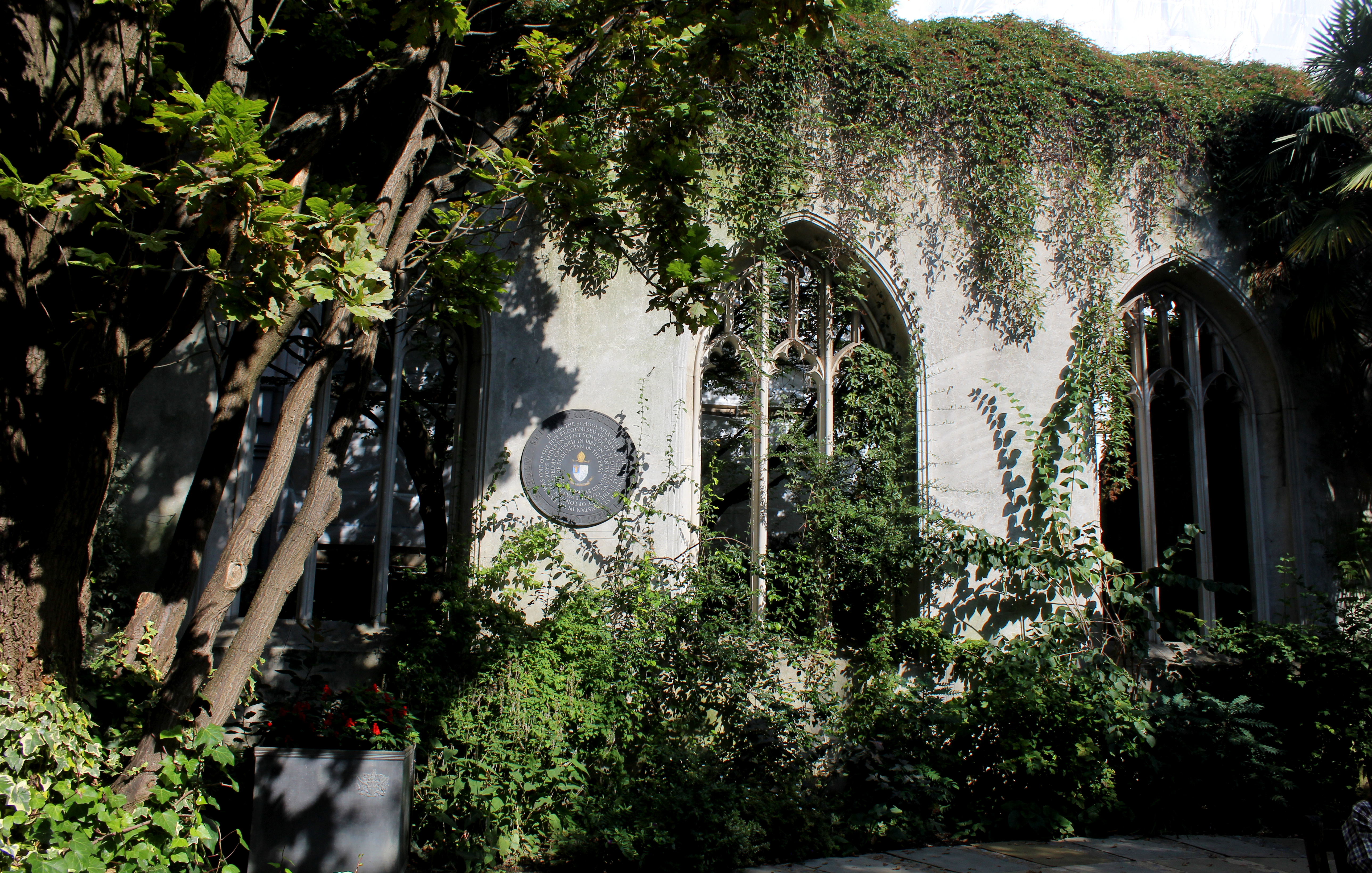
St Dunstan in the East
St Dunstan in the East is a ruined medieval church in the City of London, its Gothic walls enveloped in ivy and adorned with a 17th-century tower by Christopher Wren—a hauntingly photogenic monument to both medieval survival and post-Fire abandonment.
We begin where nature has nearly won. St Dunstan in the East clutches the London skyline with ivy-strangled fingers, its Gothic arches crumbling into silence—a church where time stopped and grew wild. This is where our story unfolds: not in triumph, but in the grip of ruin. London's fate was written in ash and smoke. In 1666, fire consumed everything these stones represent. The Great Fire didn't just destroy buildings; it erased a medieval world, a city that had stood for a thousand years. Yet here's the paradox we'll chase today: out of that annihilation came resurrection. As we descend into Roman foundations, walk the lane where the first ember fell, climb Wren's soaring Monument, and stand beneath St Paul's regenerated dome, you'll witness how a city refused to stay buried. Medieval survivors linger in shadowed corners. A cathedral rose from the flames. Fleet Street learned to tell the story—London's own story—back to itself. This is a walk through destruction and defiance. Come. Let's see what burned, what survived, and what rose impossibly from the ashes.
Welcome to St Dunstan in the East, where London's stone is slowly being reclaimed by the living world. Stand here for a moment and look around you. You're surrounded by the modern City of London—glass towers, rushing pedestrians, the pulse of contemporary finance and commerce. And yet, rising between those buildings, wrapped in ivy like some enchanted ruin from a Gothic novel, stands this church. It shouldn't feel as otherworldly as it does, not here in the heart of a working city. But it does.
This is where our story truly begins. Not with the Fire itself—we'll come to that, to the inferno and its aftermath—but with what endures. What survives. And what survives transformed.
The church you're looking at is medieval. Very medieval. Its roots run back centuries into London's past, to a time when this city was different in almost every way that matters. But the walls you see today aren't all original to that medieval structure. Look up, particularly at the tower. That elegant structure, rising above the ivy-covered nave like a final defiant gesture skyward, was added after the Great Fire of 1666. And here's where the story becomes fascinating: it was built—or at least designed and overseen—by Christopher Wren himself.
Yes, the Wren. The architect who would create St Paul's Cathedral. The visionary who would transform London's skyline after the Fire. But before he built his masterpiece, before he designed the grand cathedral that would define his legacy, he was here, at this comparatively modest parish church. He added that tower, a signature element of his style even in this smaller commission. It's as if he was sketching, practicing for something greater. Testing his ideas on London's fabric before unleashing them in full baroque splendor elsewhere.
Let me set the historical context for you, because it matters enormously. St Dunstan in the East stands in one of London's oldest parishes, dating back to the late 7th or early 8th century. In medieval times, this was a significant church, serving the local population of merchants and workers in this part of the City. It had gravitas. It had importance. But then came September 1666, and everything changed.
The Great Fire didn't destroy St Dunstan entirely. Unlike so many churches around it, this one survived the flames themselves. But survival and thriving are different things. When the fire receded and Londoners looked around at their ruined city, there was an immediate question: what do we do now? For many churches, the answer was to rebuild, grander and more ambitious. St Dunstan, though, took a different path. It was partly damaged, yes, but not devastated like so many others. Yet it would slowly fall into disrepair. Eventually, it was nearly abandoned. The parish merged with a neighboring church. St Dunstan became, essentially, redundant.
And so nature began its work.
Look at those walls now. The ivy has turned them into something almost unrecognizable as architecture—into a romantic ruin, the kind of thing that Victorian painters found irresistible. There's something profoundly moving about watching nature reclaim what humans built. It's not destruction exactly; it's more like the city and the wild reaching some kind of compromise. The ivy is beautiful, but it's also a symbol of loss. This church, once vital to its community, became a forgotten ruin in the heart of London.
What you're looking at is the visible tragedy of post-Fire London: the winners and losers. St Paul's Cathedral would be rebuilt in triumph. Wren's churches would rise across the city, magnificent and confident. But St Dunstan was damaged just enough, and in just the wrong way, to fall through the cracks. It became a victim of the Fire's aftermath—not through direct destruction, but through a slower fading into irrelevance.
That tower, though—Wren's tower—still stands. You can see it rising above the medieval walls, a reminder that even in this quiet ruin, ambition and genius once touched this place. Wren didn't just repair damage here; he left his mark, his stamp of architectural vision. It's one of the more poignant aspects of this site: the greatest architect of London's rebuilding created this tower, and yet the church itself would still slip away into obscurity. Even genius couldn't save everything.
The church is also remarkable for what's still standing. The chancel—look to the east end—has an ornate east window frame, still Gothic, still magnificent despite the centuries and the ivy. The arches supporting the roof (or what remains of it) give you a sense of the medieval proportions, the ambition with which this space was originally constructed. Underneath the romance of the ruin is the reality of medieval craftsmanship and medieval faith.
And here's something else worth noticing: the stones themselves. London is built on layers—Roman, medieval, Stuart, Victorian, modern. And the stone of St Dunstan carries that history. Some of the stones in these walls are reused Roman stone; medieval masons incorporated earlier materials into their structures. That's London's layering on display in an almost literal sense. We'll see this again on our tour, in actual Roman Walls that survive. But here, it's woven into the very fabric of the church.
The space itself, despite the ruin, still feels sacred. People come here to sit, to reflect, to photograph. Artists and romantics are drawn to it. Londoners who spend their days in the modern City stumble into this place and suddenly feel like they've been transported somewhere else entirely. It's a threshold—between the corporate world outside and something older, quieter, more haunted.
This church is also a threshold in our story. It's abandoned, yes, but not destroyed. It survived the Fire when so many others didn't. It survived the centuries, the urban development, the modern rush of the City. It's still here, still beautiful in its decay. And that combination—survival mixed with decline—is the perfect introduction to what we're about to explore.
Because as we walk this tour, you'll see the opposite tale again and again. You'll see St Paul's Cathedral, another creation touched by Wren's hand, rising in triumph from the same ashes that left St Dunstan fading. You'll see medieval buildings that somehow endured not just the Fire but the Blitz, the centuries, the relentless pressure of development. You'll stand on Roman stone that's been beneath London for two thousand years. And you'll see the modern City, built on top of it all, learning and forgetting and learning again.
St Dunstan asks a question: what do we preserve, and what do we let fade? Which stories matter? Which buildings deserve to be remembered, rebuilt, loved—and which ones slip away into beautiful ruin? It's a question London has been answering, over and over, for two thousand years. And the answer changes every time.
Now look around at the modern City pressing in on all sides. That contrast—between this ruined medieval church and the glass towers beyond its walls—that's our story in miniature. That's what this tour is about. Destruction and rebuilding. Death and resurrection. The city dying and being born again, over and over. Welcome to London's story.
Roman Wall Fragments
That is stop one, in the walk itself. The remaining 9 stops, the map and the route between them open with one free account.
Continue the walkThe written walk is free.
Thank you! Your report has been submitted.
Report an issue
Help us improve by reporting any issues you notice.