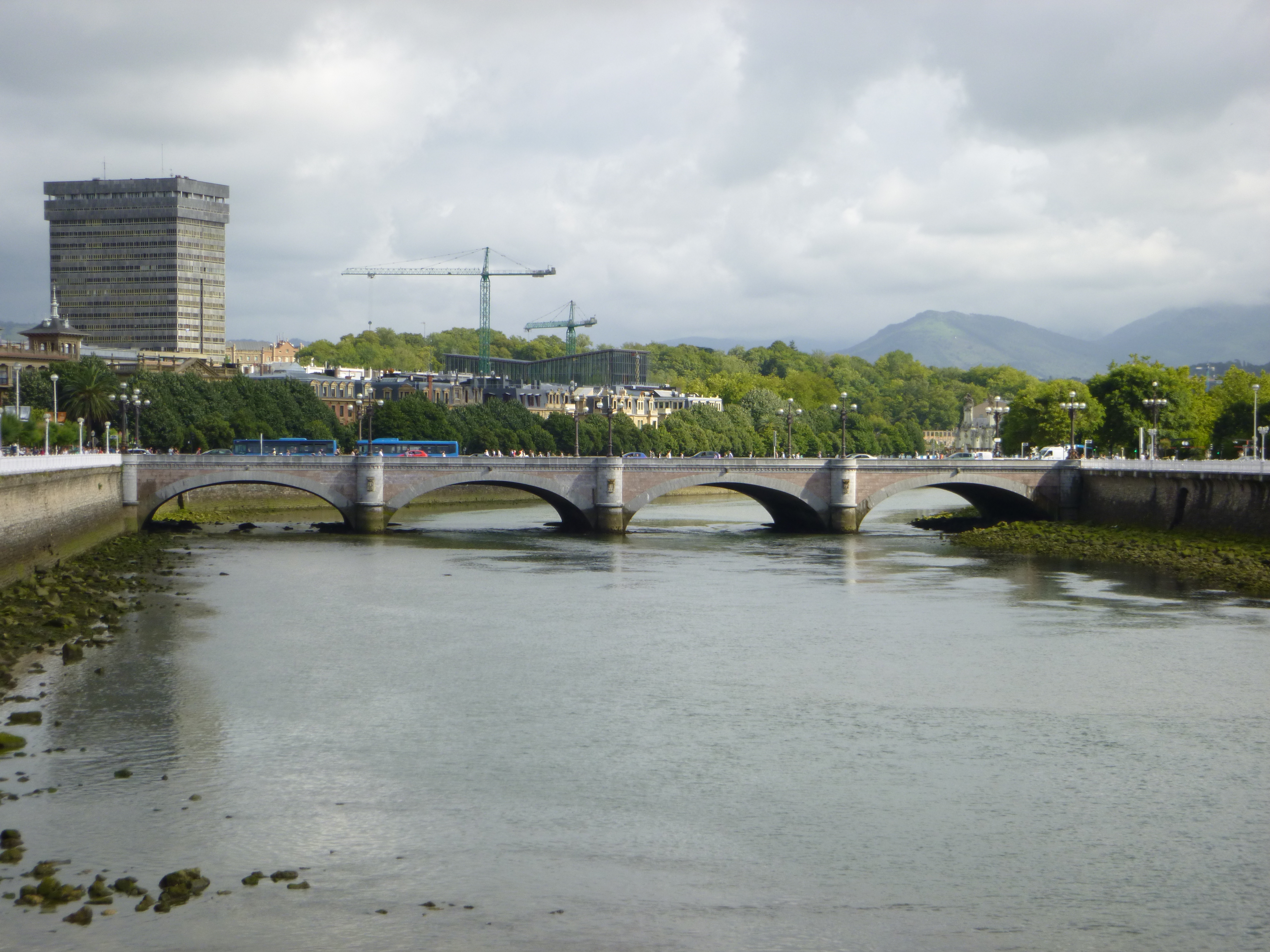
Puente de Santa Catalina
The city's oldest surviving bridge, first built in wood in the Middle Ages, rebuilt in stone to Antonio Cortázar's neoclassical design and inaugurated in 1872. It marks the historic frontier between the old walled town and the working east bank across the Urumea.
Welcome to San Sebastian, or Donostia, if you want to say it the way the locals do. Most visitors never leave the postcard half of this city, the elegant curve of La Concha and the tidy old town. Today we are doing the opposite: we are crossing the river to Gros, the east bank, the side people actually live on, the side that keeps tearing itself down and reinventing itself. This is the city that works, surfs and rebuilds, and it all starts here, on a bridge.
So stand for a second in the middle of the Puente de Santa Catalina and feel the two directions pulling at you. Behind you is the old San Sebastian, the walled town, the tourist heart. In front of you, across the water, is the other bank. For most of this city's history, that difference was everything. One river, two cities.
This is the oldest crossing point in San Sebastian, and it has been for a very long time. There has been a bridge on this spot since the Middle Ages, first mentioned in documents back in the fourteenth century, when it was a simple wooden structure. And here is the thing worth picturing: back then, the far bank you are looking at was not a neighbourhood at all. It was marsh and tidal flats and orchards, a soggy floodplain where the Urumea spread out before meeting the sea. The city was the tight little peninsula behind you, hemmed in by walls. This bridge was the thread that stitched the fishing town to all that empty, watery land on the east side, the land that would one day become Gros.
Notice how solid and permanent it feels now, all pale stone and elegant arches. Do not be fooled. This bridge has been one of the most destroyed and rebuilt things in the whole city. The wooden versions burned, collapsed and washed away with grim regularity. In 1813, during the great siege that gutted San Sebastian, the bridge here was destroyed in the fighting. It burned again in 1835 during the Carlist wars, when the city's own defenders set it alight to stop an attacking army from pouring across. Think about that for a moment. In one single stretch of the nineteenth century, this crossing was rebuilt in wood something like seven separate times, all carrying the same name, Santa Catalina. Seven bridges in seventy years. A frontier is a dangerous place to build.
The stone bridge you are standing on is the one that finally stuck. It was designed by the architect Antonio Cortazar in a clean neoclassical style and inaugurated in 1872, which makes it the oldest surviving bridge in the city. Here is a small detail almost nobody notices: it was originally built with five arches, but it lost one. When the Urumea was later channelled and tamed to create the riverside promenade, one of the arches was simply swallowed up by the new embankment. So the bridge you see is, in a quiet way, a little shorter than the one they cut the ribbon on.
Now turn and look downstream, towards the sea. See those two big pale shapes near the beach, the ones that look like enormous blocks of frosted ice that drifted in and got stuck? Those are the Kursaal cubes, and they are our next stop. Keep them in the corner of your eye, because they hold one of the best decay-and-rebirth stories in the whole city.
And if you glance the other way, upstream, you will spot a grander, more ornate bridge in the distance. That is where we finish this tour, at the crossing built for royalty arriving by train in the city's fancy resort years. Hold that thought too.
Because that is really the idea behind everything we are about to walk. Every single time San Sebastian has reinvented itself, as a royal resort, as an industrial town, as a surf city, as a culture capital, the change crossed this river first and took root on the far bank. This modest old bridge is where the city's future kept arriving. So let us follow it across, and go meet the other San Sebastian.
Kursaal
That is stop one, in the walk itself. The remaining 7 stops, the map and the route between them open with one free account.
Continue the walkThe written walk is free.
Thank you! Your report has been submitted.
Report an issue
Help us improve by reporting any issues you notice.