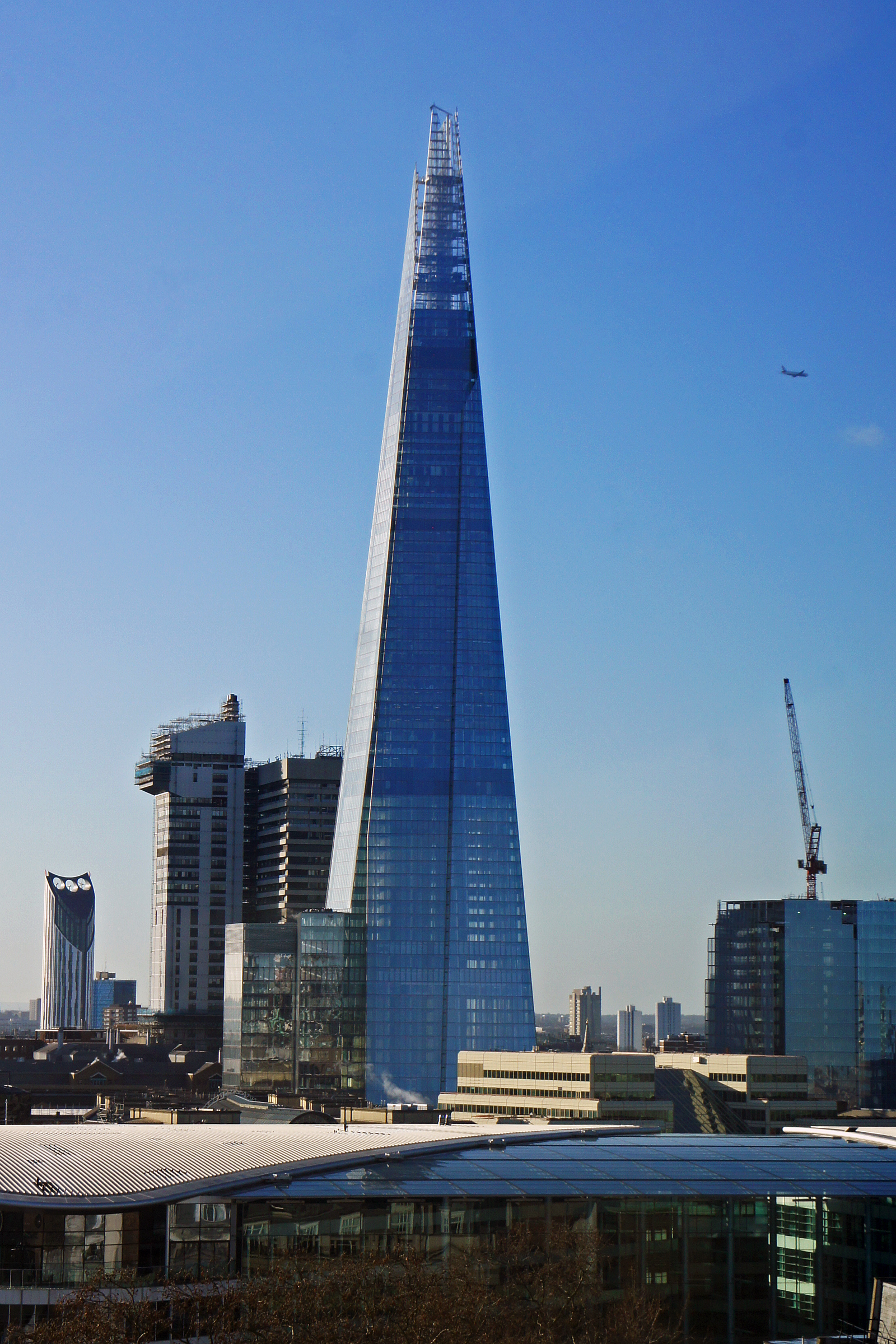
The Shard
At 310 metres, The Shard is Western Europe's tallest building and London's most audacious statement of 21st-century ambition. Designed by Renzo Piano and completed in 2012, this glass pyramid transformed London's skyline and challenged centuries of architectural restraint.
You're standing outside London Bridge station, craning your neck back. Above you, The Shard catches the light like a glass dagger pointed at the sky. It's 2012 when it was finished, which might sound recent, but in London it's practically yesterday. Around you, the city has spent the last hundred years—really, the last thirty—arguing with itself about what it wants to be. Medieval alleyways collide with glass walls. Roman foundations sit beneath shopping centres. And now, right here, we're going to follow that argument upward, sideways, and eventually back down to ground level, to a building that deliberately turned away from the sky.
This walk is about ambition. The vertical kind, the kind that makes architects dream bigger and Londoners roll their eyes at whatever nickname they've given the latest tower. We're going to see how the city climbed out of its medieval skin, built towers that still make you dizzy, and then—this is the really interesting bit—stepped back and asked whether height was actually what the city needed. So look up one more time. That's where we're heading. But we're not staying there.
Stand at the base of The Shard and look straight up. Really look up — until the glass fades into the London sky. What you're experiencing is Italian architect Renzo Piano's vision of a vertical city: 310 metres of cascading glass shards that taper towards the heavens. It's not subtle. It wasn't meant to be.
When The Shard was completed in 2012, London was still figuring out how to be a 21st-century global city. The Gherkin had arrived nine years earlier and gently suggested that modern architecture could be bold without being brash. But The Shard said something bolder: London is vertical now. London competes with Dubai and Shanghai. London reaches up.
Look at the building's form for a moment — those shards of glass that seem to dissolve upward. Piano didn't invent this gesture from nowhere. He was inspired by 18th-century engravings of London's church spires reaching toward heaven and by the masts of sailing ships on the Thames. So The Shard is actually a conversation with London's past, dressed in glass and steel. It honours the vertical yearning of Wren's spires while belonging unmistakably to the age of global finance.
The building holds what you might call a vertical neighbourhood. Around 1,000 offices occupy the lower sections. Then come residences — homes for London's ultra-wealthy, naturally. In the middle sits a five-star hotel with rooms that offer a view most humans will see once in a lifetime, if at all. And in the upper reaches: restaurants and observation galleries. The Shard doesn't just house people; it stages London for them. You go there to see the city.
Now, imagine what it felt like when this proposal was unveiled. London Bridge had been a place of medieval scale — the streets around it barely wide enough for a cart. The tallest things visible from here for centuries were the Thames, the historic buildings of Southwark, and, dominating the northern skyline, the dome of St Paul's Cathedral. St Paul's has defined London's skyline for 350 years. When Christopher Wren built it after the Great Fire of 1666, it was the statement of intent that rebuilt faith in London itself. That dome became the visual anchor of the city.
Then The Shard arrived and said: the conversation changes now.
The building was controversial from the moment it was proposed. Too tall, too foreign, too flashy — these were the criticisms. A building by an Italian architect designed for international finance, executed in glass and steel rather than the stone and brick that define London's character. Some Londoners weren't sure they wanted this thing here. But something remarkable happened. The building proved them wrong not by being different, but by being undeniably excellent. The proportions are perfect. The way the glass catches light at different angles throughout the day — sometimes mirror-like, sometimes transparent — is genuinely beautiful. Even its critics softened.
What's worth noticing now, standing here, is the collision of scales. Look at the medieval buildings pressed up against The Shard's base. Look at the narrow streets. London Bridge station, just steps away, has been on this site since the 13th century. Medieval London was built at human scale and street scale. Then, in the span of a few decades, London learned to build at skyline scale.
The Shard isn't the end of that story — it's just the beginning. But it's the entry point to our tour. We're starting here because this is where London announced its vertical ambition. From here, we'll walk through clustered glass towers competing for attention on medieval streets, until we reach the Barbican and realize that vertical ambition took a different form: social idealism rather than corporate prestige. And then we'll reach St Paul's Cathedral and understand something deeper: that London's skyline is a conversation across centuries about what buildings are for.
But that comes later. For now, just notice: you're standing in a medieval street, in a place shaped by 1,000 years of history, looking at the tallest building ever built in Western Europe. This tension — between continuity and transformation, between respecting the past and reaching toward the future — is what the modern London skyline is really about.
Sky Garden (Walkie-Talkie at 20 Fenchurch Street)
That is stop one, in the walk itself. The remaining 7 stops, the map and the route between them open with one free account.
Continue the walkThe written walk is free.
Thank you! Your report has been submitted.
Report an issue
Help us improve by reporting any issues you notice.