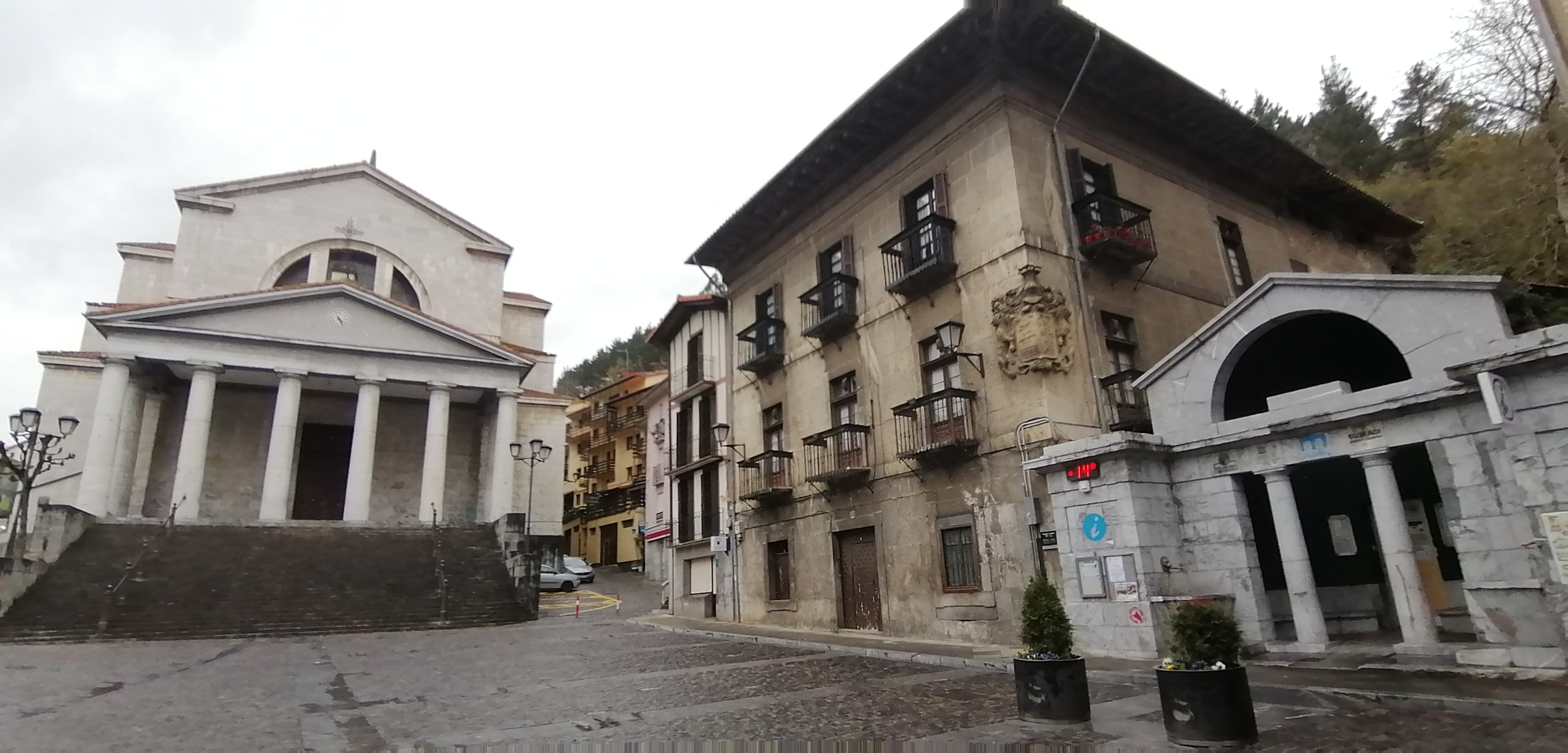
Plaza Txurruka
The town's civic heart, where a Carrara marble statue of Trafalgar hero Cosme de Churruca watches over the square that carries his name, ringed by the church, the town hall, and a cluster of old palaces.
Welcome to Mutriku, a town of barely five thousand souls clinging to a Basque hillside so steep the houses seem to be climbing over each other's shoulders to see the water. It's a small place with an outsized talent: it has mastered the sea not once but twice. First with oak and sailcloth, back when this harbour bred admirals and shipwrights whose names still echo through naval history. And then again, in our own century, with turbines humming inside a breakwater, turning the same waves that once launched war fleets into electricity. Over the next hour or so we'll trace both of those conquests, up and down these lovely, punishing streets. But we begin here, in the square where the town keeps its heart.
Stand for a moment and take in Plaza Txurruka. This is the civic center of Mutriku, and it wears all its important hats at once. Around you sit the church, the town hall, and the tourism office, and just beyond them a scattering of old stone palaces. It's a compact stage, but everything that matters in this town has passed across it. And keeping watch over the whole scene, up on his pedestal, is the man the square is named for.
Look up at him. That gleaming white figure is carved from Carrara marble, the same luminous stone Michelangelo prized, and it was raised here in 1865 by the sculptor Marcial Aguirre. The people of Mutriku didn't pay for it alone; the statue was funded by the General Assemblies of Gipuzkoa, the whole province chipping in to honor one of its own. That tells you something about the size of this man's reputation. His name was Cosme Damian de Churruca, or Txurruka in Basque, and he was born just two lanes from where you're standing.
So who was he, to earn marble and a province's gratitude? Churruca was a naval officer, a scientist, and a cartographer, but he is remembered above all for how he died. On the 21st of October, 1805, off Cape Trafalgar, the combined fleets of Spain and France met Nelson's Royal Navy in the battle that would decide command of the seas for a century. Churruca commanded a Spanish ship of the line called the San Juan Nepomuceno. He knew, going in, that the allied battle plan was flawed, and he is said to have told his officers as much. He fought anyway. When a cannonball took off his leg, he refused to leave the deck, had himself propped up so the crew could still see their captain giving orders, and forbade anyone to strike the colors, to lower the flag in surrender, while he still breathed. He died there, and only after his death did his shattered ship finally give up. The British, the story goes, were so moved by his courage that they treated his memory with honor. That is the man looking down at you now, forever calm in white stone above his hometown square.
We'll meet him again very soon. Just two narrow lanes from this spot stands the Palacio Arrietakua, the finest of the town's palaces and the very house where Churruca was born in 1761. There's a beautiful symmetry hidden in that doorway that I'll save for when we're standing in front of it, but hold the thought: this square honors the captain who died at Trafalgar, and the palace up the hill is where his life began.
Now notice the ground itself, the way it tilts. Mutriku doesn't sit on a plain; it pours down toward the water like an amphitheater, tier upon tier of rooftops dropping toward the old harbor at the bottom. That shape isn't an accident. Everything here was built facing the sea, feeding off it, reaching toward it. The town received its charter in 1209 from King Alfonso VIII of Castile, which makes it one of the oldest chartered villas in all of Gipuzkoa, and in 1995 this whole tangle of old streets was declared a protected monumental site, a Conjunto Monumental. Seven, eight centuries of history, packed into a hillside you can walk across in fifteen minutes if your knees are willing.
And here's the thread I want you to carry down the hill with you. The sea gave this town its admirals and its shipwrights, its wealth and its heroes. Churruca and men like him were the flower of that first age, when mastering the ocean meant knowing the wind, the tides, the exact curve of a hull. But the sea never stopped being Mutriku's raw material. Today, down at the harbor's edge, the town runs the world's first commercial wave-energy plant, built into the breakwater in 2011, sixteen turbines that roar so fiercely the locals nicknamed the installation the dragon. We'll stand right beside it near the end of our walk and listen to it breathe. Same ocean. Same little town. A second mastery, four hundred years after the first.
So let this square be your overture. A charter older than most European nations. A marble captain who would not lower his flag. A hillside pitched toward the water like seats in a theater. Take one more look at Churruca up there, keeping his eternal watch, and then let's start down toward the church that sits just beside him, where a neoclassical portico hides a painting that, if the stories are true, came from one of the greatest hands in Spanish art.
Iglesia de Nuestra Señora de la Asunción
That is stop one, in the walk itself. The remaining 6 stops, the map and the route between them open with one free account.
Continue the walkThe written walk is free.
Thank you! Your report has been submitted.
Report an issue
Help us improve by reporting any issues you notice.