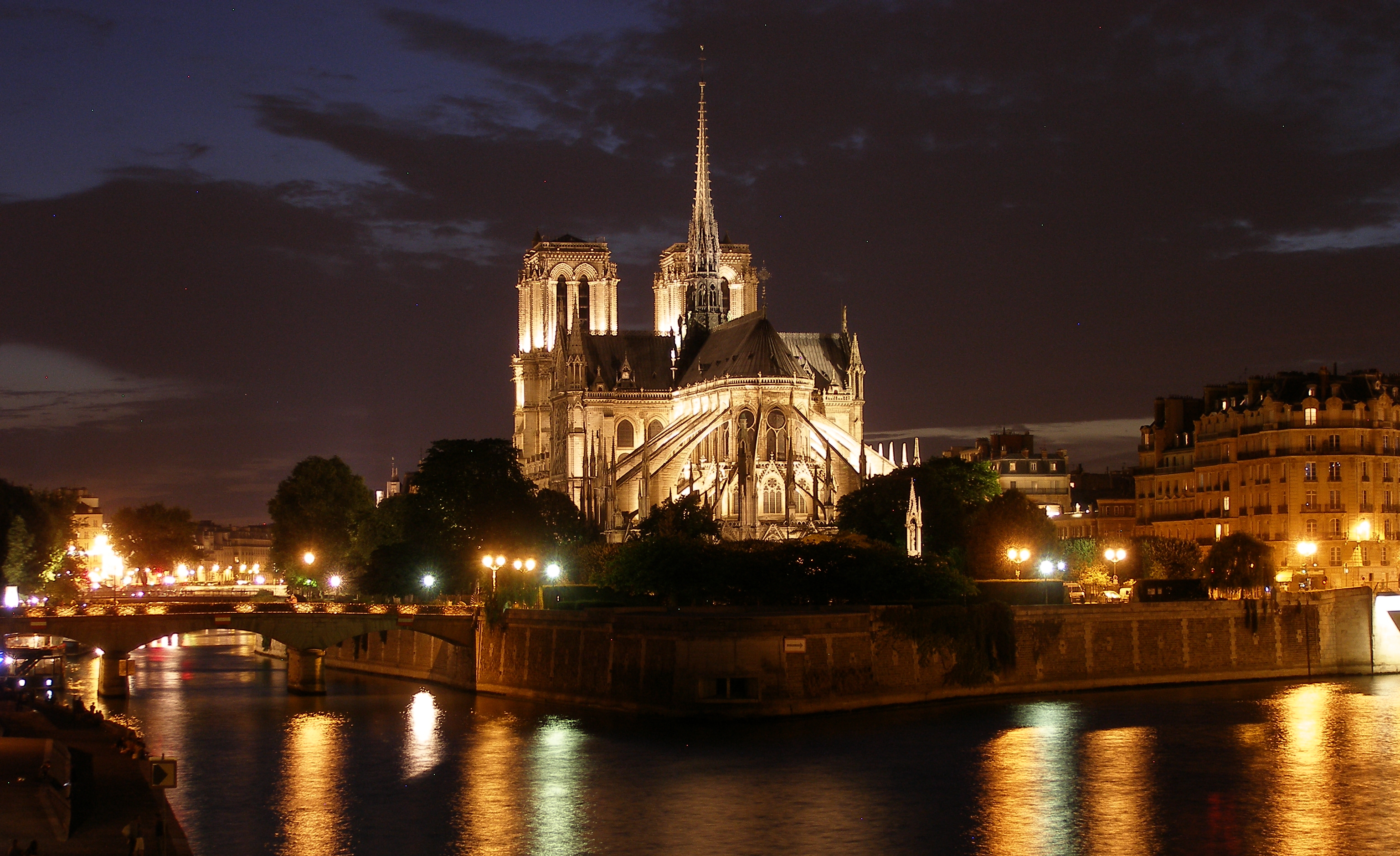
Île de la Cité & Notre-Dame
Gateway to Paris history and architectural marvel showcasing Gothic innovation and dramatic post-restoration beauty. Notre-Dame de Paris stands as a masterpiece of medieval engineering, reopened in December 2024 after the devastating 2019 fire.
Welcome to the heart of Paris. You're standing on Île de la Cité, the ancient island where medieval stone first rose from the Seine, where Notre-Dame's towers have watched over this city for nearly 900 years. Over the next two hours, we're walking through eight centuries of ambition, faith, revolution, and reinvention. From Gothic cathedrals to iron lattice, from royal gardens to monuments of triumph—each step carries you forward through time. Paris didn't become Paris overnight. It was built, stone by stone, vision by vision. Let's trace that journey together.
You're standing at the birthplace of Paris. Right here on the Île de la Cité, on this small island in the Seine, is where it all began — not thousands of years ago, but genuinely where a settlement called Lutetia first took root during the Roman era. Around the time of Augustus, in the first century, the Romans recognized what would become the eternal logic of this place: a defensible position in the middle of a river, surrounded by water, practically impossible to attack. By the Middle Ages, this island had become the spiritual and political heart of the growing city. Everything radiated outward from here.
Now look up at Notre-Dame de Paris. What you're seeing is 12th-century ambition in stone — construction began in 1163 under Bishop Maurice de Sully, and wouldn't finish until well into the 13th century. That's not a typo: two hundred years. This wasn't built by one king or one generation. This was a project of such magnitude that it outlasted the lives of the architects who started it. The first stone was laid by Pope Alexander III, a blessing from Rome itself. Each generation added its own section, its own stone, its own interpretation of what a great cathedral should be. Masons came and went. Kings died. Wars were fought. And still the cathedral grew, patient and monumental.
The Gothic style you see here was revolutionary — genuinely shocking to people at the time. Notice how the structure seems to defy gravity. The walls are almost entirely vertical, rising toward heaven with an elegance that earlier Romanesque buildings never achieved. That's not an accident. The innovation of flying buttresses, those external supports you can see jutting out from the walls like skeletal arms, meant that the weight of the roof and upper structure didn't have to be carried by thick, heavy walls. Instead, the weight was transferred outward and down along these buttresses in a brilliant choreography of force. It was engineering genius that freed architects to imagine something lighter, airier, more ambitious. For the first time in medieval history, walls could be thin enough for massive windows. Light — divine light, they believed — could pour into the sacred space, transforming stone into something almost ethereal. Stand in the nave on a sunny afternoon and you understand this viscerally. The light is not just illumination. It's theology made visible.
Look more closely at those rose windows — those enormous circular stained-glass masterpieces. There's one at the front, and if you can, walk around to see the north and south roses as well. Each one is approximately 10 meters in diameter. They're not just beautiful; they're technical marvels. The glass is arranged in intricate geometric patterns, often depicting scenes from scripture or arranged in mandala-like formations. Medieval believers stood beneath them and saw cosmic order rendered in colored light — perfect geometry representing divine perfection. The mathematical precision is staggering. Try to count the panes sometime. Hundreds upon hundreds of individual pieces of glass held together by thin lead bars, creating an image that reads from 30 meters away.
The gargoyles — those grimacing creatures crouched along the exterior — have a practical job beyond the theatrical. They're water spouts, channeling rain away from the building's stone face to prevent erosion. But they're also something else. Medieval builders understood that fear had power, and they built it into the walls. These creatures represented the darker forces pressing against the sacred space, kept perpetually at bay by the building's sanctity. It's architecture as theology, stone made into doctrine.
Then there's what happened here just a few years ago. On April 15, 2019, a fire swept through the cathedral's wooden interior. The world watched in horror as flames consumed the timber roof framework, as the iconic spire — that needle of stone that had pointed heavenward since the 19th century — collapsed in a shower of sparks. It seemed impossible that this 860-year-old building could survive such catastrophe. Millions of people who'd never been to Paris felt something break. But the stone held. The structure endured. The vaults didn't collapse. And after five years of meticulous restoration — stonecutters studying photographs to understand exactly what had been there, glassmakers learning medieval techniques, carpenters replacing burned wooden elements one piece at a time — Notre-Dame reopened in December 2024. What you're looking at now is not just medieval architecture. It's a symbol of resilience, of a city and a civilization refusing to let its heart be permanently damaged.
Walk around the exterior when you get a chance. Notice the sculpture — there are nearly 7,000 stone figures adorning this cathedral, from the kings across the front facade to the saints in niches to the anonymous faces of medieval craftspeople. Some are damaged, especially on the western facade where revolutionaries attacked the building in 1793, mistaking royal iconography for actual royalty. See the missing heads? That's the French Revolution, visible in stone.
This island, this cathedral, everything radiating outward from here — it's the foundation upon which Paris was built. You'll see it everywhere on this tour: the themes started here, the ambitions conceived here, the stones laid here as the template for everything that followed. Medieval stone giving way to Renaissance elegance, then to Enlightenment grandeur, and finally to iron-lattice modernism. But it all begins here, with a settlement recognizing the power of an island, and a medieval bishop with a vision that lasted two centuries.
Sainte-Chapelle
That is stop one, in the walk itself. The remaining 9 stops, the map and the route between them open with one free account.
Continue the walkThe written walk is free.
Thank you! Your report has been submitted.
Report an issue
Help us improve by reporting any issues you notice.