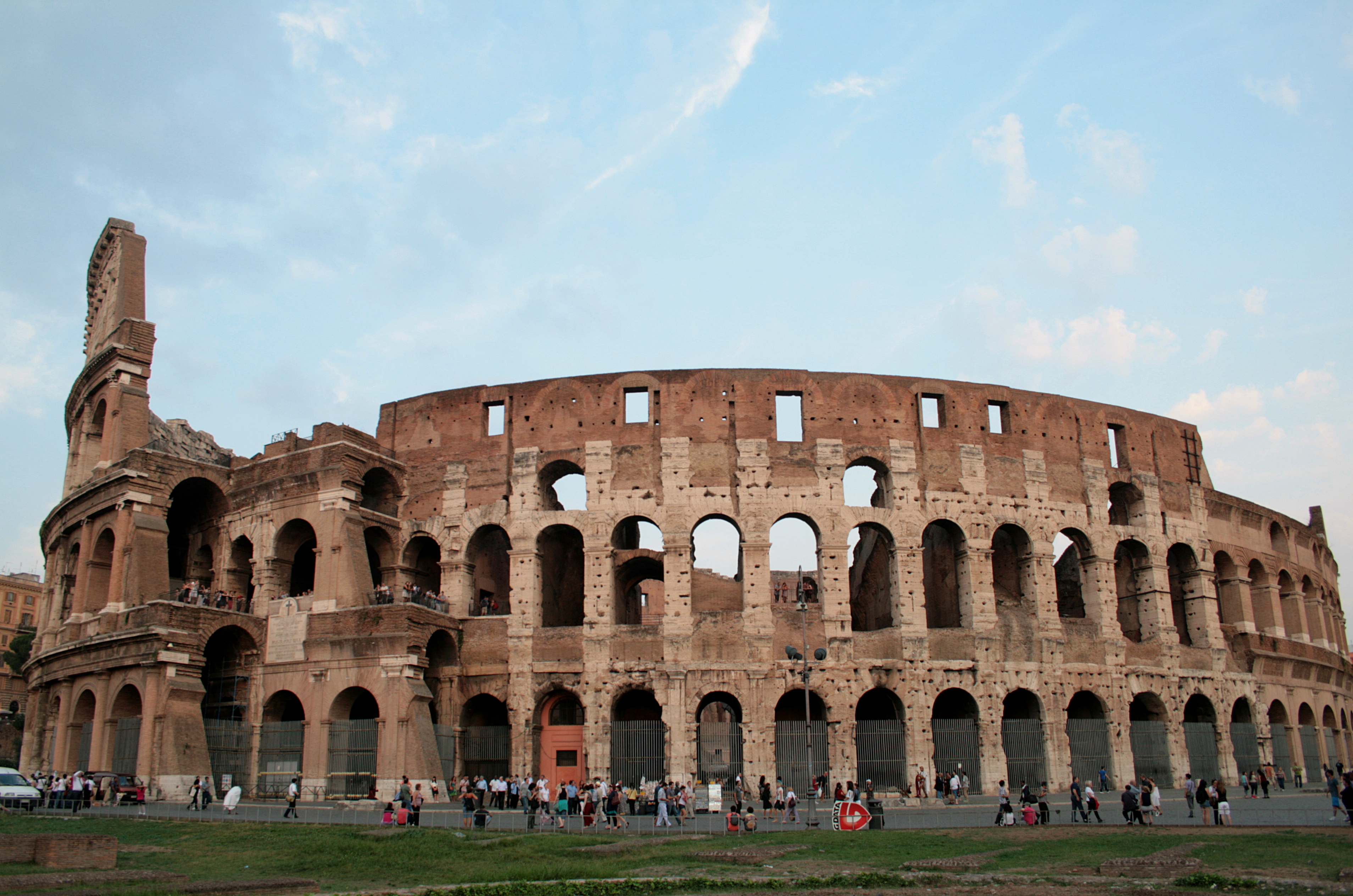
Colosseum
The largest amphitheatre ever built, completed in 80 AD under Emperor Titus. It could seat 50,000 spectators for gladiatorial contests, animal hunts, and public spectacles.
Welcome to Rome — the city that refuses to stay in the past, even though the past is quite literally built into every street corner. You're standing at one of the world's most recognizable monuments, and if you listen carefully between the tour groups and the traffic, you can almost hear the roar of fifty thousand Roman spectators who sat right here, nearly two thousand years ago.
Today, we're walking the great triangle that holds Rome's entire story: from the raw, ambition-soaked power of empire to the breathtaking beauty that made the world fall in love with this city. We'll move through time itself — ancient Rome's engineering genius, the Renaissance reimagining of classical ideals, and the theatrical splendor of the Baroque masters who understood that beauty was a form of power too.
It's three and a half kilometres, roughly two hours if we don't dawdle, though Rome has a way of making you dawdle. You'll see some of humanity's greatest achievements, and you'll understand why people have been unable to leave this city alone — or unimproved — for two millennia. So take a breath, look around, and let's begin where Rome's greatest ambitions were always built to last.
Stand here for a moment and let your eyes adjust. The Colosseum rises in front of you like a slice of a wedding cake that's been left out in the Mediterranean sun for nearly 2,000 years. And that's exactly what it is — a monument to an empire's absolute conviction that it would last forever. Spoiler alert: empires don't. But this? This keeps standing.
When the Emperor Vespasian commissioned this arena in 72 AD, Rome had just put down the Jewish revolt in Judea and needed a grand gesture to remind the city of its power. His son Titus finished the building eight years later with 100 days of inaugural games — 5,000 animals slaughtered on the opening day alone. That's the scale we're talking about. Everything about the Colosseum was designed to overwhelm you with Rome's power, resources, and the empire's absolute grip on the city's imagination. Even today, with half of it gone to earthquakes, medieval stone-robbers, and the relentless erosion of time itself, it still does exactly that.
Look at those arches. Really look. Each tier uses a different order of classical architecture — Doric on the ground level, then Ionic, then Corinthian as you go up. That's not decorative; it's not arbitrary. It's a visual proof of Rome's engineering mastery and architectural literacy. The Romans didn't just copy Greek architecture; they solved structural problems the Greeks couldn't. They perfected the arch, engineered massive concrete vaults, and created structures that could handle enormous crowds and extreme structural stress. The Colosseum held between 50,000 and 80,000 people in perfect sightlines — not a single pillar blocked anyone's view, no matter what social tier they sat in. That's hydraulic engineering, crowd psychology, and mathematical precision all working in flawless harmony.
What's remarkable is what you're not seeing. Beneath that arena floor — which has long since completely decayed away — there was an entire underground city called the hypogeum. Trapdoors, pulleys, mechanical elevators, and passages for moving animals and stage props. Archaeologists have found fragments and markings that suggest the arena floor could be flooded for naval battle recreations. Imagine it: in the middle of Rome, at the height of summer, they could fill this enormous structure with water and stage mock sea battles in front of tens of thousands of spectators. The engineering was absolutely brutal and brilliant.
The people who watched from the lower tiers — the working classes, the enslaved, those without status — they saw something very different than the senators and emperors settled into their cushioned seats up top. The upper tiers were positioned in direct sun or under canvas awnings depending on the time of day. Social hierarchy wasn't just observed at the Colosseum; it was literally built into the architecture. Rome was an empire, and this was a monument to absolute power, absolute entertainment, and absolute inequality all combined into one structure.
Notice the outer walls facing you. Those travertine blocks were quarried from outside Rome and transported here at enormous cost and effort. The interior, by contrast, used cheaper tufa and brick — hidden from public view, but still built to last indefinitely. Nothing was wasted on decorative display that wasn't visible to the crowds. That's Roman pragmatism wrapped in imperial ambition. It's a building that tells you exactly how the Romans thought: elegant and impressive on the surface, ruthlessly practical and efficient underneath.
Here's something to carry with you as we move through Rome today: the Romans who designed this arena, who engineered those vaults, who figured out how to move 80,000 people safely in and out of a crowd without panic — those same brilliant minds also figured out how to pour a dome that's stood for 1,900 years without a single reinforcing beam or internal support. We'll stand under it later at the Pantheon, and you'll feel the difference between spectacle and genius. This place is spectacle. Overwhelming, deliberate spectacle. But it's also the foundation of everything Rome became architecturally.
The Colosseum wasn't just entertainment. It was a statement. It said: we are Rome, we are eternal, we have resources beyond counting, and we exist to dominate. Time proved it half-right. The empire fell. But the building? The building stayed.
Arch of Constantine
That is stop one, in the walk itself. The remaining 8 stops, the map and the route between them open with one free account.
Continue the walkThe written walk is free.
Thank you! Your report has been submitted.
Report an issue
Help us improve by reporting any issues you notice.