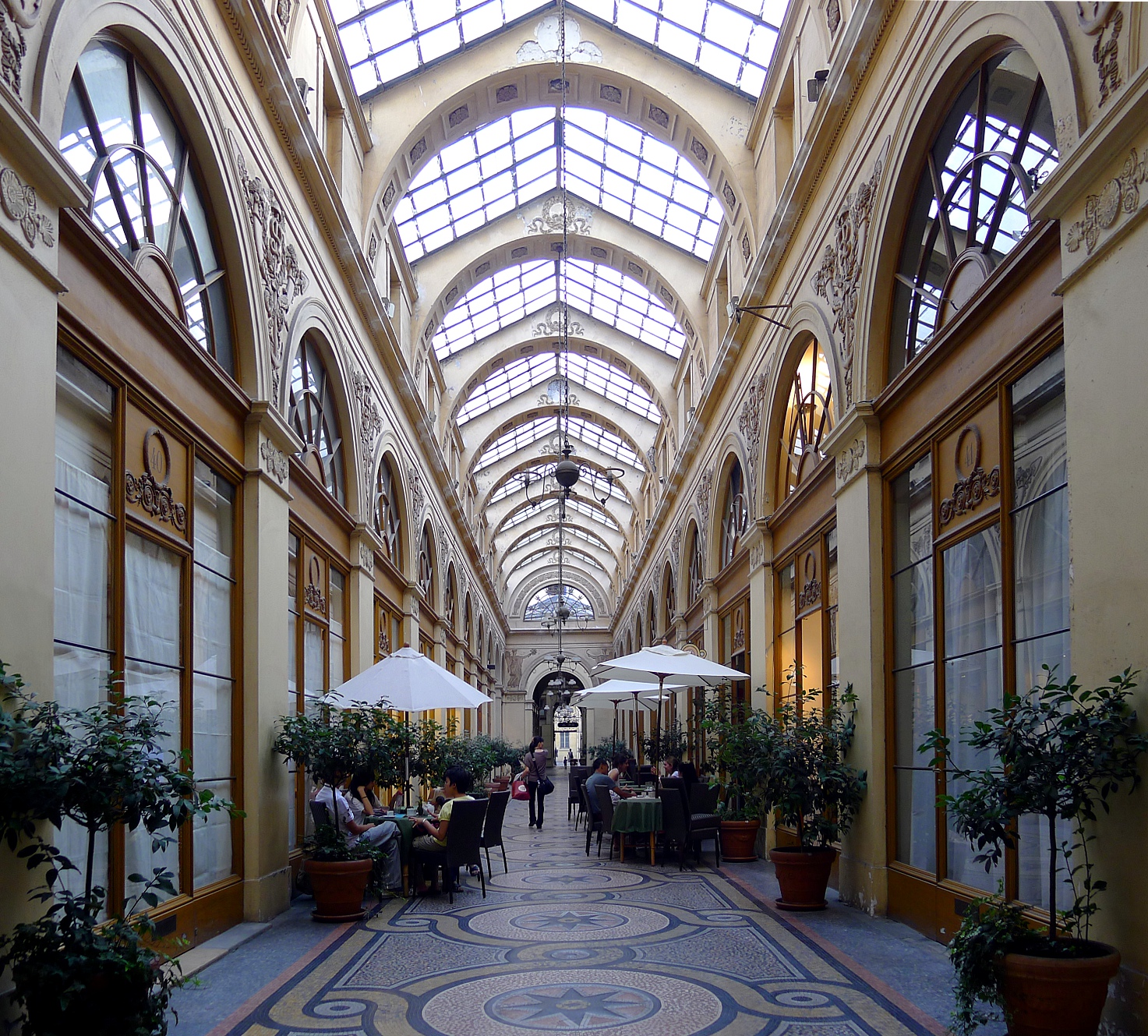
Galerie Vivienne
Built in 1826, Galerie Vivienne is the architectural jewel of Paris's covered passages—a pioneering retail innovation featuring an ornate geometric mosaic floor, delicate glass ceiling with ironwork, and a grand rotunda that demonstrates how 19th-century merchants transformed shopping into a palace-worthy experience.
In 1799, Paris invented the covered passage—a radical idea: protect shoppers from mud and chaos with a roof and glass. For nearly fifty years, these passages perfected commerce by making it beautiful. But something strange happened. The decoration got bolder. The ironwork more extravagant. The mosaics more daring. Function and beauty stopped being separate concerns and became the same thing. Today, we're walking through that collision. We'll see where practical buildings couldn't resist ornament, where structural steel became sculpture, and where architects and designers asked a dangerous question: what if we refused to choose between shelter and splendor? Watch the light. Notice what draws your eye. These buildings are teaching us how to see.
We're standing at the entrance to Galerie Vivienne, and I want you to take a moment to really look at what you're about to step into. This isn't just a shopping mall. This is where Paris invented the modern shopping experience—and they did it with the elegance you'd expect from a city that considers commerce an art form.
Built in 1826, Galerie Vivienne opened just three decades after the French Revolution had upended the old order. And here's something remarkable: in a city obsessed with grand public monuments and palatial architecture, merchants decided their covered shopping arcade should be just as beautiful. The vision was radical for its time—take the chaos and weather of Paris streets, cover it, and transform it into something that feels like you're shopping inside a work of art.
Look down at your feet. That geometric mosaic floor isn't a happy accident. It's the work of artisans named Facchina, and it's been there for two centuries. The pattern is so precise, so mathematically perfect, that it almost hypnotizes. Notice how the eye naturally follows the lines—the pattern guides you deeper into the passage, pulling you forward. That's intentional design. The floor isn't just beautiful; it's functional. It's telling you where to go. In 1826, this was revolutionary. Most commercial streets were muddy, chaotic, crowded with carriages and horses. Here, the floor is clean, the pattern is orderly, and somehow that order makes you feel like you belong in this space.
Now look up. See that glass ceiling stretching above us? The panes are held together by ironwork that looks almost delicate, like lace rather than industrial framework. This is the real innovation of the covered passage—it creates an entirely new kind of public space. It's outside, technically, because you can see the sky. But it's inside, protected, covered. In 1826, Paris was a city of severe weather and open streets. If you wanted to shop, you faced rain, snow, mud, and the constant chaos of street life. These passages changed everything. They created a middle ground—a climate-controlled public space where commerce could happen with dignity.
As you move deeper into the gallery, you'll notice the space opens into what feels almost like a cathedral—the rotunda. This is the beating heart of Galerie Vivienne. The rotunda is where the passage widens, where the geometry shifts, where architecture becomes almost theatrical. Around you, you'll see the neoclassical facade elements that frame each shop entrance—nothing is left plain or functional. Every doorway is a little frame, every storefront is a small monument. The merchants of the 1820s understood something we've forgotten: the setting in which you buy something affects how you feel about it.
Look at the boutiques around you. Jewelry stores. Bookshops. A few cafes. They're not chains; they're independent, curated spaces. And they're housed in a passage that has barely changed in two centuries. That's not preservation by accident—it's preservation because this design works. The boutiques can be elegant without being vast. The passage can accommodate dozens of independent merchants without feeling overcrowded. Each shop is distinct, but they share something more valuable than any shared theme: they share beauty.
Here's the context you need: Paris was experiencing a shopping revolution in the early 1800s. The old model—individual shops scattered through residential neighborhoods, reached by navigating streets filled with carriages and street commerce—was becoming obsolete. But the new model—grand department stores that would come later in the century—hadn't been invented yet. For a brief, shining moment, there was this in-between solution: the covered passage. A grid of elegant, protected commercial space where small merchants could thrive.
Galerie Vivienne competed with other passages being built across the 2nd arrondissement. But what made Vivienne special—what still makes it special—is that it never compromised on beauty. Every passage had shops. Vivienne added art. Every passage had a glass ceiling. Vivienne made the ironwork sing. Every passage was covered and protected. Vivienne made you feel like you were somewhere sacred.
As you wander through, notice the color palette—creams, golds, soft grays. Nothing jarring. The lighting is warm and even, filtered through the glass above. There's a reason luxury brands still choose to open here despite the competition from modern shopping districts. This passage sells something that no mall can replicate: the sense that shopping is an experience worthy of your time and attention. Not a transaction. An experience.
This is where our tour begins because everything you'll see over the next few stops—the architectural innovation, the focus on decoration as design priority, the marriage of function and beauty—it all starts here. Galerie Vivienne is the template. It's the answer to a question Paris asked in 1826: What if we built commercial spaces like we build palaces?
Passage des Panoramas
That is stop one, in the walk itself. The remaining 9 stops, the map and the route between them open with one free account.
Continue the walkThe written walk is free.
Thank you! Your report has been submitted.
Report an issue
Help us improve by reporting any issues you notice.