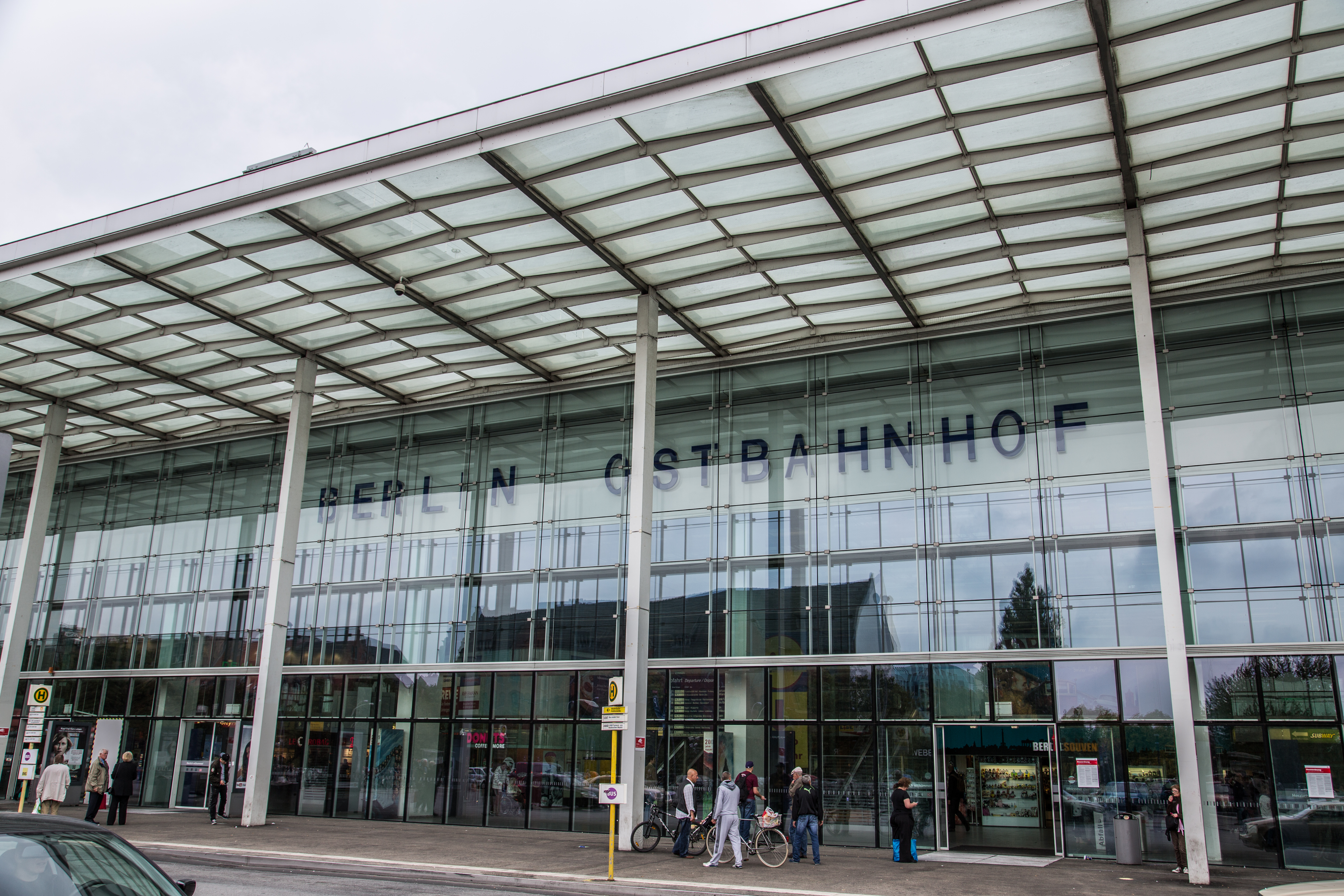
Ostbahnhof
Ostbahnhof, opened in 1842, has carried five names under five regimes — Frankfurter Bahnhof, Schlesischer Bahnhof, Ostbahnhof, the GDR's Hauptbahnhof, and Ostbahnhof again — while serving as Berlin's rail gateway to Warsaw and Moscow. The tour begins here, with the East Side Gallery just across Mühlenstraße.
Take a second outside Ostbahnhof. Trains rumble in, commuters pour out, and a block away stands a slab of concrete that changed its meaning overnight. This walk runs about three and a half kilometres in three acts. Act one is the painted Wall: the East Side Gallery, where in 1990 painters swarmed a stretch of border concrete that had been untouchable for a lifetime — a Trabant, a river with a dark memory, and the most famous kiss in the city are waiting. Act two is a single bridge: the Oberbaumbrücke, the hinge between two Berlins, with towers like a fairy tale and a history like a thriller. Act three is the kiez that freedom built — rail yards turned into clubs, squat streets turned into café strips, ending at a square where the whole neighborhood sits down together. One thing before we start: this tour is about what Berlin did to the Wall. For the border system itself — the death strip, the escapes, the full machinery — take our separate Wall tour at the Bernauer Strasse memorial, also in this app. Ready? Let's go meet the concrete.
Take a look around before we start walking. Ostbahnhof is nobody's idea of a landmark — a plain glass front from a 1990s renovation, the smell of bakery stands, S-Bahn trains grinding along the viaduct overhead. That ordinariness is a disguise. You're standing at one of the oldest working station sites in Berlin, and its whole story is written in its names.
It opened in 1842 as the Frankfurter Bahnhof, terminus for trains to Frankfurt an der Oder. When Prussia's railways pushed on toward the coalfields of Silesia, it was rebuilt and rebranded the Schlesischer Bahnhof — the Silesian Station. After 1945, Silesia was suddenly Poland, and a station named for a lost province was politically impossible, so the young GDR scrubbed it down to a plain Ostbahnhof in 1950. Then in 1987, for East Berlin's share of the city's 750th birthday, the regime rebuilt it again and crowned it Hauptbahnhof — the central station of a capital that was only half a city. Reunified Berlin took that title back in 1998 and later handed it to the shiny new Hauptbahnhof across town. Five names, one platform hall. Every regime that ruled Berlin felt the need to rename this exact building — you can read a century and a half of German politics off the departure board alone.
The names mattered because this was always Berlin's door to the East. In the 1920s, the Schlesischer Bahnhof was where trains from Warsaw, Riga and Moscow spilled out migrants, traders and refugees — the writer Joseph Roth described them arriving here — and the quarter around it was considered the roughest in Berlin, its name practically slang for smuggled goods. The Cold War formalized the role: this became East Berlin's window to Moscow, the platform for the eastbound expresses, where Western sleeping cars rolled through with their curtains drawn and, so the lore goes, more than one quiet career in espionage started with a handshake under these arches.
Now, orientation. Head out the south side of the station, toward the river. The broad street in front of you is Mühlenstraße, and across it runs a long band of concrete: the Berlin Wall itself, painted end to end. That's where we're going — its story starts at the next stop, barely a block away. One last glance at the station of five names first. For a century, people arrived here from the East hoping Berlin would change their lives. In 1990 that current reversed — and the proof is waiting across the street.
East Side Gallery — Test the Rest
That is stop one, in the walk itself. The remaining 7 stops, the map and the route between them open with one free account.
Continue the walkThe written walk is free.
Thank you! Your report has been submitted.
Report an issue
Help us improve by reporting any issues you notice.