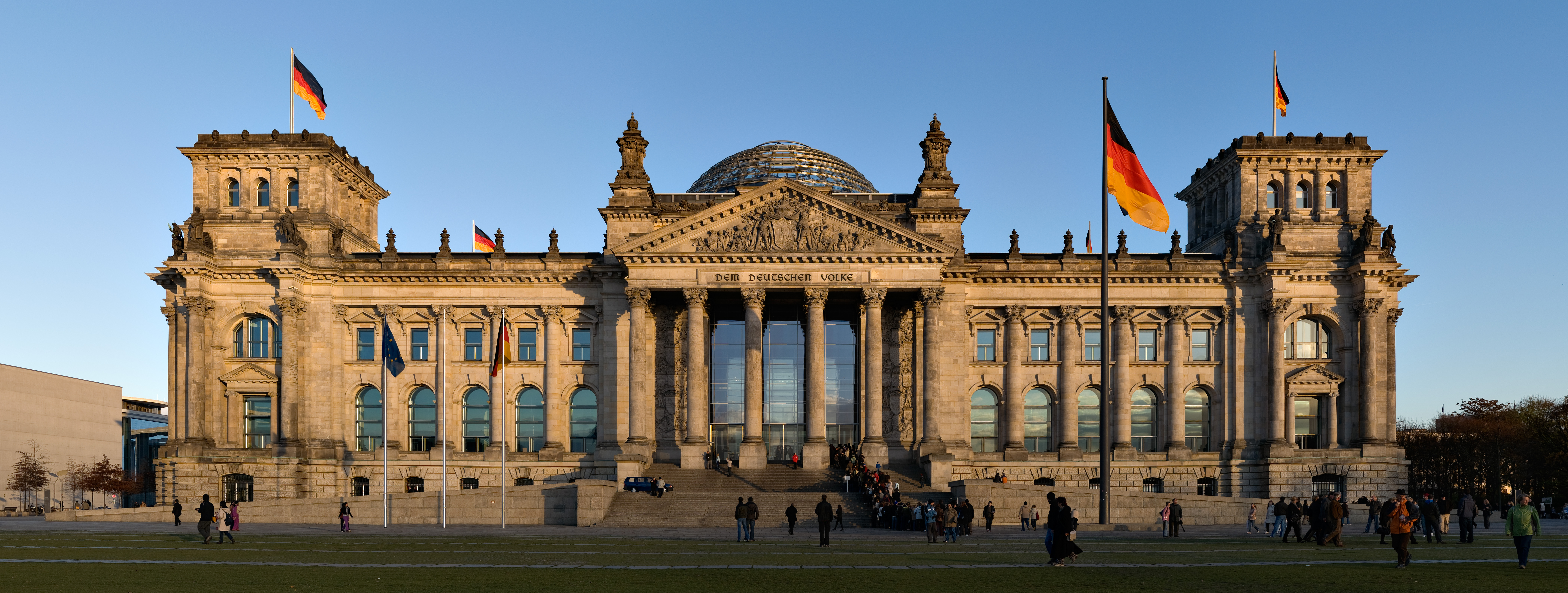
Reichstag
Germany's parliament building, completed in 1894 and rebuilt by Norman Foster with a glass dome in 1999, carries the marks of the 1933 fire, the 1945 Soviet capture, and the 1995 Christo wrapping. The dome is free to visit with advance registration at bundestag.de.
Welcome to Berlin. You're standing on the wide lawn in front of the Reichstag, where office workers eat lunch and families sprawl on the grass as if this were any ordinary park. It isn't. Over the next two and a half hours and barely three kilometres, you'll walk through five different Germanys — five regimes, five ideas of what this country should be, each one leaving its mark on the same three kilometres of city. Most cities repaint their history. Berlin leaves the cracks showing — on purpose — and that strange honesty is what makes it one of the most compelling places in Europe. Every stop on this walk was built, burned, divided or rebuilt by a different Germany, and once you learn to read the layers, you'll see them everywhere: in a line of cobblestones, a replanted tree, a patched facade. We begin with the building right behind you — a parliament that has lived more lives than most nations. Take a breath, turn around, and let's read it together.
Look at this building for a moment before we say anything about it. A pompous stone facade from the age of emperors, and floating on top of it, a glass dome you can walk into for free. That collision — imperial stone below, transparent glass above — is not an accident of taste. It is the whole story of this walk in one building. Over the next ten stops you'll see five different Germanys — an empire, a fragile republic, a dictatorship, a divided country, and today's federal republic — and every one of them left its fingerprints on this boulevard. The Reichstag is the only place where all five are visible at once.
Start with the inscription over the columns: Dem Deutschen Volke — To the German People. It went up in 1916, in the middle of the First World War, and Kaiser Wilhelm II hated it. He'd hated the building from the start, privately calling it the Reichsaffenhaus — the imperial monkey house — because a parliament, even a weak one, offended him. The bronze letters were cast, with deliberate irony, from melted-down French cannons captured a century earlier.
Then came the night of 27 February 1933. Hitler had been chancellor for just four weeks when the plenary chamber behind these walls went up in flames. A young Dutch council communist, Marinus van der Lubbe, was arrested inside; historians still argue about whether he really acted alone. What matters is the speed of what followed. By the next morning, the Reichstag Fire Decree had suspended free speech, free press, free assembly, and protection from arbitrary arrest — the constitutional core of the Weimar Republic, gone overnight, signed away as an emergency measure that was never lifted. German democracy did not fall in a battle. It burned in a night and was buried by breakfast. Here's the strange footnote: the Nazis barely used this building afterwards. Their tame parliament met in an opera house across the square. The Reichstag stood here through the Third Reich as a scorched, half-empty shell.
Which makes what happened in 1945 doubly ironic. Stalin had decided the Reichstag was the symbolic heart of Hitler's Reich, so the Red Army fought room by room to take it — a building the Nazis had essentially abandoned. On 2 May, photographer Yevgeny Khaldei staged the famous shot of a soldier sweeping the Soviet flag over the ruined roofline. Staged is the word: the spontaneous flag-raisings had happened earlier, in darkness, so Khaldei restaged it in daylight with a flag his uncle had sewn from tablecloths. Look closely at the original and censors had to retouch it — one soldier wore a wristwatch on each arm, awkward evidence of looting.
Through the Cold War the building sat patched-up and mostly purposeless, the Wall running close behind it, the real parliament far away in Bonn. Its resurrection began, of all things, with art. The artists Christo and Jeanne-Claude spent twenty-four years asking permission to wrap it, and in 1994 the Bundestag did something no parliament had done before: it held a full floor debate and voted on an artwork — 292 to 223 in favor. For two weeks in the summer of 1995, the Reichstag disappeared under silver fabric and blue rope, and five million people came to see it. Many Berliners describe it as a kind of ritual cleansing: the building shed its past like a skin before the renovation began.
What emerged in 1999 is Norman Foster's dome, and its symbolism is unsubtle on purpose. The public walks the spiral ramps directly above the debating chamber — the people, literally over the heads of their representatives, looking down. A mirrored cone pours daylight onto the politicians below. Visiting is free, but register a few days ahead on bundestag.de. Inside, Foster kept something most architects would have scrubbed away: whole walls of Cyrillic graffiti scrawled by Soviet soldiers in 1945, preserved mid-corridor where members of parliament pass it daily.
A building that keeps being remade to answer a political question — hold that thought, because this walk ends at another one, with a very different answer. For now, walk south with me, toward the gate where a divided city fell into its own arms.
Brandenburg Gate
That is stop one, in the walk itself. The remaining 9 stops, the map and the route between them open with one free account.
Continue the walkThe written walk is free.
Thank you! Your report has been submitted.
Report an issue
Help us improve by reporting any issues you notice.