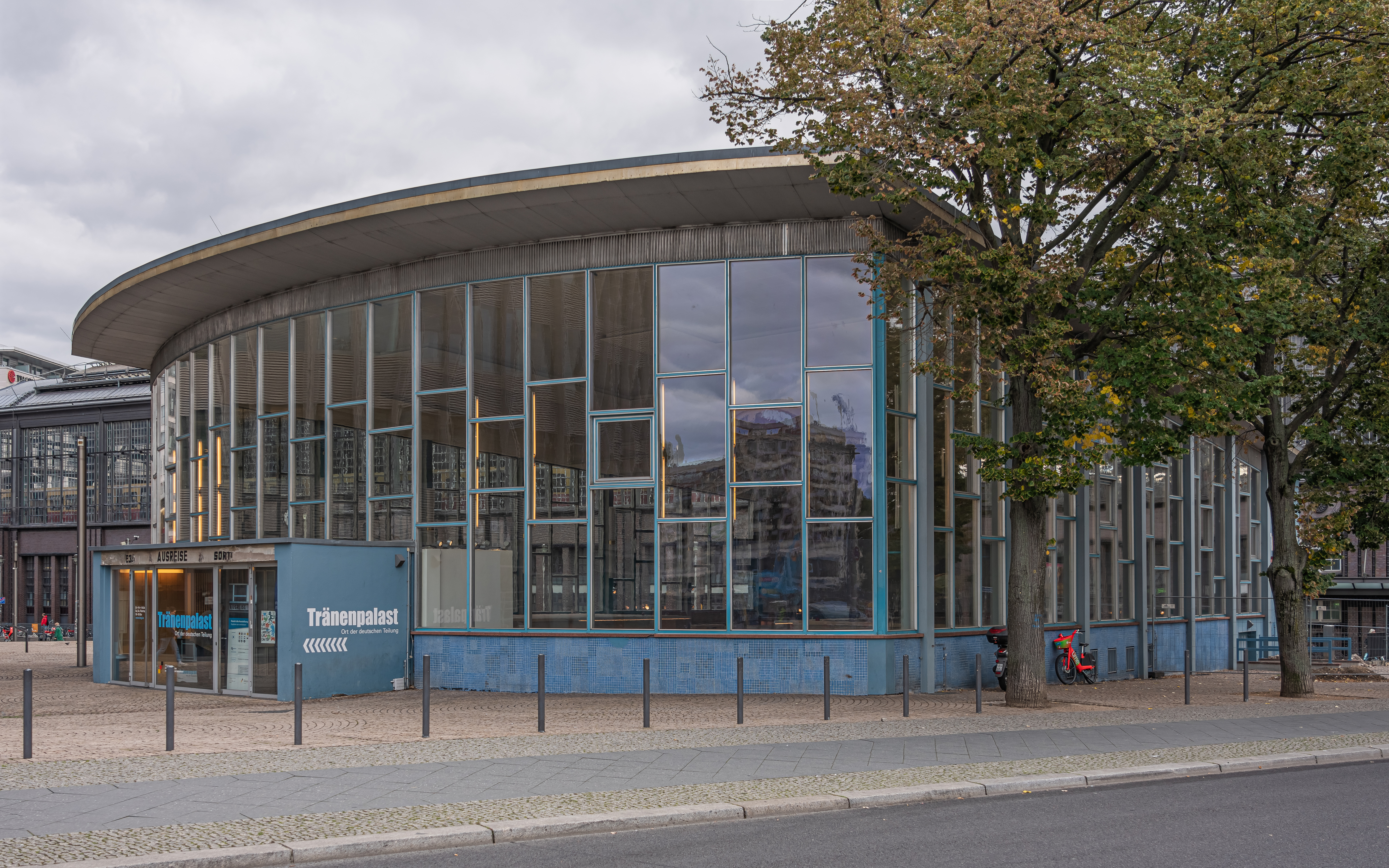
Tränenpalast
The glass departure hall built in 1962 at Friedrichstraße station, where East Berliners said goodbye to visitors leaving for the West — nicknamed the 'Palace of Tears' by Berliners. Today it is a free museum with the original passport booths preserved.
Stand with your back to Friedrichstraße station and let the commuters flow past. Today this is just a busy interchange — trains, currywurst, people checking phones. For twenty-eight years it was something stranger: a hole in the Iron Curtain, a place where two Berlins touched and tore apart, daily. The Wall you're picturing — concrete slabs, spray paint — was only the outer skin. What actually divided this city was a system: two walls with a killing ground between them, sealed stations under the streets, floodlights, dog runs, paperwork, and thousands of goodbyes. Over the next three kilometers, we'll walk that system from the inside. We begin here, at the hall where East said farewell to West, then follow the old border north to Bernauer Straße — the one place where the entire apparatus still stands — and finish where Berliners now dance and sing on the death strip. One note before we start: if you came for the painted Wall, that's the East Side Gallery, a different place across town and a different tour in this app. This walk goes somewhere quieter, and deeper. Ready? Let's step inside.
Look at this building for a moment before you learn what it was. A light, elegant pavilion of glass and steel, blue-tinted panes, a gently folded roof — it could be a 1960s airport lounge or a municipal swimming pool. That was the point. The East German state built it in 1962, and it filled the hall with daylight. What happened inside was one of the darkest daily routines in Berlin: this was a departure hall that worked in one direction only. You entered here to leave East Berlin for the West — and almost everyone doing the leaving was a Western visitor going home, while the people who loved them stayed behind.
To understand why this spot even existed, you need one strange fact: Friedrichstraße station, right behind this pavilion, was a border crossing in the middle of East Berlin. Not at the edge of the city — in its heart. Western trains and the U-Bahn still ran into the station, and Westerners could come through here on day visas to visit family on the other side. A grandmother from West Berlin would arrive in the morning, change a mandatory amount of hard Western currency at a fixed rate — a fee for the privilege of visiting her own relatives — and spend the day with people she might see only a few times a year. Her visa expired at midnight. Berliners lived a Cinderella story in reverse: when the clock ran down, it wasn't the magic that ended, it was the family.
So every evening, this forecourt where you're standing filled with goodbyes. East Berliners would walk their visitors to this building — and no further. Families were allowed only to the door. Inside was for travelers with the right papers; outside was for everyone else. People stood here and wept, holding on to a sleeve until the last possible second, watching a son or a sister disappear behind glass, not knowing if the next visa application would be approved, or when. The state's official name for this place was a dry mouthful of bureaucracy — a 'border crossing point departure hall.' Berliners ignored it and coined their own: Tränenpalast. The Palace of Tears. The nickname stuck so hard that today it's the official name on the museum sign.
Inside, the goodbye turned into choreography. The hall was divided into channels — separate lanes for West Berliners, West Germans, foreigners, diplomats, transit travelers, and the few East Germans with permission to leave, mostly pensioners the state was happy to stop paying for. Each traveler stepped alone into a narrow passport booth, barely wider than your shoulders, and the door closed behind them. The border guard sat elevated behind glass, looking down. And here is the detail that tells you everything about this system: above the traveler's head hung a mirror, angled so the guard could see behind you — the back of your head, your hands, whether anyone was pressed against you trying to slip through as a second body in a one-person cell. You stood in a box of light, being watched from angles you couldn't check, while a stranger decided with a stamp whether your day in the East was legally over. Then a buzzer, and you were gone — into the station, onto a train, back to another world a few hundred meters away.
This is why your tour starts here, and it's the whole idea you'll carry for the next two hours: the Berlin Wall was not a wall. It was a system — and in this hall the system wore no concrete at all. It was queues, categories, stamps, mirrors, and a doorway a mother was not allowed to walk through. Before you see a single watchtower today, understand that this is what the border actually did to people, every single evening, for twenty-seven years.
The building's afterlife is its most surprising twist. After 1989 the hall wasn't torn down — it became a nightclub and concert venue. For a decade and a half, Berliners danced, drank, and watched cabaret in the very hall where they had once queued to be inspected, until the venue closed in 2006 and the pavilion, by then a protected monument, was handed over to history. Since 2011 it has housed a free permanent exhibition on everyday life in divided Germany, run by the Haus der Geschichte foundation. Go in if it's open — it costs nothing and takes twenty minutes. The original passport booth still stands there, and you can step into it yourself, under the mirror. Around it are the suitcases: the carefully chosen contents of lives being packed into an allowance, by people leaving the East for good.
When you're ready, we'll follow the border north. But know this as you leave: beneath the station behind you, the trains themselves were doing something even stranger — and that's our next stop.
Nordbahnhof Ghost Station
That is stop one, in the walk itself. The remaining 8 stops, the map and the route between them open with one free account.
Continue the walkThe written walk is free.
Thank you! Your report has been submitted.
Report an issue
Help us improve by reporting any issues you notice.