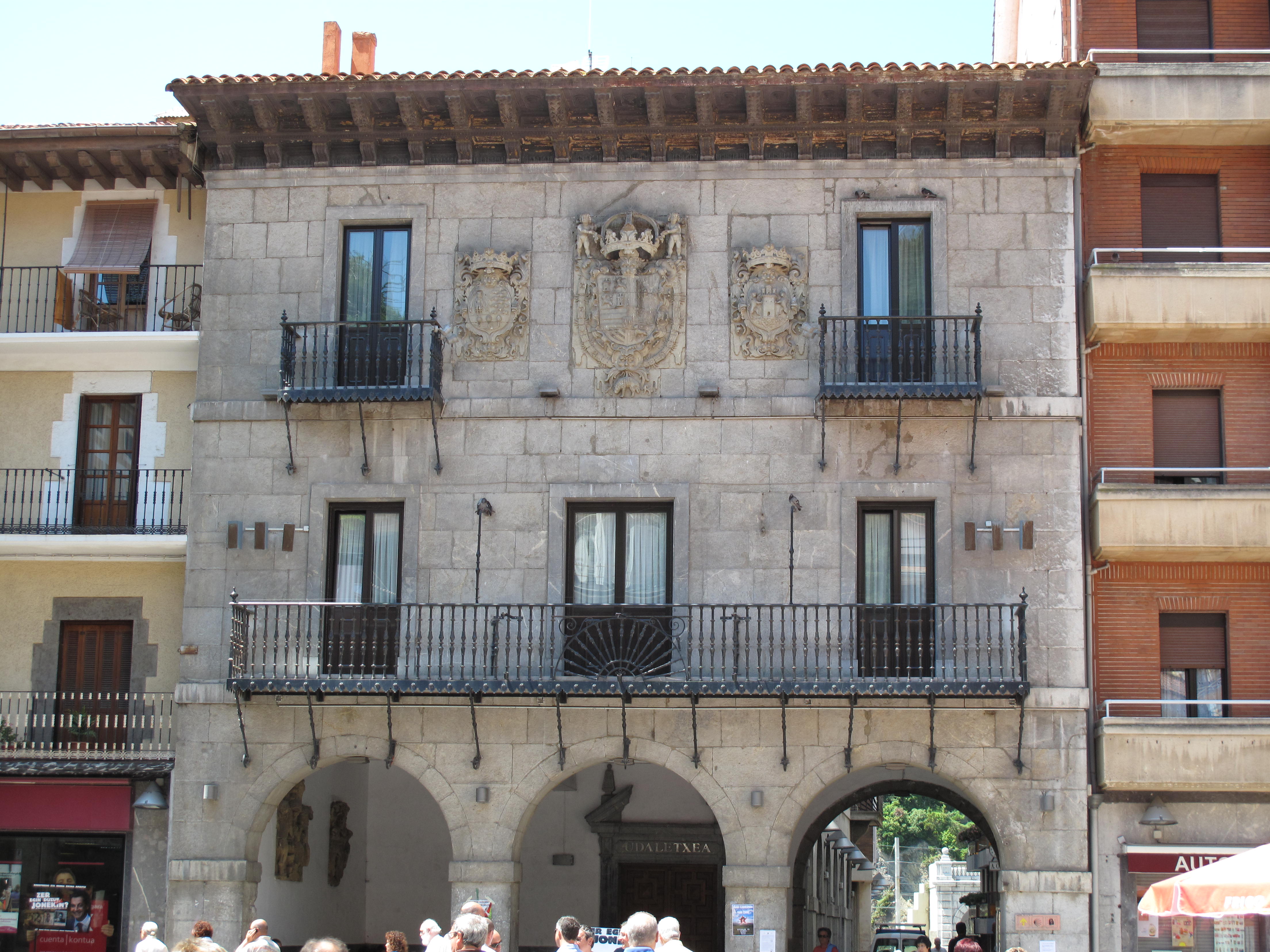
Plaza & Ayuntamiento
The arcaded main square is the heart of a town laid out on a grid in 1343, when the whole population of hilltop Itziar came down to the river mouth to found Monreal de Deba. On the plaza stands the Baroque town hall of 1747, designed by Ignacio de Ibero, its arcades still sheltering the Camino del Norte as it passes through.
Welcome to Deba, and to a walk we're calling Stone, Steam and the Tide. This is a small Basque town with a single, stubborn habit: over seven centuries it keeps edging closer to the water. A royal charter, a merchant's fortune, a hissing railway, and finally the tide itself have each tugged it seawards, and over the next hour and a half we'll follow that pull from this square all the way down to the sand. So let's begin here, in the middle of the plan.
Stand still for a moment and look around the plaza. Notice how the streets run straight and cross each other at clean right angles, how the blocks are regular, how the whole place feels drawn rather than grown. That's because it was. Most old towns you visit tangled themselves together over centuries, one cowpath at a time. Deba did the opposite. It was founded, all at once, as a deliberate act.
Here's the story that explains everything you're standing in. Up in the green hills behind the town sits an older settlement called Itziar, gathered around its church on high ground, safe and defensible in the medieval way. But safe and prosperous are not the same thing. In 1343, King Alfonso XI granted a charter, and the people of Itziar made a remarkable decision: they came down. The whole community packed up and relocated to the mouth of the river, right here, and founded a brand-new town. They even gave it a brand-new name, Monreal de Deva, 'royal mountain of Deva', though the older name eventually won out, as older names tend to do.
Think about what that move actually meant. They left the high, protected ground their ancestors had chosen, and traded it for the riverbank, for the water, for access to the sea and the trade it carried. That's the first tug in our story, and it's the loudest one. A town that quite literally walked itself downhill to be closer to the tide. Everything else on this tour is a footnote to that decision.
And because it was a planned town, they could lay it out properly. The grid you're standing in is that plan, still legible almost seven hundred years later. When you walk these streets today, you're reading a medieval document written in stone and street corners.
Now turn your attention to the grandest building framing this square, the Ayuntamiento, the town hall. This one came much later, in 1747, the work of the architect Ignacio de Ibero, and it's a confident piece of Baroque civic pride. Look up at the proportions, the balance, the sense of a town that had money and wanted to show a little of it. But look down, too, at the arcades, the covered walkways running along the ground floor. On a coast where rain is a way of life rather than an event, these porticoes are pure practicality dressed up as elegance. Market stalls, gossip, shelter from a squall blowing in off the Bay of Biscay, they've hosted all of it. Duck under them and you're doing exactly what people here have done for centuries.
Here's a detail worth watching for as we walk. Look down at the ground, at doorways, at walls, and you'll start spotting the scallop shell, the emblem of the Camino de Santiago. Deba sits squarely on the Camino del Norte, the coastal pilgrim route to Santiago de Compostela, and pilgrims have been passing through this very plaza for as long as the town has existed. That's a lovely piece of continuity: the same square that was built to move Deba toward the sea has, all along, been a way-station for people moving along the coast toward something else. Keep an eye out for those shells underfoot; they'll follow us the whole way.
Before we move on, a small promise about where we're going. This town spent its early trading wealth on one spectacular thing, and it's just a few steps from here. At our next stop you'll meet the church of Santa María la Real, reputedly the finest Gothic church in all of Gipuzkoa, with a painted stone portico of thirty-eight sculpted figures and the oldest cloister in the province. That's what the people of that 1343 charter chose to build first, and it's magnificent.
And right at the end of this walk, we'll reach the place where all this seaward pulling finally arrives: the beach, the tide, and something far older than any charter waiting just beneath the sand. For now, though, take one more look at this quiet, orderly square. It's the beginning of the plan, the moment a whole town decided to move toward the water. Let's follow it.
Iglesia de Santa María la Real
That is stop one, in the walk itself. The remaining 5 stops, the map and the route between them open with one free account.
Continue the walkThe written walk is free.
Thank you! Your report has been submitted.
Report an issue
Help us improve by reporting any issues you notice.