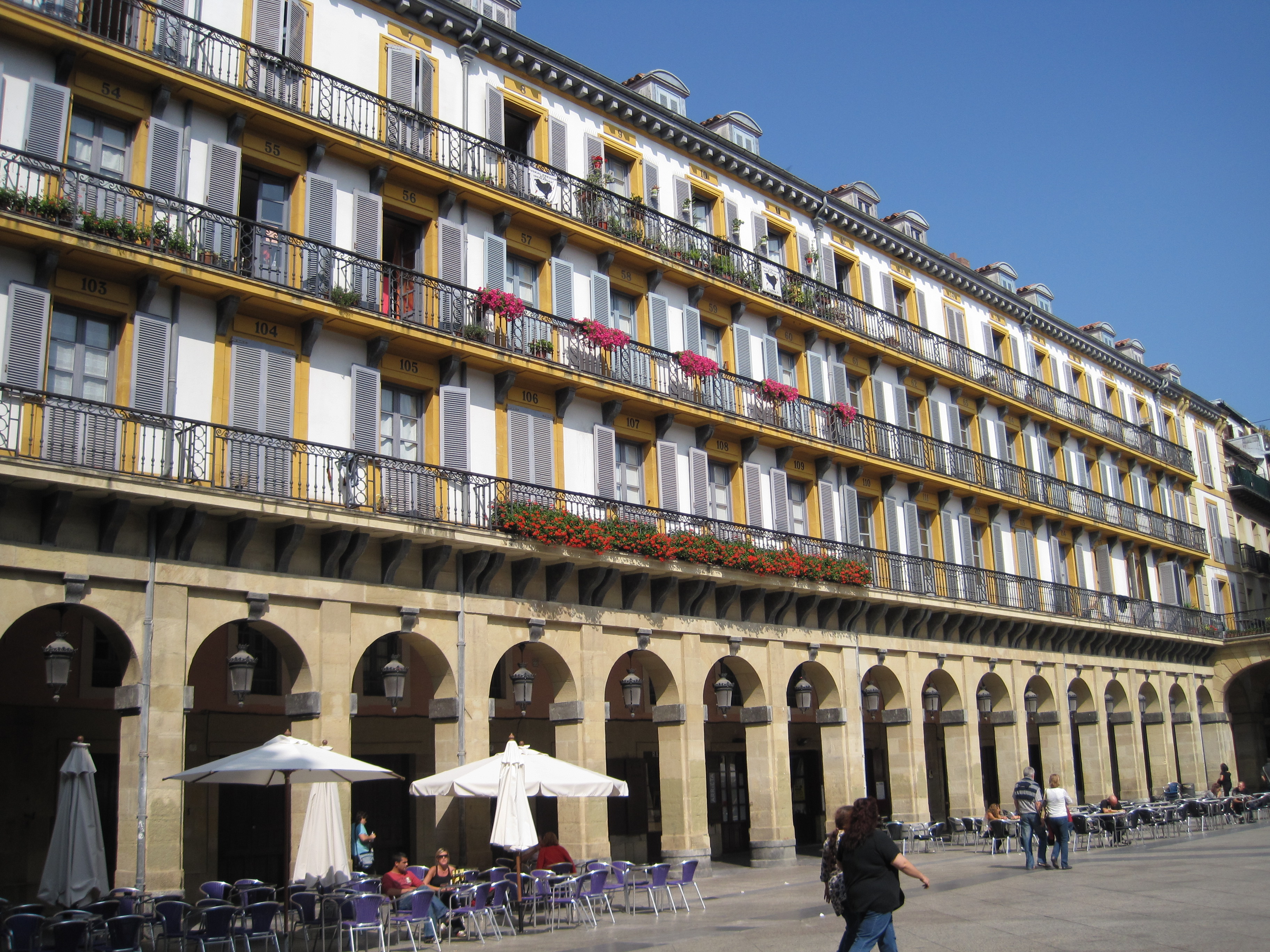
Plaza de la Constitución
The arcaded main square of the rebuilt Old Town, completed in 1817 with numbered balconies once rented as boxes for the bullfights held below. Each January it becomes ground zero for the Tamborrada, when the city flag is raised here and thousands of drummers march for twenty-four hours.
Welcome to San Sebastián, or Donostia, as you'll see it written in Basque all over this city. You're standing in a town with a secret buried under its good looks: on the last day of August 1813, this place burned for a week and came out the other side as barely thirty houses. Everything you're about to walk through was rebuilt from that ruin, and over the next couple of hours we'll climb the fortress that explains why anyone bothered to fight for this rock, and end at the very breach where the attackers broke in. So let's begin where the new city began.
Look up. Before we talk about anything else, look up at the buildings ringing this square, and count the numbers painted above the balconies. Go on, find number one, then let your eye run along the row. Those numbers aren't house addresses, and they aren't decoration. They're seats. This plaza was once the town's bullring, and every one of those balconies was rented out as a spectator box, a private balcony for the corrida happening on the sand right where you're standing. The residents who lived behind those windows made a tidy income letting the good people of San Sebastián lean out over their railings to watch the bulls. It's one of my favourite details in the whole city, because you're looking at a ticketing system frozen into the architecture. The bulls are long gone, but the numbers stayed.
Now, why does a square built for bullfights matter to a story about fire? Because this plaza is younger than the catastrophe. It was completed in 1817, just four years after the disaster, and it's one of the first things the city raised from its own ashes. Notice how orderly everything is: the arcades running around all four sides, the even rhythm of the arches, the way the streets lead off at clean right angles. That's not an accident of medieval growth. When the town was rebuilt after 1813, the planners threw out the tangled old streets and laid down a grid, straight lines, right angles, the logic of a fresh start. So as you wander the Parte Vieja today and think how charmingly walkable it all is, remember: those straight streets are the fingerprint of a fire. The old town isn't old in the way it looks. It's a nineteenth-century reconstruction wearing a medieval name.
Here's the thread I want you to carry with you all afternoon: almost everything you'll see in these streets is younger than 1813. Almost everything. Because one street survived. When the flames tore through, a single row of houses, then called Trinity Street, came through more or less intact, reportedly because it was being kept for the lodging of Allied officers. Roughly thirty houses. And that street is our very next stop. It has a name that will stop you in your tracks once you know what it means, because the survivors didn't name it for a saint or a king. They named it for the date everything burned. But I'll let that one land when we get there.
Stand still for a moment and let the square do its work. Hear the café chatter under the arcades, smell the coffee and, if it's the right hour, the frying from the pintxo bars tucked into these streets. It feels like the gentlest place in the world. Now picture it once a year transformed completely. On the night of the nineteenth of January, at the stroke of midnight, the city's flag is raised right here in this plaza, and San Sebastián erupts into the Tamborrada. It's a drum festival, and calling it that undersells it wildly. For twenty-four hours, companies of drummers and barrel-players parade through the streets dressed as cooks and as Napoleonic-era soldiers, thundering out the same marches. Thousands upon thousands of them, children in their own daytime parade, the whole city pounding on drums until the following midnight. It's been going since 1836, and it grew, as these things do, half in mockery and half in memory of the soldiers who once occupied this town. There is something perfect about a city that answers the memory of invading armies by dressing up as them and drumming all night. Respect and mischief, in the same beat.
And that midnight flag-raising happens here, in the bullring square, in the rebuilt heart. It's the city planting its own banner on the spot where it started over.
Before we move on, look past the arches toward the hill you can sense rising behind the town, Monte Urgull, crowned by its fortress. That castle is why San Sebastián exists and why it was worth besieging for centuries, and we're going to climb it. Up there the French garrison finally surrendered with the full honours of war while the town below was still smouldering, and Wellington, notably, refused to pay a penny of compensation for the sack, blaming the French for the whole affair. We'll stand where that surrender happened. And at the very end of our walk we'll come down to the sea, to a place called La Bretxa, which means 'the breach', the exact gap in the walls where the attackers poured in. Today it's a food market. The wound that feeds the city.
But first, the survivor. Let's walk to the one street that remembers the date in its name.
Calle 31 de Agosto
That is stop one, in the walk itself. The remaining 9 stops, the map and the route between them open with one free account.
Continue the walkThe written walk is free.
Thank you! Your report has been submitted.
Report an issue
Help us improve by reporting any issues you notice.