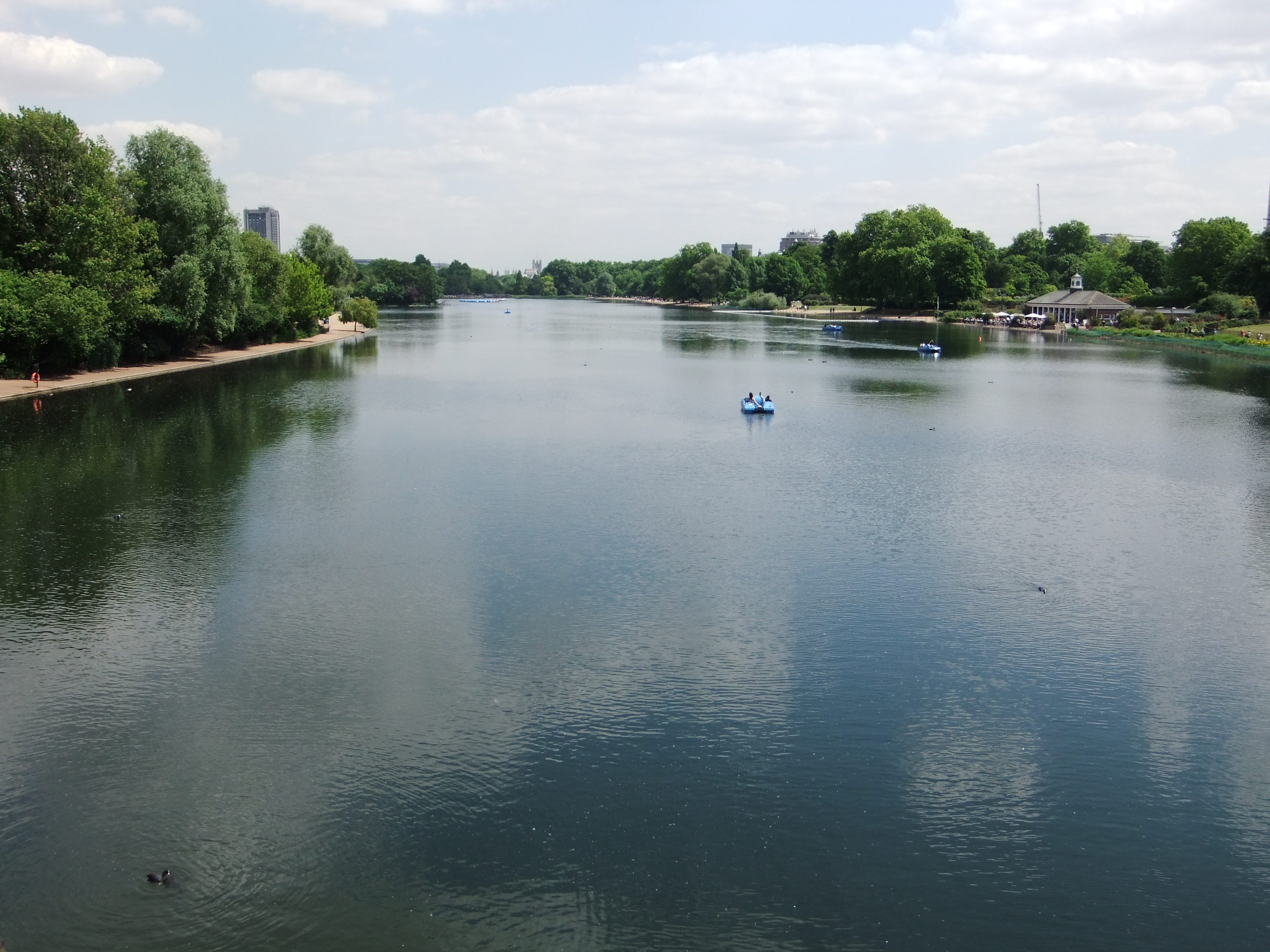
The Serpentine
An artificial lake at the heart of Hyde Park, created in 1730 by damming the River Westbourne. The Serpentine became a defining symbol of Victorian leisure culture and democratic public access to recreation.
Welcome to one of London's most extraordinary patches of ground—a neighbourhood shaped by a single man's audacious belief that beauty, knowledge, and culture should belong to everyone. We're starting at the Serpentine, that graceful artificial lake in Hyde Park where Londoners have come to swim, stroll, and dream for centuries. It's a place of leisure and light, and it sets the perfect tone for what we're about to discover. Behind these trees lies a story that begins in 1851, when the Great Exhibition astonished the world and planted an ambitious seed in the mind of Prince Albert. That vision—that museums should be temples of learning, not locked away from ordinary people—transformed this entire corner of London. Over the next couple of hours, we'll walk through the very museums he dreamed into existence, stand before monuments to his legacy, and finish at the palace where a young queen was born. It's a walk through the Victorians at their most hopeful and inspired—and it all starts here, with water, sky, and the promise of discovery ahead.
Stand here for a moment and notice what you're looking at. This arc of water stretching before you, with its gentle banks and the trees reflected in the glass-like surface, is the Serpentine—and it changed everything about how ordinary Londoners thought about leisure and public space.
The lake itself is remarkably young, historically speaking. It was created in 1730 by damming the River Westbourne, the small river that once ran through this land. But what makes it interesting to us isn't just its engineering—it's what it came to represent. By the Victorian era, the Serpentine had become the heart of Hyde Park, and Hyde Park had become something revolutionary: a massive, freely accessible public space right in the centre of London. Three hundred and fifty acres of green, belonging to no one and everyone at once. For a city choking on industrial smoke and crowded with workers packed into tenements, this park was literally a breath of fresh air.
If you'd lived in Victorian London and wanted to escape the soot and noise of the city, you came here. Not to a private estate—to a public park. This was radical. For most of human history, the countryside belonged to someone. It was enclosed, gated, private. But London's great parks represented a different kind of thinking: that beauty and fresh air and space weren't luxuries for the rich, but necessities for everyone. The Serpentine was where this democratic vision of leisure actually took physical form. The park had been open to the public since the 1630s, but it was the Victorians who truly transformed it into a beloved destination for all classes.
Look around at what you can see here. On warm days, you'll notice people swimming in the lake—there's a designated swimming area, Serpentine Lido, which has been welcoming swimmers since 1930. But Victorians were swimming in these waters long before that, despite the murky colour and the swans. Boating was the other great Victorian pastime here. If you had a few shillings to spare, you could rent a small rowboat and spend an afternoon on the water. It sounds simple, but the ability to do that—to own a few hours of leisure, to enjoy beauty without wealth or status—was part of a much larger transformation happening all around you. This democratization of pleasure was genuinely revolutionary for the time.
Notice how the park flows naturally from here. To the south and east, just beyond the park's edge, is where the Great Exhibition of 1851 took place—the vast iron and glass building that astounded the world and announced that Britain was a nation confident in its progress. That exhibition was Prince Albert's great gamble: that ordinary people should see science, art, and innovation. That beauty and knowledge should not be locked away in private collections, reserved for the elite. When that exhibition closed, the profits funded something even more ambitious: the great museums of South Kensington, which we'll see next. The Serpentine and the museum quarter are two sides of the same vision—one offers refreshment and pleasure, the other offers knowledge and wonder. Both insisted that these things belonged to everyone.
As you look at the water, imagine the Victorian Sunday afternoon here: the splash of rowing boats, the rustle of long dresses along the banks, the sound of children and conversation. This wasn't a retreat from society for the wealthy—it was society itself, mixing and mingling in a way that would have been impossible just fifty years earlier. Governesses walked alongside gentlemen, shopkeepers strolled past merchants. Class boundaries didn't dissolve entirely, of course, but the Serpentine represented a genuine crack in the idea that public pleasure should belong only to the privileged.
In a moment, we'll head into the museum quarter, where that same democratic vision that transformed this lake into a public treasure will be written into every stone and every collection. But first, let this place settle in. Notice the light on the water, the casual mix of people enjoying it, the sense of space and air. This is what the Victorians fought for—not just better museums or more monuments, but the fundamental right to stand in a beautiful place and feel that it belonged to you as much as to anyone else.
Victoria & Albert Museum
That is stop one, in the walk itself. The remaining 6 stops, the map and the route between them open with one free account.
Continue the walkThe written walk is free.
Thank you! Your report has been submitted.
Report an issue
Help us improve by reporting any issues you notice.