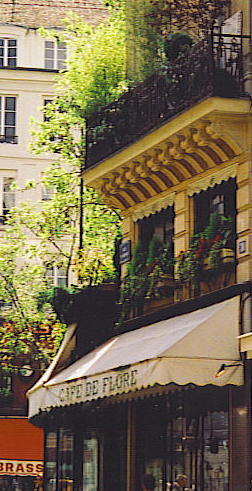
Café de Flore
The legendary café in Saint-Germain-des-Prés where Sartre and de Beauvoir debated existentialism over coffee, now an iconic but pricey destination that still captures the intellectual energy of 20th-century bohemia.
Welcome to the Left Bank of Paris, where literature didn't just happen—it was invented over coffee, debated in gardens, and written in the margins of everyday life. For over a century, this neighborhood has been the world's capital of ideas: the Lost Generation typed their masterpieces in cafés, existentialist philosophers shaped the 20th century through late-night discussions, and ordinary streets became the setting for extraordinary works. You're about to walk the same paths as Hemingway, Sartre, and Beauvoir. Every café, bookstore, and medieval street corner tells a story of intellectual passion and artistic freedom. This isn't just a tour of literary landmarks—it's a journey through the living geography that made Paris the most influential literary city in the world.
Welcome to Café de Flore. You're standing at one of the most famous addresses in literary Paris—and I want you to notice something first: the red velvet banquettes, the zinc bar counter polished by decades of elbows, the mirrors reflecting the morning light. This is a café frozen in a particular moment of history, and that's part of what makes it matter.
The building opened as a café in 1880, but it became truly legendary in the 1920s and 1930s, and especially after World War II. The Nazi occupation of Paris lasted four years, from 1940 to 1944. During those years, this café, like thousands of others across the city, was filled with German officers. Parisians continued their café culture under occupation—some collaborating, some resisting, most simply surviving. But what matters for our story is what happened after liberation.
When the war ended in 1945, Paris emerged hungry for meaning. The old certainties—nationalism, tradition, organized religion—had collapsed in catastrophe. How could anyone believe in progress after the Holocaust? How could old ideas about human nature survive Auschwitz? That moral and philosophical crisis is the real birthplace of existentialism, and it happened in places exactly like this.
Jean-Paul Sartre was already a published philosopher, but he became the face of existentialism after 1945. He spent enormous amounts of time here, often all day, with his partner Simone de Beauvoir. They would arrive mid-morning and work, write, argue, and meet people until late in the evening. The café became their office, their salon, their second home. Sartre suffered from insomnia and depression, and he medicated himself heavily with tobacco, amphetamines, and endless coffee. The café was where he could be around people while still being in his own head—the perfect refuge for an anxious, restless mind.
But here's something worth thinking about: this wasn't a quiet place to work. Look around now and notice the density of tables, the acoustic chaos when it fills up. Sartre and de Beauvoir weren't hiding in corners. They sat at prominent tables, visible, available. Other writers, artists, musicians, journalists, and hangers-on would join them or nearby. Albert Camus spent time here. Hemingway drank here. Picasso was known to sketch on the margins of newspapers while sitting at tables like these. The café was a stage, and these were the performers.
What's crucial to understand is that the café culture of Saint-Germain wasn't accidental or romantic. It was practical. These writers often lived in tiny, unheated apartments—no running hot water, no electricity in some cases. The café was heated. It had light. You could buy a coffee or hot chocolate for a few francs, sit for hours, and no one would throw you out. You could write, read, meet friends, make love, have political arguments. For writers living on almost nothing, the café was survival. It was also democracy. You weren't separated by wealth or status. A poor student sat at the next table from an artist who might become famous.
Sartre's philosophy was about human freedom and responsibility. He believed that existence precedes essence—that we are not born with a predetermined nature, but create ourselves through choices. That's an uncomfortable idea. It means you can't blame God, tradition, or fate for who you are. You are responsible. That philosophy, hammered out in heated debates right in spaces like this, spoke to a generation that had seen traditional authority destroy itself in war.
The Café de Flore became so associated with existentialism that it transformed into a destination. By the 1950s, tourists were coming to see the café where Sartre worked. That created a strange paradox: the more famous the café became as the headquarters of existentialist philosophy, the more it became a performance of itself, a stage set rather than a working space. Sartre eventually stopped coming as frequently because of the crowds and the intrusion on his privacy.
Look at the prices on the menu board now. A coffee will cost you eight euros or more. That would have been three weeks of rent in 1945. The café is no longer a refuge for poor writers. It's a luxury destination, owned by a corporation, catering to tourists and the wealthy. Yet something of the original atmosphere remains—in the quality of the light, in the way people sit for hours over a single cup, in the conversations that still happen here. It's a paradox, and a fitting one for a place built on existentialist philosophy, which is fundamentally about the tension between what we hope for and what the world actually offers.
What you're experiencing here is both the authentic location of a real historical moment and a tourist version of that moment. That's not to dismiss it—authenticity is always a complicated thing in a city that has been itself for centuries. But it's worth noticing the gap between the mythic Café de Flore and the actual business operating at this address. That gap, that tension between ideal and reality, is very much in keeping with the ideas that were developed here.
In the next stop, we'll visit Les Deux Magots, another legendary existentialist café just across the square. The two cafés were rivals of sorts, and together they defined the intellectual geography of Saint-Germain. But first, notice something about where you are: the architecture, the narrowness of the streets, the way the light falls differently in this arrondissement than it did in the Latin Quarter we just left. Physical place shaped intellectual life here. The geography wasn't random.
Les Deux Magots
That is stop one, in the walk itself. The remaining 10 stops, the map and the route between them open with one free account.
Continue the walkThe written walk is free.
Thank you! Your report has been submitted.
Report an issue
Help us improve by reporting any issues you notice.