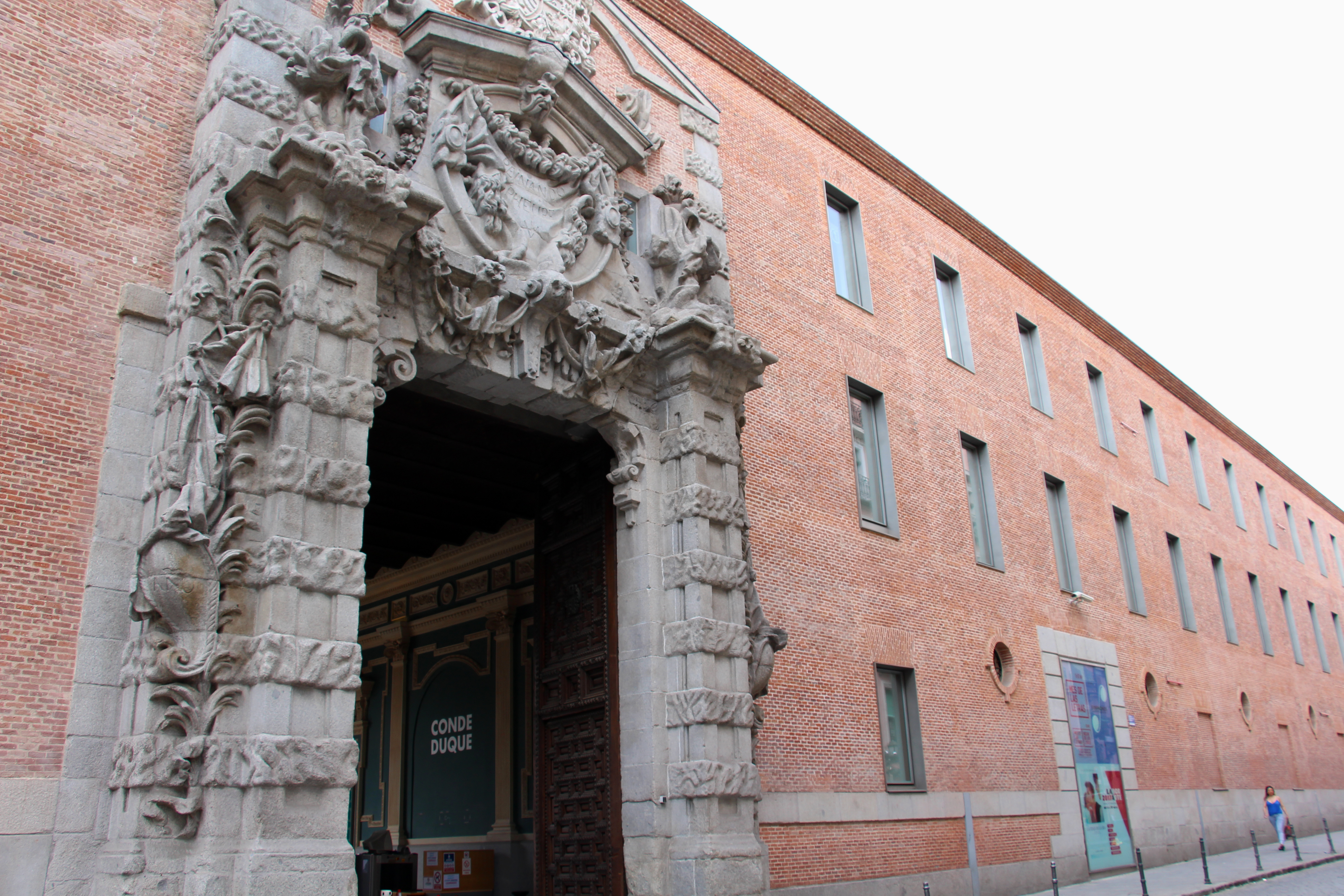
Centro Cultural Conde Duque — From Barracks to Culture
The tour begins at an 18th-century military barracks with a magnificent Baroque doorway — now one of Madrid's most important contemporary cultural spaces. This military fortress transformed into a house of art is the perfect metaphor for everything this tour explores.
Welcome to Madrid Rebelde — a journey through a city that has refused to be broken. What you're about to walk is a map of rebellion, written in stone, art, and memory. It stretches from 1808, when Madrid's citizens rose against an occupying force, through 1936, when this city became the crucible of Spain's defining tragedy, to the 1980s, when a generation transformed trauma into music, fashion, and unstoppable creative force. You'll stand where cannons fired, where bombs fell, where voices were silenced by decree. But you'll also see where those silenced voices found new expression — in murals, galleries, nightclubs, and streets reclaimed by the young and defiant. This is not a tour of monuments to victors. It's a tour of a city that was besieged, that was bombed, that was repressed into submission. And a city that, every single time, came back louder than before. Madrid's rebellion isn't a chapter of history. It's the city's heartbeat.
Stand here and let your eyes travel up to the main entrance. That doorway — it's overwhelming, isn't it? The sculpted stone seems to cascade down and explode outward in waves of baroque ornamentation. This is Pedro de Ribiera's work, designed in 1717, when Philip V ordered this building constructed to house his most elite guard: 600 soldiers and 400 horses. The red brick facade stretches 228 metres — massive, imposing, built to impress and intimidate. It's the visual language of power at its most confident. This is Churrigueresque style, a Spanish baroque tradition that combines elaborate ornamentation with Mudéjar influences — everything designed to overwhelm the spectator into submission.
But something remarkable happened here. This fortress of authority became, in 2011, one of Madrid's most vital cultural spaces. The same structure that was designed to protect the king now protects freedom — of expression, of imagination, of dissent. You'll find the City Archives here, the Historical Library, the Madrid Museum of Contemporary Art. Art where artillery once stood. Exhibitions where soldiers once marched. The transformation was complete and total. Not just a cosmetic refresh, but a fundamental repurposing of space and intention.
That transformation — from barracks to culture — is not just a renovation. It's a perfect metaphor for what happened to this entire city over the last two centuries. Madrid was besieged, repressed, and silenced. And it responded by becoming one of Europe's most vibrant, creative, and defiant capitals. The journey you're about to take today is the story of that transformation, and this building is its opening statement.
Notice the three interior courtyards. During the dictatorship — Franco's long rule after the Civil War that you'll learn about in just a few minutes — this building would have been a symbol of state control. Military precision. Submission. Closed spaces where hierarchy was enforced. But look around now. These courtyards host performances, gatherings, conversations, light and movement. Light flows through them differently now. They're breathing spaces instead of rigid hierarchies. The very air feels different.
The 1808 uprising against Napoleon started not far from here, just over in the next plaza. Ordinary Madrilenians stood up against an occupying force. That spirit of rebellion — defiance in the face of overwhelming power — is woven into this city's identity like a thread that never breaks. The French suppressed that uprising brutally. But you can't suppress a city's character. Madrid rebelled again and again: against the king, against fascism, against repression. Even when silenced by force, the impulse toward freedom kept surfacing, kept insisting on being heard.
What fascinates historians about this building is how it contained such contradictions for so long. Under Franco, it remained a military barracks — an institution of the regime. But even then, Madrid was changing beneath the surface. By the 1970s, after Franco died and as democracy slowly returned, young Madrileños were gathering in neighborhoods like Malasaña, just steps from where you're standing. They were creating music, art, cinema — making a culture of pure freedom and defiance. Artists like Pedro Almodóvar, musicians, filmmakers — they were in the streets, in the clubs, rejecting the gray conformity that had been imposed on their parents. The building was still officially a military space, but the world around it was being born anew.
And then, in 2011, this building itself became a monument to that creative spirit. It's almost poetic — the government acknowledging that culture, not military force, is what defines a city's true strength. The transformation recognized something fundamental: power evolves. The Spain of today understands that soft power — cultural influence, creativity, freedom of expression — matters more than the hard power of soldiers and walls.
As you stand in front of this baroque masterpiece, notice the detail in the stonework. Every flourish, every sculpted element was meant to overwhelm you with the power of authority. Now, it frames a space where that power has been transformed into something life-giving. That's what Madrid did to itself. It took the very structures of oppression and repurposed them into engines of creativity and freedom.
This is where your story begins. Not with the Civil War itself — that comes next. But with the understanding that Madrid's rebellious DNA runs deep. Before the bombs fell, before the siege, before the darkness of dictatorship, there was already a city that said no. And you're about to understand why.
Plaza del Dos de Mayo — Where Rebellion Began
That is stop one, in the walk itself. The remaining 8 stops, the map and the route between them open with one free account.
Continue the walkThe written walk is free.
Thank you! Your report has been submitted.
Report an issue
Help us improve by reporting any issues you notice.