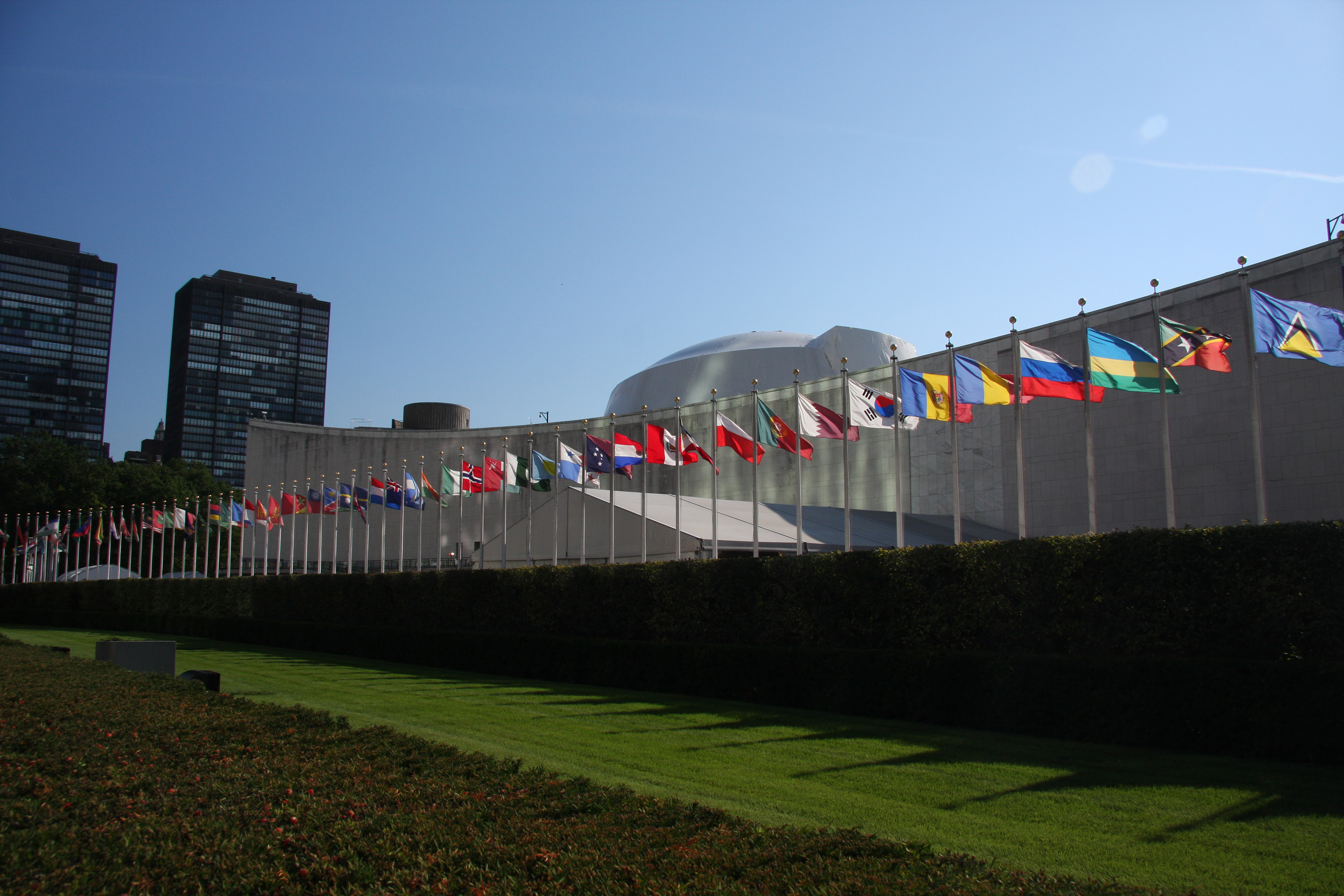
United Nations Headquarters
The United Nations complex on First Avenue sits inside eighteen acres of open ground that New York gave away outright in 1946, on territory the city no longer governs.
You are on First Avenue, on the East Side, where Manhattan runs out of grid and meets the river. Over the next couple of hours you will walk about two and a half kilometres north-west, out of Turtle Bay and across Midtown, finishing on Fifth Avenue.
This is a walk about ground. Midtown is the most expensive and most densely built district in the world. Land here is priced in thousands of dollars per square foot, and every instinct in the place says the same thing: turn ground into floors, and floors into rent. And yet the district keeps opening up on you. A plaza on a corner. A sunken garden with steps down into it. A slot mid-block with trees in it and water running down a wall.
None of that was accidental. Somebody owned each of those patches, knew to the foot what it was worth, and left it empty anyway. That is an odd decision to make once. It has been made here block after block, by people who are not sentimental about money. So carry the question with you and keep asking it: who gave this ground away, and what did they get for it?
You're standing on First Avenue, looking across at a wall of green glass that runs up thirty-nine stories without a single setback, without ornament, without anything trying to be pretty. The Secretariat slab is the plainest building on this walk, and it sits on some of the most valuable ground you'll see all morning, not crowding the street the way a Manhattan tower usually does, but pulled back behind eighteen acres of lawn, trees, and river frontage. In a borough where a single buildable lot can be worth more than most American towns, somebody left this much of it open. That's the fact to hold onto before anything else: nobody built here. Not because they couldn't. Because they chose not to.
Start with how the ground got here. Before 1946 this stretch between 42nd and 48th was Turtle Bay, slaughterhouses, tenements, a working East River waterfront thick enough with smell that Manhattan real estate had mostly left it alone. That neglect is what made it available. When the fledgling United Nations was choosing a permanent home and looking hard at Philadelphia and San Francisco and a patch of land north of the city, it was John D. Rockefeller Jr. who moved first: he put up 8.5 million dollars, bought out the district in a matter of days, and gave the whole parcel away. Not sold at a discount, given. The site became the one thing on this walk that isn't a deal at all. It's a gift, made once, with nothing expected back except that the UN would stay.
And here's the part that matters more than the generosity: once the land changed hands, it stopped being New York's. Look at where you're standing. The sidewalk under your feet is city property, patrolled by the NYPD, subject to city law. Cross that boundary line just past the visitor plaza and you're on international territory, technically outside New York's jurisdiction, outside its building code, outside every zoning rule that will come up again and again on this walk. Every other stop today sits under the city's rules and had to answer to them in one way or another. This one doesn't. New York gave the ground away entirely and kept no leverage over what got built on it. If the compound doesn't feel like the rest of Midtown, that's not an accident of style, it's a fact of law.
What got built was a genuine committee project, which is unusual enough to be worth noticing. The design board was chaired by an American, Wallace Harrison, but it ran through an international slate of architects, and the two names that get argued about most are Le Corbusier, who pushed hard for a tower freed from the street, and Oscar Niemeyer, whose scheme for a slab paired with a low horizontal building is closer to what actually rose here by the early 1950s. You're not going to settle that argument standing on First Avenue, and nobody who was in the room ever fully settled it either. What you can see is the outcome: a thin slab set deliberately back from its own frontage, floating a green rectangle in front of a river, built to be looked at from a distance rather than walked past close.
That's the move worth noticing before you go any further today, not the politics of the UN, not the flags, just the sheer amount of unbuilt ground behind that fence. In the densest, most expensive square miles on the continent, this walk is going to keep finding buildings that left space empty on purpose. Some of that space you'll be able to sit in later today. Some of it you'll only be able to look at, the way you're looking at this. Nobody's going to tell you yet why that keeps happening. Just notice that it does.
Before you walk on, one thing to know. What you can see from here is what most people ever see: the grounds are not open to casual walk-in visitors. Getting inside the gate means airport-style security screening, and the guided interior tour of the General Assembly hall, the Security Council chamber, and the art collection, is ticketed and usually needs booking days in advance. If you want that, it's worth doing on a separate trip with time set aside for it; this walk isn't built around getting you through security today. For now, the exterior is the tour: the scale of the lawn, the flat plane of glass, the sense of a building that turned its back on the value of its own lot. Walk north along First Avenue, and keep that image of empty, expensive ground in your head. You're about to find a much smaller version of the same instinct, on a block with none of the UN's excuses.
Greenacre Park
That is stop one, in the walk itself. The remaining 7 stops, the map and the route between them open with one free account.
Continue the walkThe written walk is free.
Thank you! Your report has been submitted.
Report an issue
Help us improve by reporting any issues you notice.