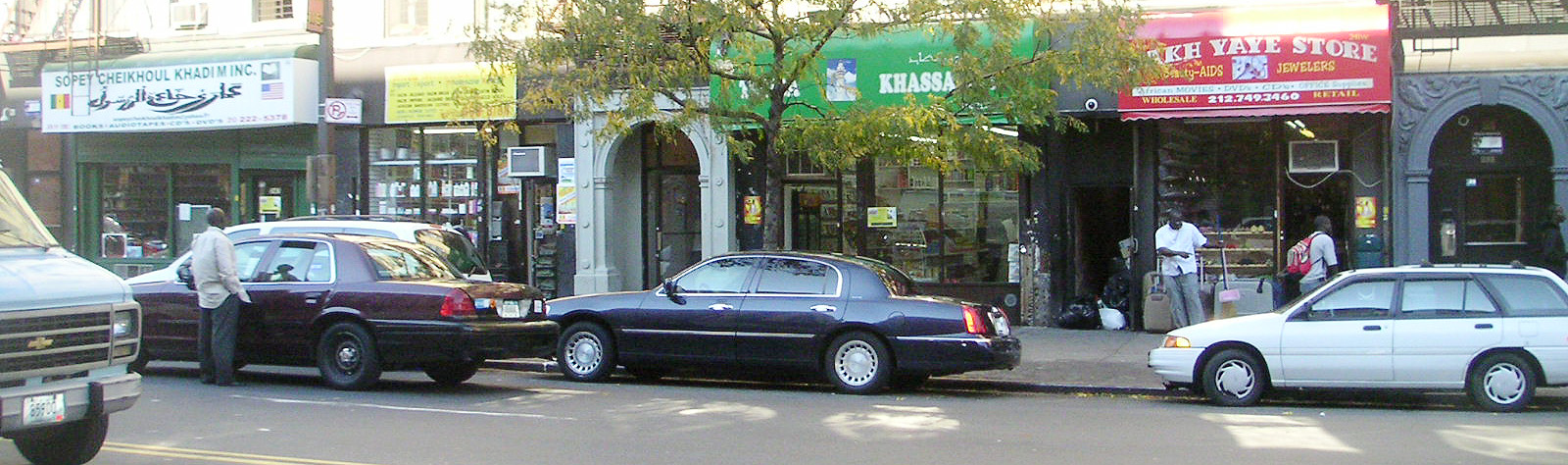
West 116th Street
West 116th Street between Frederick Douglass Boulevard and Malcolm X Boulevard is the commercial heart of Little Senegal, where Francophone West African businesses that took root in the 1980s and 90s trade alongside older Black American soul-food institutions, with the green-domed Masjid Malcolm Shabazz anchoring the block's eastern end.
West 116th Street. Whatever time you got here, this street is working, and over the next couple of hours you will walk about 2.7 kilometres north through Harlem: nine stops, flat the whole way, finishing on a residential block up in the 130s. Ninety-five minutes if you keep moving.
What you are walking through is the political and cultural capital of Black America, and a neighbourhood where a couple of hundred thousand people live, work and argue with their landlords right now. Nothing here is preserved for your benefit. People will be going about their day around you.
One thing to watch as you head north. The housing will surprise you. Harlem is older and considerably grander than most first-time visitors expect, and two of the blocks ahead look almost nothing like the rest of Manhattan. When you reach them, look at what they must have cost to build before you look at anything else.
So carry the question with you: who was this built for? Not the people who made Harlem matter. The answer is not the one most visitors assume, and it is waiting roughly halfway up the route.
Stand here on West 116th Street, between Frederick Douglass Boulevard and Malcolm X Boulevard, and do the easiest fieldwork of the day: breathe. On one side of the block a steam table holds smothered chicken, collard greens, candied yams, the food generations of Black Southern families carried north and have kept cooking here for the better part of a century. A few doors down, another kitchen is turning out thieboudienne, the Senegalese rice-and-fish dish built on tomato paste and dried fish and patience, or grilling lamb and chicken over charcoal the way it's done in Dakar. Both smells are in the air at once, coming from storefronts that share a wall. That's this stop in one sentence: two waves of the same diaspora, cooking on the same block, neither one a museum piece.
The West African wave is the newer one. Starting in the 1980s and accelerating through the 90s, Senegalese and Malian traders and their families began settling on and around 116th Street, Francophone, largely Muslim, carrying different papers and a different mother tongue than the Black New Yorkers who had been here for decades, but landing in the one part of the city built to absorb Black newcomers. New Yorkers started calling the strip Le Petit Senegal, Little Senegal, and the name has stuck because the business district it describes is still doing business: hair-braiding salons staffed by West African stylists, halal butchers, import shops stacked with fabric and phone cards, money-transfer offices wiring earnings back to Dakar and Bamako. Africa Kine, a few storefronts up, opened in the 1990s as one of the first Senegalese restaurants in Harlem and is still one of the reliable rooms on the block. Order the thieboudienne and you'll understand why regulars keep coming back after twenty-some years.
Look east and you'll catch a green dome over the roofline at Malcolm X Boulevard. That's Masjid Malcolm Shabazz, an active mosque holding regular Friday prayers, not a historical marker; the dome is the landmark, but the building underneath it is doing what mosques do, today, for a congregation that includes a good share of the West African families living within a few blocks of it. Before it took its current name and building, this site held Nation of Islam Temple No. 7, led for years by Malcolm X. His fuller story, and his break from the Nation, belongs to a stop further up this tour, but it's worth knowing, standing here, that the pulpit belonged to him before the dome did.
Here's the thing worth sitting with before you start walking: this street is not a relic and it's not a revival. The Great Migration generation that built the soul-food side of this block arrived from the American South across the early-to-middle twentieth century. The Senegalese and Malian generation arrived from West Africa across the 1980s and 90s. Different centuries, different oceans crossed, different papers at immigration, and yet both ended up choosing the same eight or nine blocks of Manhattan, for overlapping reasons that have everything to do with what Harlem is and how it got that way, a story this tour tells properly a few stops from now. For today, just register that the street is still being written. Rents on this block have climbed hard over the last decade, and some businesses that opened in the 90s have already lost their leases to buildings that turned over to buyers with deeper pockets; that pressure is real and current, not a footnote. But the street you're standing on hasn't emptied out. It's still two cuisines deep, still two languages at the register, still adding chapters rather than closing them.
That's the whole idea of this walk: Harlem is the political and cultural capital of Black America, and capital doesn't mean a fixed set of monuments from one decade. It means a place where each generation that arrives adds something and expects the next one to keep it running. Over the next roughly ninety-five minutes and 2.7 flat kilometers, heading north, you'll see what Black New Yorkers built for themselves when the rest of the city wouldn't build it for them: a theater where the audience became the harshest critic in American entertainment, a hotel that pulled world leaders uptown, a museum that bet on living artists instead of collecting dead ones, and blocks of housing, like Strivers' Row further along, that tell their own version of who gets to hold this ground. A few blocks from here, on 125th Street, is the commercial spine the next stretch of this tour runs along. First, though, a short walk to the Apollo. Head north and let's go.
Apollo Theater
That is stop one, in the walk itself. The remaining 8 stops, the map and the route between them open with one free account.
Continue the walkThe written walk is free.
Thank you! Your report has been submitted.
Report an issue
Help us improve by reporting any issues you notice.