Daily News Building
Raymond Hood strips away every scrap of ornament and lets the mandated stepped shape do all the design work, turning the tower's facade into unbroken vertical stripes of white brick and dark window.
You are standing on East 42nd Street, a few minutes east of Grand Central, traffic going one way and the crowds going every other. Over the next two hours you will cover about 2.9 kilometres and ten stops, working west, then north, then south again, and finishing in front of the Empire State Building. Offices, a terminal, a theatre, a park, a library.
Before you take a single step, look up. Not at the building in front of you. At all of them.
Watch what happens as your eye climbs. The mass does not go straight up. It rises, then steps back. Rises again, steps back again. Shoulders, then a narrower shaft, then whatever crown somebody put on the end of it. A wedding cake.
Now notice the strange part. They all do it. Different architects, different clients, different budgets, buildings that agree on nothing else, sharing a profile so close you could trace one over another. That is not fashion. Fashion produces variety.
So here is the question to carry with you: why does this skyline look as though every architect who built it was working to the same instruction?
The answer is waiting halfway along the route, in the least famous building on it.
Look up. The Daily News Building doesn't rise as a single slab — it climbs in a series of shoulders, stepping back three, four, five times before it tops out at 476 feet. And when it gets there, nothing happens. No crown, no cornice, no finial, no decoration of any kind — just the setbacks stop, and the building ends. From here at street level, the whole thing reads as unbroken vertical stripes: alternating bands of white brick and dark, recessed window running straight up from the lower floors to the roof, so your eye never actually counts the 37 floors underneath the pattern.
Now look around. Every serious tower within a few blocks of where you're standing does the same thing — steps back as it rises, in roughly the same rhythm, at roughly the same heights. That is not a coincidence of taste. Nobody wakes up and independently decides to build the same shoulder three times over. Something is making them do it, all of them, all at once, and it isn't fashion. Hold that question. Five stops from now, the least photogenic building on this walk is going to answer it in full. This one isn't going to.
What this stop owns is a change of mind. In 1922 the Chicago Tribune ran an international competition for its new headquarters, and Raymond Hood won it with a Gothic-crowned tower wrapped in flying buttresses — ornament stacked on ornament, all the way to a spiky stone finial. Eight years later, in 1930, working the same regulated envelope every other architect in this city was working within, Hood built this with John Mead Howells and did the opposite of everything that had won him Chicago. No buttresses. No finial. No applied decoration at all. He took the shape the law handed him and simply stopped adding anything to it. The setbacks are the whole design. That's not modesty — it's a bet that honest massing alone would be more interesting than anything he could hang on it. You're looking at the answer to that bet.
Two quick pointers before you go inside. Look east and slightly south and you'll catch the Chrysler Building's crown over the rooftops — you'll get the full story there in a few minutes. And the man who designed this building goes on, later in the walk, to lead the design team on an entire block of Manhattan; keep his name in your pocket.
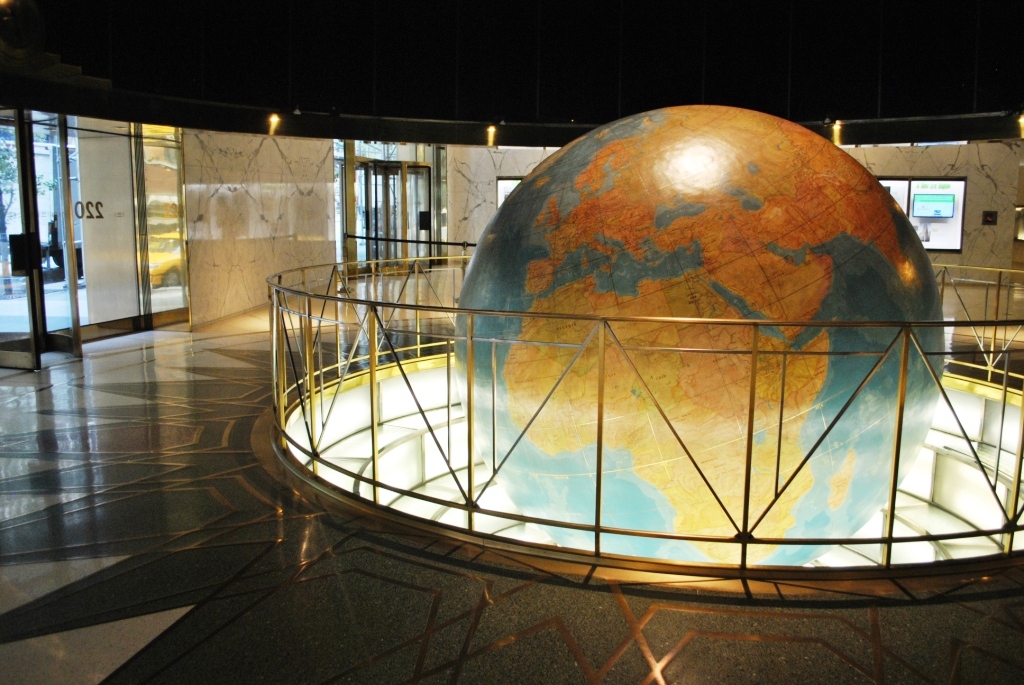
Now step into the lobby — it's free, it's open during business hours, and it's the best free thing on this tour. Sunk into a black-lined well in the floor, under a domed black glass ceiling lit to look like a night sky, is a revolving globe twelve feet across. Set into the floor around the well are dials and instruments still tracking weather and distances to cities around the world. None of it has anything to do with producing a newspaper. It exists purely to make people look down for once, in a lobby built to make everyone else look up.
One last thing before you move on. The Daily News itself left this building in 1995 — it's still called the Daily News Building, but there's no newsroom upstairs anymore. What stayed is the facade's other career: in 1978, this is the exterior Christopher Reeve's Superman flew past as the Daily Planet. The interiors were shot on a soundstage — nobody actually filmed in that globe lobby.
Chrysler Building
That is stop one, in the walk itself. The remaining 9 stops, the map and the route between them open with one free account.
Continue the walkThe written walk is free.
Thank you! Your report has been submitted.
Report an issue
Help us improve by reporting any issues you notice.