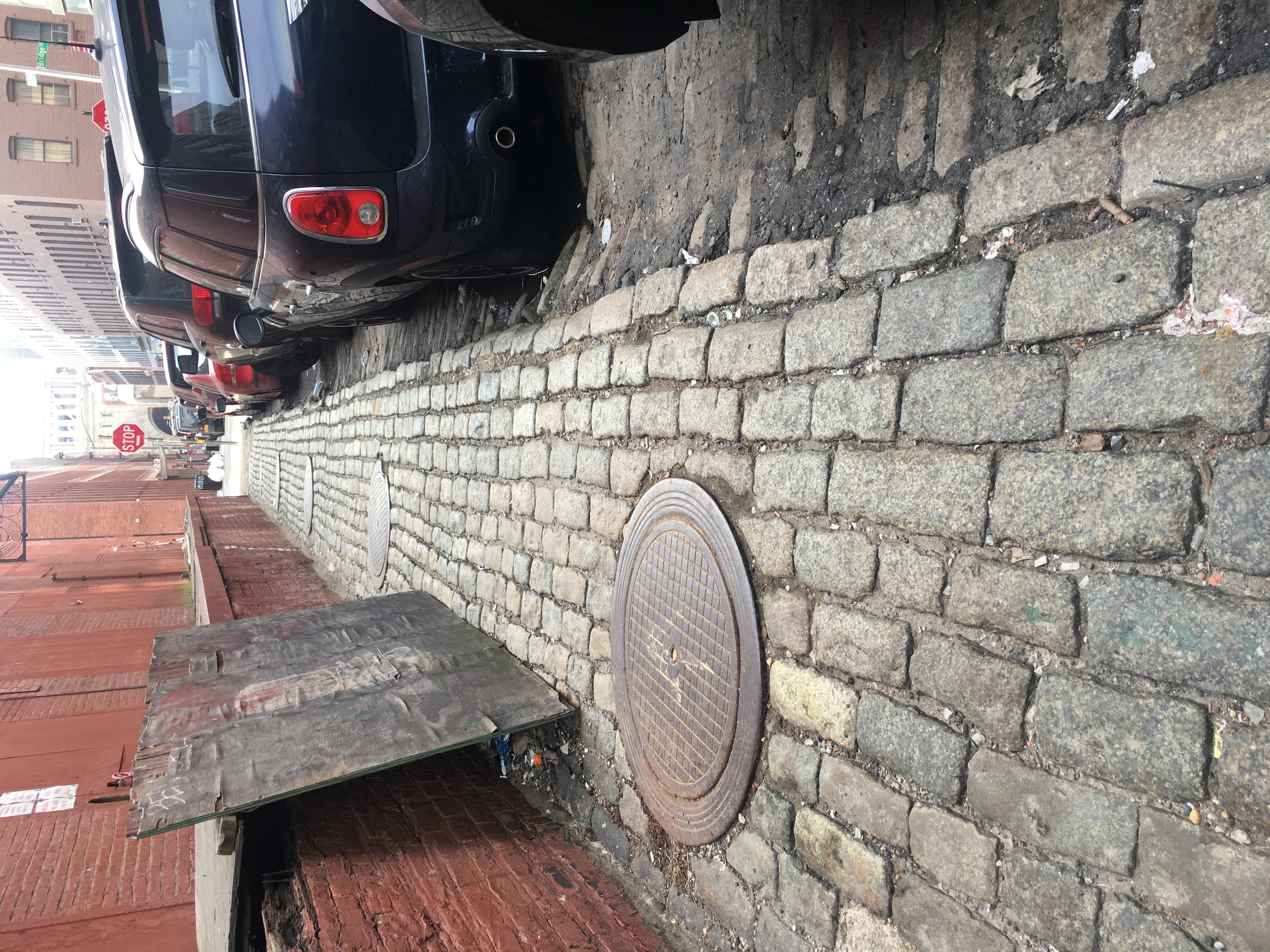
Vinegar Hill
Three short blocks of Belgian-block streets and Federal and Greek Revival rowhouses survive here, wedged between the Farragut Houses, a Con Edison plant, and the Brooklyn Navy Yard fence.
Start here, in Vinegar Hill, with the river a couple of blocks north and almost nobody around. This is the industrial floor of Brooklyn: brick, iron, fence line, old paving that has never been smoothed over. Over the next two hours or so we walk west along that floor, through the warehouse blocks and the rebuilt waterfront below the bridges, and then we climb.
Which is where the problem starts. Up on the bluff ahead of you there are streets of houses from the 1820s and 1830s — older than most of what you will pass down here, larger, and lined up with a uniformity that costs money. When they went up, this was not a city. It was farmland and shoreline with a working river in front of it. Somebody looked at that and decided to live out there and cross the water to work, every single day, at a time when essentially nobody in America organised a life that way.
That is the question to carry uphill: what made that possible, and who could afford it? Hold it. It gets answered, and not where you expect.
You're standing on Belgian block, not cobblestone. Cobbles are rounded river stones; these are quarried granite setts, cut rectangular and set by hand in sand, and that distinction matters because almost nobody gets it right. Look down at how regular the pattern is, then look up at the brick in front of you: three- and four-bay Federal and Greek Revival rowhouses, most of them built in the 1830s and 1840s, low-doored, flat-fronted, plain. This is what's left of Vinegar Hill, and what's left is genuinely small — a handful of blocks, nothing more.
The name is not an accident of geography. A developer named John Jackson platted these streets in the early 1800s and named them for the Battle of Vinegar Hill, fought in Ireland in 1798, on purpose, to advertise the neighborhood to Irish tenants he wanted to fill it with. It worked. Irish dockworkers and their families moved in to be close to the shipyard next door, and for over a century this was a dense, working, Irish waterfront neighborhood, not a curiosity.
Today fewer than 3,000 people live in Vinegar Hill, and the honest reason these particular blocks are still standing has nothing to do with anyone deciding to protect them. The Brooklyn Navy Yard next door operated for a century and a half as an active federal shipyard, and an active federal shipyard is a bad neighbor for real estate speculation — nobody builds luxury housing next to a working naval installation, and nobody bothers to tear down modest rowhouses when there's no profit in replacing them. So the demolition pressure that flattened so much of industrial Brooklyn simply never arrived here. Vinegar Hill wasn't saved. It was ignored long enough to survive.
And it's hemmed in, not preserved in some sealed bubble. Turn and you'll see it: the Farragut Houses, a public housing complex of brick towers built in 1952, rise directly along one edge. The Con Edison plant, still generating power, occupies the other, its stacks visible over the rooflines. And beyond both, the Navy Yard's fence line marks where these streets simply stop — a boundary, not a story, and you'll get more of the Yard itself only in passing today, never the full history. This is not a museum piece. It's a few surviving streets squeezed between three very different, very active neighbors, and the contrast is the whole point: nothing here was ever precious enough, or profitable enough, to be worth fighting over.
A practical note while we're here. The block is quiet — these are private homes, occupied, lived-in — so keep your voice down and don't sit on anyone's stoop. And the paving that makes this place worth seeing also makes it easy to turn an ankle, so watch your footing, especially if the stones are wet. One more thing: the Commandant's House, the old Navy Yard commander's residence, sits just inside the active Yard boundary nearby. It's not open to the public and we won't be walking toward it — it belongs to an active federal facility, not to this tour.
DUMBO's crowds are five minutes west of where you're standing, and almost none of them make it here, which tells you something about how thoroughly this pocket sits outside the city's attention.
Hold onto one thing as we start walking. In about twenty minutes, this route climbs uphill into Brooklyn Heights, and the houses up there are older, larger in scale, and far more uniform in style than anything on this block — built, without exception, for people who never did a single day's work on this waterfront. Who were they, and how did they get to a job every morning from a hill with no docks, no shipyard, no factories of its own? Keep that question. This tour answers it, but not yet, and not here.
Washington Street
That is stop one, in the walk itself. The remaining 8 stops, the map and the route between them open with one free account.
Continue the walkThe written walk is free.
Thank you! Your report has been submitted.
Report an issue
Help us improve by reporting any issues you notice.