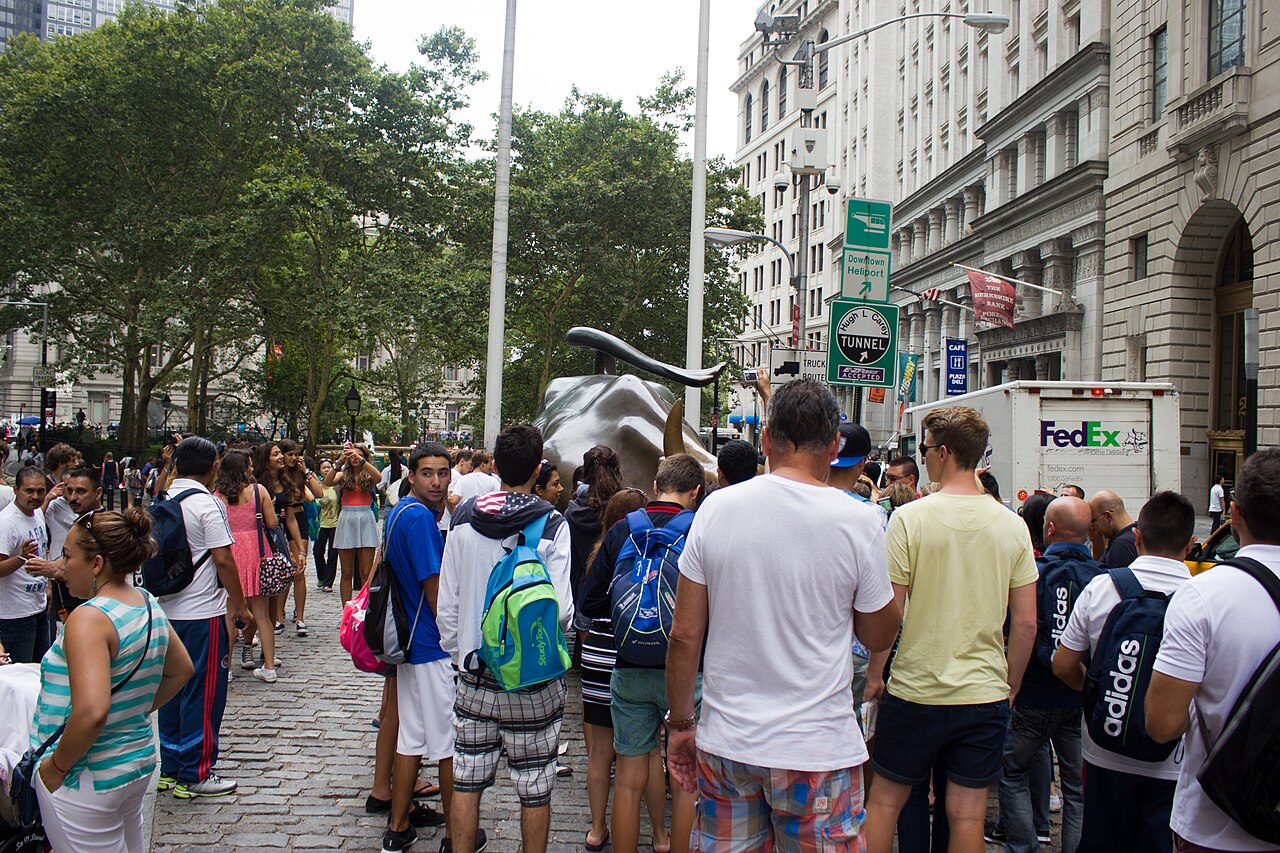
Charging Bull
Sculptor Arturo Di Modica illegally installed the 7,100-pound bronze bull outside the New York Stock Exchange overnight in December 1989, self-funding it as a response to the 1987 crash; after being impounded, it was reinstated by public demand two blocks south at Bowling Green.
Welcome to Wall Street, or rather to the ghost of it. You are standing at the southern tip of Manhattan, in front of a bronze bull so famous it barely needs pointing out, on a patch of ground that has been rebuilt so many times it has forgotten what it looked like the first time.
Somewhere near here, in 1625, a handful of Dutch settlers put up a fort. A few decades later, they put up a wall. The wall came down. The fort came down. The whole town that grew around them came down. And yet the shape of what they built is still under your feet, not in stone, but in the width of a street, the bend of a corner, the place where a market once stood and an exchange now moves trillions.
Over the next ninety minutes, you will walk eleven stops and roughly four centuries, from a barricade built to keep people out to the street that became the address for the world's money coming in. Almost nothing you are about to hear about still stands. That is rather the point. Let's start with what's actually here, and what it isn't telling you.
Look at it now: horns lowered, haunches coiled, nostrils flared as if it might actually charge across Bowling Green. Reach out and touch the horns -- everyone does, thousands of hands a day, and you can see it in the bronze itself. The horns, the nose, and a certain other part of the anatomy have gone bright gold, rubbed smooth by decades of tourists grabbing them for luck, while the rest of the animal has settled into a dull greenish patina. Nobody planned that. It's just what happens when a sculpture becomes one of the most-touched objects on the planet.
Here's the part most people never learn: this bull was not supposed to be here. It was not supposed to be anywhere, officially. In the small hours of December 15, 1989, an Italian-born sculptor named Arturo Di Modica backed a flatbed truck up to the front steps of the New York Stock Exchange, a few blocks from where you're standing, and with a small crew of accomplices, craned a seven-thousand-one-hundred-pound bronze bull off the truck and onto the pavement. No permit, no permission, and by his own account timed to a police shift change. By morning, traders arrived at work to find a three-and-a-half-ton animal blocking the exchange's front door, decorated with a giant Christmas bow, and no idea where it had come from.
The city had it impounded within hours. Public works crews hauled it away to a pound, and for a couple of days it looked like that would be the end of it -- an illegal stunt, towed, forgotten. Except the public wouldn't let it go. Phone calls flooded City Hall. Reporters wanted the sculptor's name. Within days the Parks Department relented and put the bull back on public land -- not outside the Exchange, that spot was never really available -- but two blocks south, here, at the northern tip of Bowling Green, on ground with its own much older claim to being fought over, which is a story for a few minutes from now. So the single most photographed patch of sidewalk in the Financial District is essentially a compromise with a city bureaucracy, arrived at because nobody had the stomach to keep towing it.
And Di Modica paid for the whole thing himself. Roughly three hundred sixty thousand dollars of his own money, by his own account, for a gift nobody commissioned and nobody asked for. He'd watched the market crash in October 1987 and wanted to make something that argued back -- an emblem of resilience, strength, the animal spirit of American finance refusing to stay down. He called it Charging Bull and meant it, quite sincerely, as a present to the city. Wall Street took the gift and made it something closer to a mascot, then a logo, then the most reproduced image of capitalism on earth, sold on every keychain and coffee mug within three blocks of where you're standing -- not exactly the interpretation one guerrilla sculptor with a truck full of bronze had in mind.
It picked up company in 2017 -- a small bronze girl, arms on hips, staring the bull down -- and we'll meet her properly in a few stops. For now, just notice what's actually beneath your feet: not a plaza built for a statue, but a patch of ground this city has been arguing over the use of since long before anyone thought to put a bull on it.
Bowling Green
That is stop one, in the walk itself. The remaining 10 stops, the map and the route between them open with one free account.
Continue the walkThe written walk is free.
Thank you! Your report has been submitted.
Report an issue
Help us improve by reporting any issues you notice.