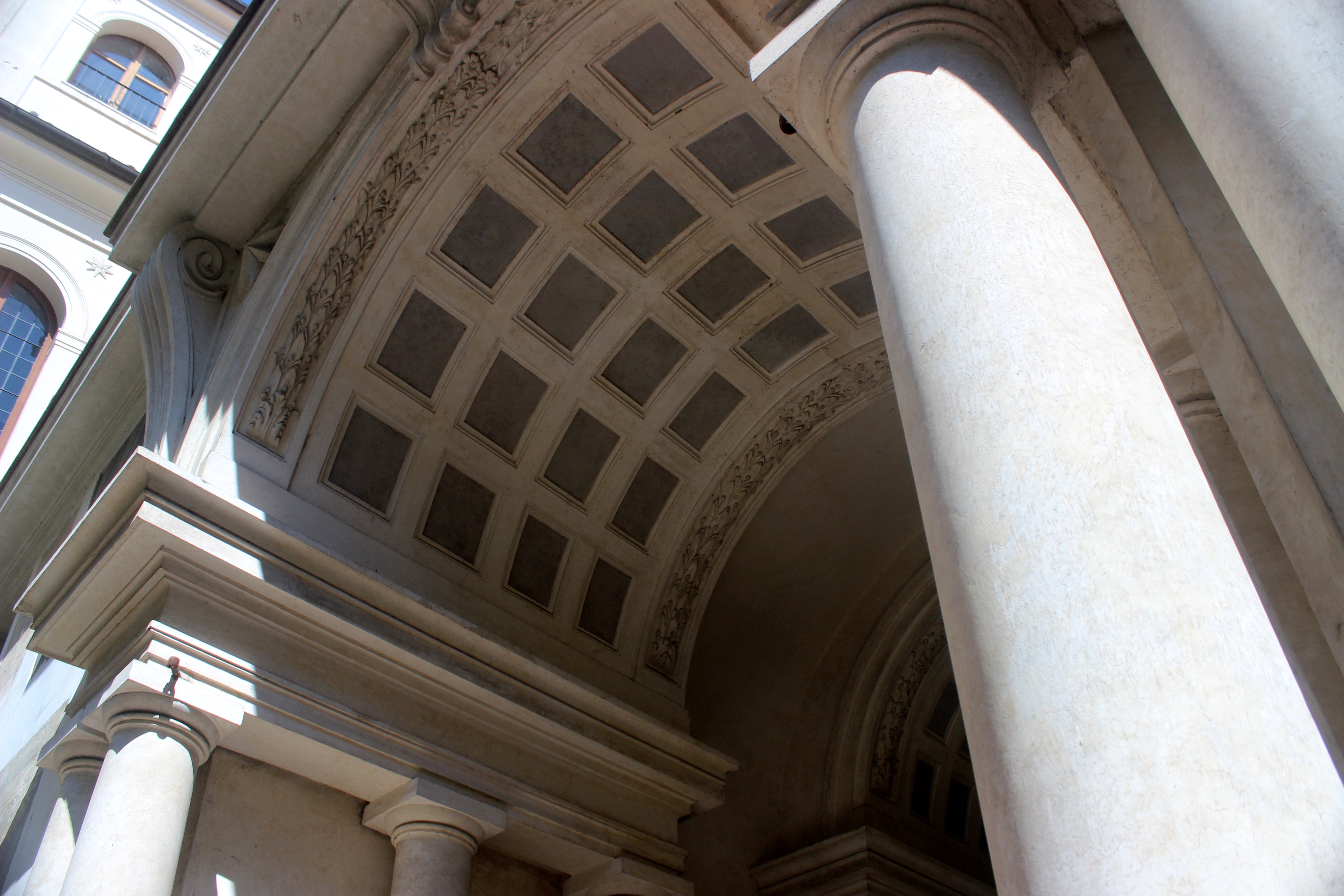
Palazzo Spada
Borromini's masterclass in optical illusion: a 9-metre corridor that punches way above its weight, appearing to stretch nearly 37 metres through pure geometric brilliance.
Welcome to the greatest artistic showdown Rome has ever witnessed—a tale of two geniuses, infinite ambition, and the question that has haunted this city for four centuries: who was the supreme master of the Baroque? I'm talking about Francesco Borromini and Gian Lorenzo Bernini, architects and sculptors who didn't just design buildings and sculptures—they fought over the very soul of Rome's streets and squares. These weren't polite rivals exchanging nods at gallery openings. This was warfare. Bernini had the Pope's ear and the commissions to match. Borromini had something else: relentless innovation and a refusal to follow anyone's rules but his own. Over the next ninety minutes, we're going to trace their knockout punches across 3 kilometers of Baroque brilliance. We'll stand where they clashed, marvel at their contradictory visions, and discover how their rivalry didn't destroy Rome—it transformed it into the theatrical, passionate, architecturally audacious city we're about to explore. So lace up your walking shoes. The bell is about to ring, and this is a match for the ages.
Welcome to Round One of our architectural heavyweight bout, folks. You're standing in front of what might be the single greatest magic trick ever built in Rome—and no rabbits required.
Francesco Borromini, our first contender, was not a man who believed in doing things the easy way. While other architects were content with straightforward hallways and conventional spaces, Borromini looked at this palazzo and thought: "What if we could bend reality itself?" The result is the Gallery of Perspectives, and it's pure theatrical genius wrapped in mathematics.
Here's what makes this the ultimate power move: you're looking at a corridor that's actually only about 9 metres long. But your eyes? Your eyes are completely convinced it stretches nearly 37 metres into the distance. It's geometric theatre at its finest, and Borromini orchestrated every single element like a conductor leading a symphony of sight lines.
The magic happens through a series of brilliantly calculated tricks. The ceiling gradually slopes downward as it recedes. The side walls angle inward subtly, creating forced perspective without you quite realizing it's happening. The floor squares diminish in size as they move away from you. Even the lighting conspires against your sense of proportion—carefully positioned windows ensure the far end stays mysteriously shadowed, enhancing the illusion of impossible depth.
But here's where it gets really interesting: this isn't just smoke and mirrors, or rather, it is smoke and mirrors, but it's smoke and mirrors with an architectural philosophy behind it. Borromini understood something fundamental about how we perceive space. He knew that our brains make assumptions about proportion and distance based on learned patterns. By subtly violating those patterns—making everything just slightly smaller, just slightly lower, just slightly angled inward—he created a cognitive dissonance that reads as "distance" even though your feet know better.
Walk down it. Really walk down it. You'll feel it the whole way—that nagging sense that you're traveling farther than you actually are. The trompe-l'oeil becomes a visceral experience rather than just a visual parlour trick. Your body and your eyes are having an argument, and Borromini wins.
This corridor was Borromini's response to a specific commission, a way to maximize the perceived grandeur of a space that was architecturally constrained. But it became something far more significant: a manifesto. In this 9 metres, Borromini announced that he could manipulate perception through precision, that geometry could be weaponized for dramatic effect, and that an architect's true opponent wasn't another architect—it was the laws of physics themselves.
When Bernini—our second contender, who we'll meet shortly—heard about this corridor, he couldn't help but acknowledge the sheer audacity of it. This was Borromini throwing down the gauntlet and saying: "I don't just build spaces. I rebuild how you perceive reality."
Stand here at the entrance, let your eye travel down the corridor, and you'll understand why this small palazzo became one of the most talked-about architectural achievements in Rome. This is Borromini at his most mischievous, most brilliant, most characteristically himself: taking constraints and transforming them into spectacle through pure intellectual rigor and geometric wizardry.
Church of Sant'Agnese in Agone
That is stop one, in the walk itself. The remaining 8 stops, the map and the route between them open with one free account.
Continue the walkThe written walk is free.
Thank you! Your report has been submitted.
Report an issue
Help us improve by reporting any issues you notice.