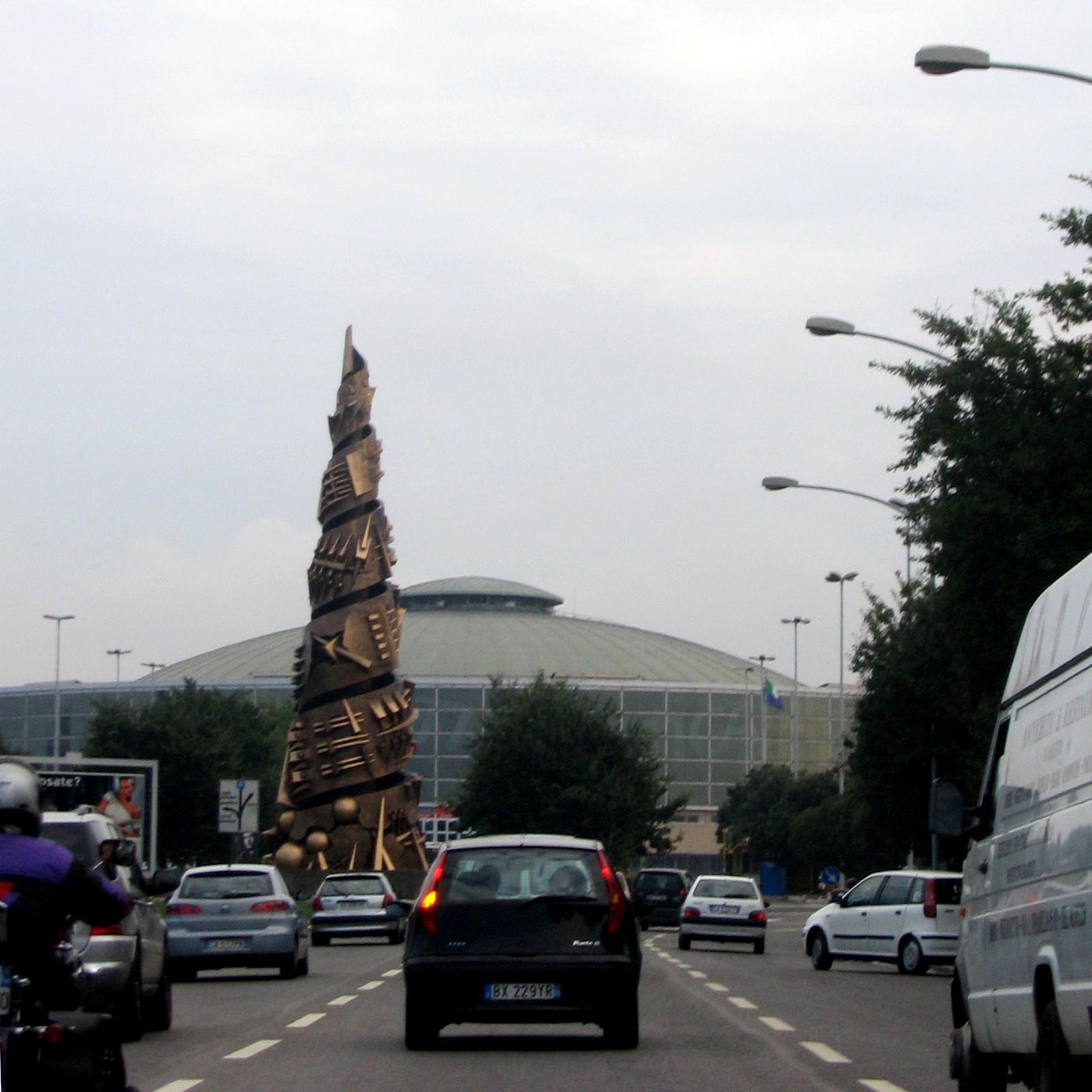
Palazzo dello Sport (EUR)
Pier Luigi Nervi's reinforced concrete dome for the 1960 Olympics—a 100-meter-diameter masterpiece that proved Italy could engineer beauty at monumental scale, signaling the nation's resurrection from postwar rubble.
Welcome to the Rome that most visitors never see. While millions flock to the Colosseum and the Pantheon, you are about to walk through the city that rose from the rubble of World War II and reinvented itself as one of Europe's most surprising capitals of modern design and contemporary art. Over the next few hours, you will cross from Pier Luigi Nervi's Olympic domes in the EUR to Zaha Hadid's gravity-defying MAXXI museum in Flaminio, passing through garden city neighborhoods, street art explosions, a power plant turned sculpture gallery, and fairy-tale facades that defy every rule of architecture. This is the story of how a bombed city rebuilt not just its buildings but its creative identity. We begin where that ambition first took concrete form.
Most people come to Rome for ruins. But look at this. This isn't ancient. This is 1960. This is Palazzo dello Sport, and it's the moment Italy stopped being a country defined by what it had lost and started building what it could become.
Walk around it first—just take it in. You're seeing a dome 100 meters across with no columns underneath. Nothing holding it up except this gossamer skin of reinforced concrete that somehow carries everything. When Pier Luigi Nervi finished this, he didn't just design a basketball arena for the Olympics. He rebuilt Rome's confidence in concrete itself.
The dome is made of over 1,000 individual concrete elements—nine different types, fitted together like a vast 3D puzzle. This wasn't brutalism for brutalism's sake. This was engineering as sculpture. Nervi understood that concrete doesn't have to be heavy; it can be rational, precise, almost delicate. The thin shell vault radiates from a central oculus—that circular opening at the top lets light flood down into the arena below. It's functional, yes, but look at how the light moves. That's not accident. That's intention.
Here's what gets lost in the history books: Rome hosted the 1960 Olympics to tell the world something. The war had been over for 15 years. Italy's economy was moving. Industry was returning. And they needed a building that screamed not "we're recovering"—too meek—but "we're inventing ourselves." Nervi gave them that. In an era when most postwar reconstruction was about efficiency and repair, this was ambition. This was saying: we don't just rebuild, we reimagine.
The concrete here is load-bearing poetry. Every line radiates from the center, creating these triangular buttresses at the perimeter that look almost structural art. And they are structural art—there's no difference. The form follows not just function but logic made visible. That's what separates Nervi from a lot of his contemporaries. He didn't add ornament to concrete; he made the concrete itself ornamental through pure engineering.
Walk inside and you feel it immediately—this opening, this breathing space. The lack of columns changes your spatial experience completely. Basketball courts had always been boxes. This is a space. The ceiling seems to float.
You should know too that Nervi didn't work alone here. Architect Marcello Piacentini designed the building; Nervi was the structural engineer. But when Nervi worked, he was the architecture. The distinction barely mattered. You'll see this pattern again in Rome's modern turn—engineer as architect, structure as form, concrete as material of utmost refinement.
This is where our tour begins because everything that follows—the Auditorium, the MAXXI, even contemporary Roman design—can be traced back to this moment. This dome said: Rome is capable of bold, beautiful, structural thinking. And the city believed it.
EUR District Center
That is stop one, in the walk itself. The remaining 9 stops, the map and the route between them open with one free account.
Continue the walkThe written walk is free.
Thank you! Your report has been submitted.
Report an issue
Help us improve by reporting any issues you notice.