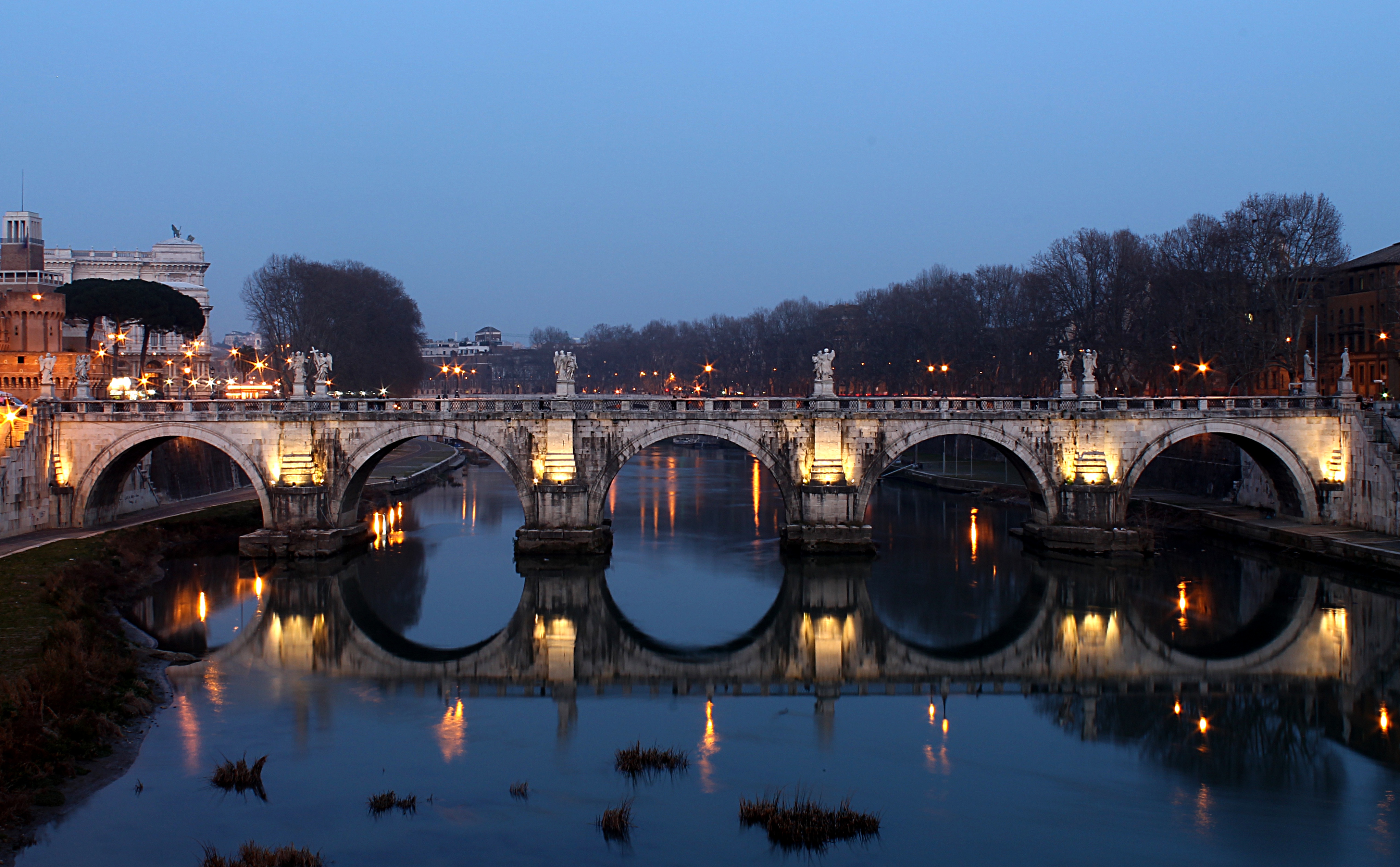
Ponte Sant'Angelo
Ponte Sant'Angelo, the ancient bridge adorned with Baroque angels, stands at a threshold — the Tiber dividing occupied Rome from Vatican territory, a crossing that offered the faint possibility of refuge during the nine months of Nazi occupation.
This tour walks through Rome's wartime history — the nine months of Nazi occupation between September 1943 and June 1944 that transformed the city into a landscape of persecution, resistance, and survival. We begin at a bridge that served as an escape route, move through the Jewish quarter where a 2,000-year-old community was shattered in a single morning, witness the machinery of Gestapo terror, stand at the site of Rome's worst massacre, and end at a basilica that offered sanctuary.
The places on this walk are not distant history. The last survivor of the October 1943 deportation died in 2022. The brass memorial stones in the pavement are polished by the feet of people walking to work. The cells at Via Tasso still bear the scratched messages of prisoners.
This is emotionally demanding ground. Take the time you need at each stop. Silence is as appropriate as speech. These things happened here, to real people, in living memory.
You're standing on one of Rome's oldest crossings. Hadrian built this bridge nearly two thousand years ago, and for eighteen centuries it was simply a passage — civilians and pilgrims, traders and soldiers, all moving freely across the Tiber. But in September 1943, geography became destiny.
When German forces occupied Rome on September 9, 1943, two days after Italy's surrender, the city transformed overnight. The Wehrmacht moved in. Martial law took hold. The Tiber, which had been a river, became a line — and on the western bank lay Vatican City, which the Germans had agreed not to enter. That agreement, fragile as it was, meant that for eight thousand Jews living in Rome, this narrow strip of water represented the difference between exposure and concealment.
The Jewish Ghetto, where most Roman Jews lived and worked, sat just behind you on the eastern bank — cramped into four dense blocks near the Theatre of Marcellus, bounded by the river itself. When the raids came, those who could flee moved toward the bridges. Ponte Sant'Angelo was one of the crossing points. You could walk it openly; that was both its use and its terror. No papers required to cross. But German patrols worked the city too.
By October 1943, less than a month into the occupation, the SS arrived. On October 16, they surrounded the Ghetto before dawn. In the confusion and fear, some families scattered. Some tried to run. Those who reached the Vatican's protection — who made it across one of these bridges, who found a Catholic institution willing to hide them — survived. For every Jew the Germans caught in Rome, at least ten escaped and went to ground, many sheltered by the Church. Over four thousand seven hundred found refuge in Catholic institutions across the city.
But not everyone made it across. Over a thousand were deported from Rome that October morning; almost none returned.
This bridge saw all of it. The ordinary foot traffic of occupation. The desperate calculations of a family deciding whether to run. The gamble that these few hundred meters of stone and water might mean another day alive.
Jewish Ghetto
That is stop one, in the walk itself. The remaining 7 stops, the map and the route between them open with one free account.
Continue the walkThe written walk is free.
Thank you! Your report has been submitted.
Report an issue
Help us improve by reporting any issues you notice.