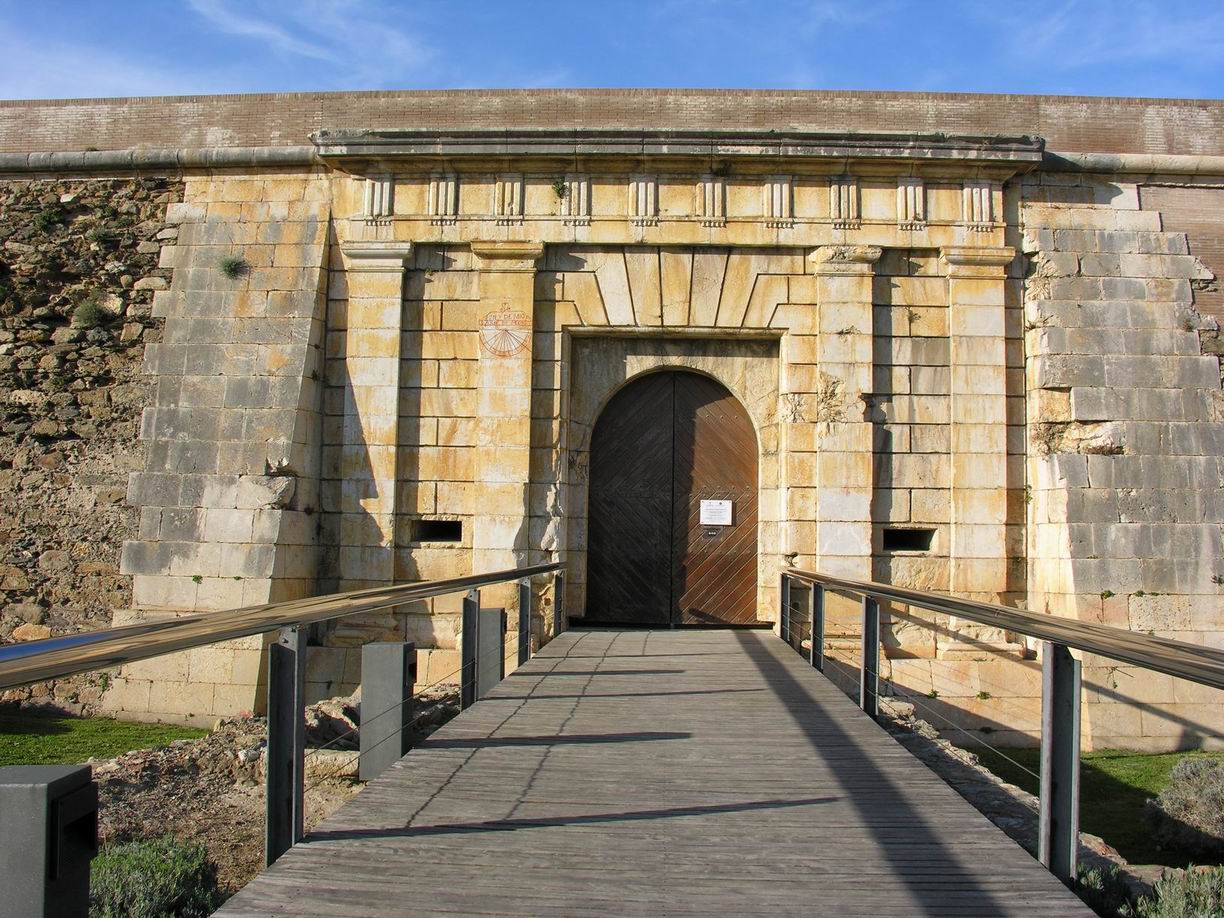
The Porta de Mar
The monumental sea gate of the Ciutadella de Roses, built in limestone on the model of a classical triumphal arch and once defended by a barbican whose foundations still show. It is the main entrance to a 17-hectare fortress that was not a castle guarding the town but the town itself.
Welcome to Roses. You are standing at the front door of a town that isn't there any more.
Take a second before you walk in, because this is the bit most visitors get wrong. From the road it looks like the usual arrangement: a fortress up on the rise, a resort town below it, the two politely ignoring each other. It isn't that. There is no castle-above-the-town here. This enclosure in front of you IS the town, or was. Streets, houses, a church, people who were born and married and buried inside these walls without ever needing to leave them.
So the question this walk keeps asking is a simple one: where did the town go?
You'll find the answer in layers — Greek, then Romanesque, then medieval — and then you'll do something better than read about it. You'll walk it. Every stop from here leads downhill, out of the walls and toward the water, the exact route the people in here took when they finally gave up on the place. Two and a bit kilometres, all of it gentle, and at the bottom of it their descendants are still working.
Let's start where they started. At the gate.
Stand back from this gate for a moment, far enough that you can see the whole of it, and ask yourself what you are actually looking at. Because it is not really a door. Doors are functional. This is a monumental block of pale limestone with a rounded arch set between flanking pilasters and an entablature riding above it, and the whole composition is lifted more or less wholesale from a Roman triumphal arch. Somebody sat down in the sixteenth century and decided that the way into this place should look like the thing emperors built to march their armies home through.
That is your first clue. Nobody builds a triumphal arch for a barracks.
So here is the reveal, and it is the question the next two hours keep answering: where did the town go? This is not a castle standing above a town. This was the town. Behind these walls is where Roses lived: streets, houses, a church and a market. You are standing at the front door of a place that is not there any more, and every stop on this walk is another step in working out where its residents went.
Look at the ground on either side of the gate. Those low foundations, easy to walk straight past, are what survives of the barbican, an outer defensive work that stood in front of the entrance so that anyone coming through had to make a turn under fire rather than charge straight in. The triumphal arch was the ceremony. The barbican was the honest part. And if you want a measure of how deliberate that ceremony was, remember it when you reach the far side of the site, where the Porta de Terra faces inland. That gate is a hole in a wall. No pilasters, no entablature, nothing. This one faces the sea, and the sea is where anyone worth impressing arrived from.
The dates are worth having. In 1543 Charles V ordered the place built. The engineer Luis Pizano proposed earthworks first, cheap and quick, which is what you want when you think the French are coming. By 1545 they had switched to stone and a design with four bastions. Then in 1553 the Italian engineer Giovanni Battista Calvi produced the definitive scheme, five bastions, the shape that is still under your feet. It went on being adjusted, patched and thickened for the best part of a century, and only settled into the form you see around 1642 to 1645.
And it is enormous. An irregular pentagon roughly a kilometre across, 1,013 metres if you like precision, with two concentric levels of defence. The inner wall runs 1,218 metres and stands nine metres high, and it is buttressed every two metres along its entire length. Every two metres. Walk the inside of it later and you will feel the rhythm of it. The five bastions all carry saints' names: Sant Joan and Sant Jordi to the west, Sant Andreu to the north, Sant Jaume and Santa Maria to the east.
Why here, though? Not vanity. The port of Roses was a link in a supply chain. The Habsburgs held both Spain and large parts of Italy, and the ships moving between the two needed a defensible bay on this coast. Add the French pressing from the north, and the Barbary and Ottoman raiders working the western Mediterranean and lifting people off the shoreline to sell, and a fortified harbour halfway along the route stops looking extravagant and starts looking like basic accounting.
One thing to look for before you go in, out on the seafront promenade. There is a bronze figure, life size, a sixteenth-century master builder crouched over a scale model of this very fortress, studying it. He was installed in 2017 and he is one of a pair. His colleagues are further along at Plaça de les Botxes, an engineer and a foreman in the middle of a full argument over a blueprint. The reasoning behind putting them on the promenade was blunt and rather good: thousands of people walk that seafront every summer looking out at the water, and the sculptures were commissioned to make a few of them turn round and look inland at this instead.
So, through the gate. Somewhere behind it there is a Greek colony, and a monastery, and a field of foundations, and we will get to all three. But keep hold of the arch itself, because there is one particular stretch of days in this town's history when the people living inside this fortress came out through this opening carrying what they could and did not go back in. When we reach that spot, at stop four, I want you to be able to picture the door they used.
A practical word first. The Ciutadella is a ticketed site: five euros, free under sixteen, and it is closed on Mondays. If you would rather not pay, or you have arrived to find the gate shut, stay out here. The next three stops work perfectly well listened to from outside the walls, and I will tell you when we come back out.
The Hellenistic Quarter of Rhode
That is stop one, in the walk itself. The remaining 10 stops, the map and the route between them open with one free account.
Continue the walkThe written walk is free.
Thank you! Your report has been submitted.
Report an issue
Help us improve by reporting any issues you notice.