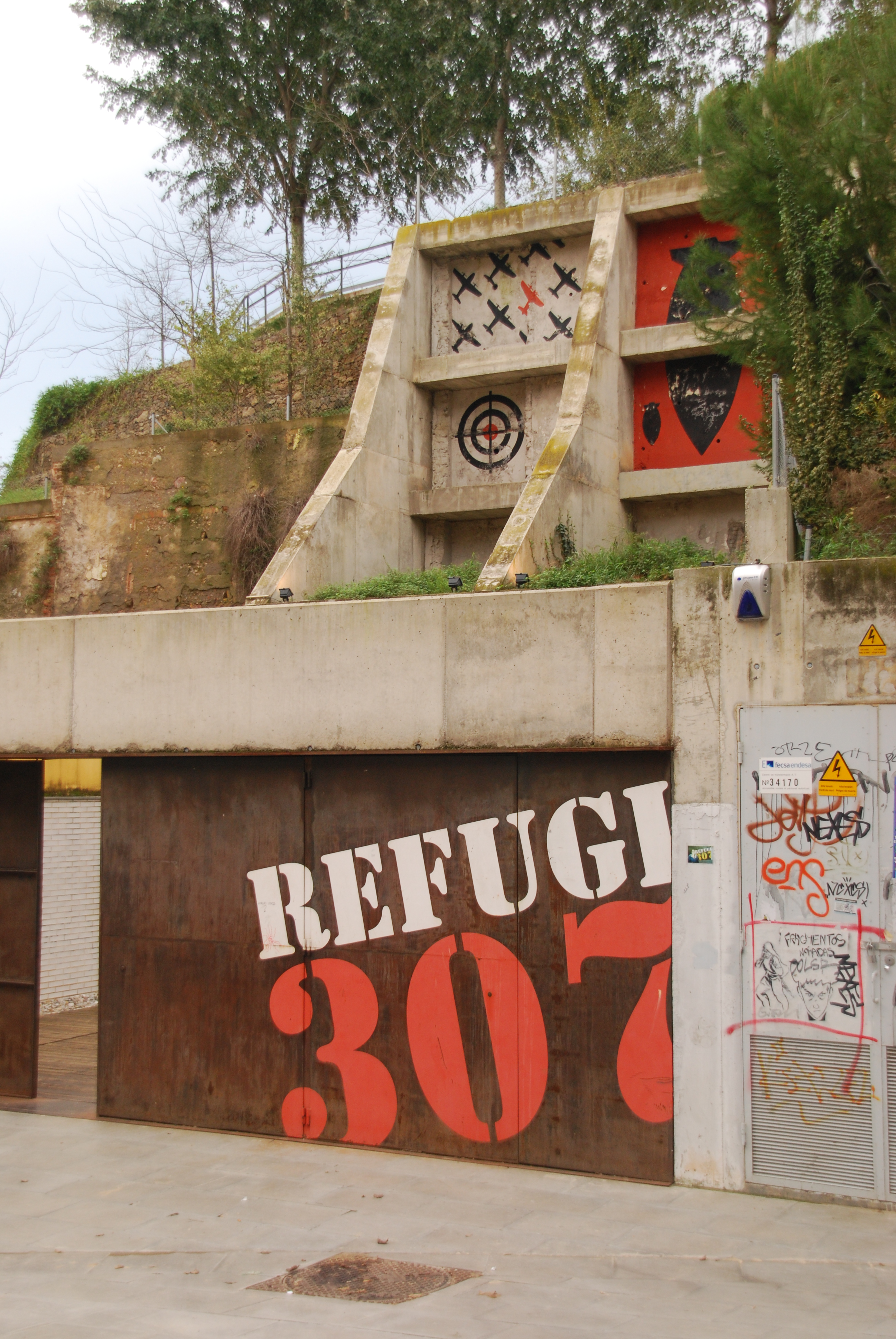
Refugi 307
Four hundred metres of tunnels carved into Montjuïc by ordinary civilians. Barcelona was the first major European city systematically bombed from the air—and its people built their own survival.
Between 1936 and 1939, Barcelona fought a war. Not just any war — a war where the city's own citizens took up arms against a military coup, where anarchists collectivised the factories and burned the churches, where international volunteers came from fifty countries to fight fascism, and where the Republic's own allies turned on each other while the bombers kept coming.
Barcelona was bombed 385 times during the Civil War. An estimated 2,500 civilians were killed by aerial bombardment. The city built over 1,400 air raid shelters — hand-dug by ordinary people, not by the government. Those numbers don't live in textbooks. They live in the walls and tunnels and squares we're about to walk through.
This tour moves through the scars. We'll start underground, in a shelter where people survived. We'll walk the streets where barricades stood and flags flew. We'll stand in the square where bombs killed children and the shrapnel marks are still in the stone. We'll end on a hilltop where anti-aircraft guns defended the sky, and where you can see every place this war touched.
Nothing about this tour is comfortable. That's the point. What happened here happened to real people, in the streets you're about to walk. Let's begin.
Stand at the entrance to Refugi 307 and you're looking at proof that a city doesn't wait for governments to save it. These 400 metres of tunnels were dug by hand—by women, elderly people, children hauling baskets of sandstone. The tunnel mouth opens into the soft stone of Montjuïc like a wound that never fully closed.
Barcelona endured 385 bombing raids between 1936 and 1939. Not military targets. Civilians. The city was the first major European city to experience systematic aerial bombardment. That's not a metaphor—it's a historical threshold. Before Barcelona, bombing was tactical. After Barcelona, it became a weapon against civilians themselves. Italian Savoia-Marchetti bombers came from Mallorca. The German Condor Legion came too. They brought their new aircraft, their new tactics, their ideology. They called it practice.
In March 1938, over three days, the city was bombed relentlessly. March 16th to the 18th. More than 1,000 people died in seventy-two hours. A woman shopping at the market. Children in a schoolyard. A family in an apartment. The bombers didn't distinguish—they weren't trying to. This was terror. This was the future announcing itself.
The shelters appeared because they had to. The Republic's government was overwhelmed. The military couldn't protect the city. So neighbourhood committees decided: we will dig. They gathered people—factory workers with tool experience, but also bakers, teachers, shopkeepers. They bought or stole pickaxes and shovels. They worked in shifts. They worked at night. They worked in rain. Children carried away the broken stone in baskets. Old men swung the tools. Women hauled rubble. By 1939, over 1,400 shelters existed across Barcelona. Most were built by these neighbourhood committees, not the government.
Refugi 307 tells you what ordinary people understood about survival. The builders carved ventilation shafts at precise angles—they knew that fresh air was essential but that blast waves could follow. They built corridors in zigzags, knowing that a straight tunnel funnels shock waves like a gun barrel channels fire. They created an infirmary because they knew people would be hurt. A water fountain—because thirst is part of terror. A children's area—a space where small bodies might sleep, or at least rest, while the city thundered above.
The sandstone is soft enough to work with a pickaxe, hard enough to hold its shape for ninety years. You can see the marks where tools bit into the walls. You can trace the geometry of survival—nothing was accidental, nothing was decorative. People down there spent hours in darkness, listening. Sometimes bombing lasted six hours. Sometimes eight. Sometimes it paused, and you thought it was over, and then it started again. You sat 4 metres underground, holding your child, and felt the floor shake with each explosion.
2,500 civilians died in this city. Refugi 307 held people—dozens at a time—while death fell outside. We don't know how many people it saved. We know it mattered. The museum opened in 2006. The volunteers who run it know the names of the people who dug it. They have stories. They have gratitude.
When you walk through those tunnels now, you're not descending into memory. You're descending into the moment when a city decided it would not be passive in its own destruction. The pickaxe marks on the walls are signatures. The ventilation shafts are engineering. The water fountain is defiance. We will endure.
Carrer Nou de la Rambla
That is stop one, in the walk itself. The remaining 8 stops, the map and the route between them open with one free account.
Continue the walkThe written walk is free.
Thank you! Your report has been submitted.
Report an issue
Help us improve by reporting any issues you notice.