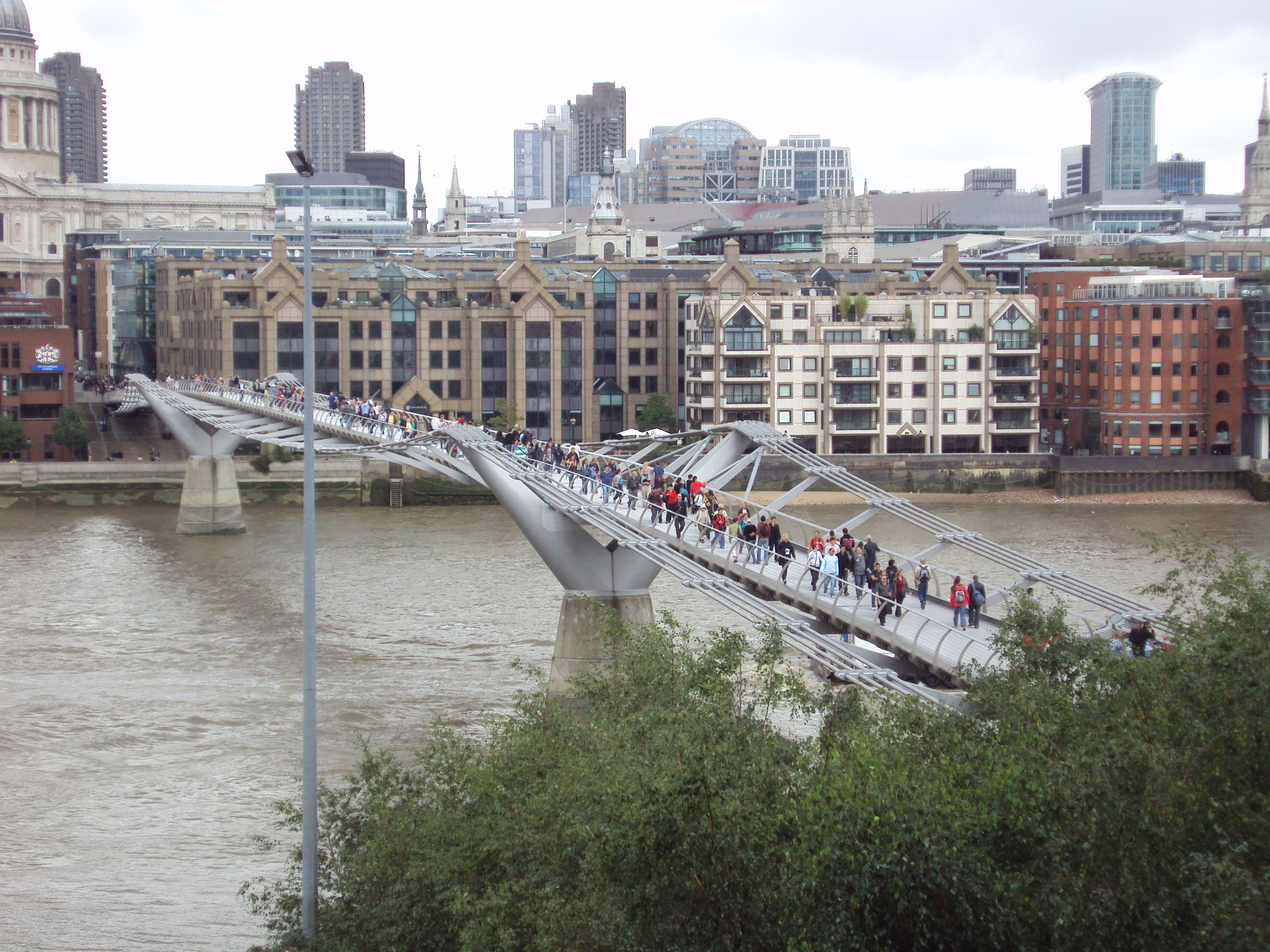
Millennium Bridge
A modern cable-stayed bridge connecting the City of London to the South Bank, framing the same river crossing that Elizabethan theatergoers made centuries ago. From here, St Paul's Cathedral looms behind you while Tate Modern and the cultural powerhouses of Southwark await ahead.
You're about to cross a threshold—and not just a bridge. The Millennium Bridge beneath your feet is glass and steel, uncompromisingly modern. But step onto its other side, and you're stepping backwards through centuries into a place that thrived precisely because it existed in the shadows. Southwark was London's greatest secret: the district where the rules bent, where profits soared, and where theater—scandalous, thrilling, alive—happened outside the law's reach. For nearly two centuries, this was where desire came to be satisfied, where art came to be dangerous. Today, we'll reverse-engineer that history, peeling back layers of gentrification and heritage plaques to find the medieval port, the Elizabethan transgression, the bishops' palaces and bear-baiting pits. By journey's end, you'll stand where London Bridge once stood—the medieval crossing that created Southwark in the first place. This walk is a conspiracy. You're in on the secret now.
You're about to cross a river. That sounds simple, but it's the oldest rule in Southwark: crossing water meant crossing into a different world. Stay with me on that thought.
The bridge beneath your feet is barely twenty-five years old. It's sleek, it's efficient, it's utterly modern—cable-stayed, all mathematical precision and contemporary steel. It's also the exact opposite of what stood here in Shakespeare's day, yet somehow it's doing the same job. In 1599, audiences didn't walk across a steel span; they took boats across the Thames, or they used London Bridge four blocks east. But they were making this same journey. They were crossing the river, leaving the respectable jurisdiction of the City behind, stepping into Southwark—where the rules were different.
Look back at St Paul's Cathedral for a moment. That dome commands the skyline of the City, the seat of respectability, the seat of power. The City could dictate terms to the Crown. The City had money, rules, authority. The City said no to theaters. Too rowdy, too subversive, too full of the common people mixing with their betters. Theater was prohibited inside the City walls.
But Southwark? Southwark belonged to the Bishop of Winchester. And the Bishop was often away. More importantly, Southwark already had a reputation. It was the place you went to do what wasn't allowed on the northern bank. The prisons were here—the Clink, the Marshalsea, places where the City threw its troublemakers. The brothels were here, tucked along the riverside. The taverns were here. And soon, the theaters would be here. The Globe. The Rose. The Swan. Some of the finest minds of the age were writing plays for audiences who crossed this river specifically because they wanted to enter a space beyond ordinary law.
That's the secret Southwark has guarded for five centuries: transgression and art go hand in hand. You crossed the river to see something you couldn't see at home.
Now turn around and look ahead. You'll see Tate Modern rising up from what was the Bankside Power Station—a massive industrial building that once pumped electricity into London. Now it pumps culture instead. Further along the South Bank, the reconstruction of Shakespeare's Globe stands where the original burned down in 1613, a phoenix rebuilt from historical obsession and theatrical memory. Borough Market, one of the oldest markets in London, still operates where medieval merchants offloaded goods from ships. And in the distance, The Shard—Western Europe's tallest building—pierces the sky like a glass needle.
This is modern Southwark's revenge on respectability. The neighborhoods that once held London's outcasts and entertainers have been reborn as its cultural heart. The place where you went to do forbidden things is now a destination for beauty, art, and history. The crossing is still a threshold, but instead of entering a world of transgression, you're entering a world of transformation.
Walking across this bridge, you're making the same choice that thousands made before you: leaving the familiar behind, stepping into possibility, crossing toward something that can only exist on the other side. They came for theater and forbidden pleasures. You're coming for something just as human—the desire to see the world differently.
So let's walk. The bridge is modern, yes. But the journey is ancient.
Tate Modern
That is stop one, in the walk itself. The remaining 8 stops, the map and the route between them open with one free account.
Continue the walkThe written walk is free.
Thank you! Your report has been submitted.
Report an issue
Help us improve by reporting any issues you notice.