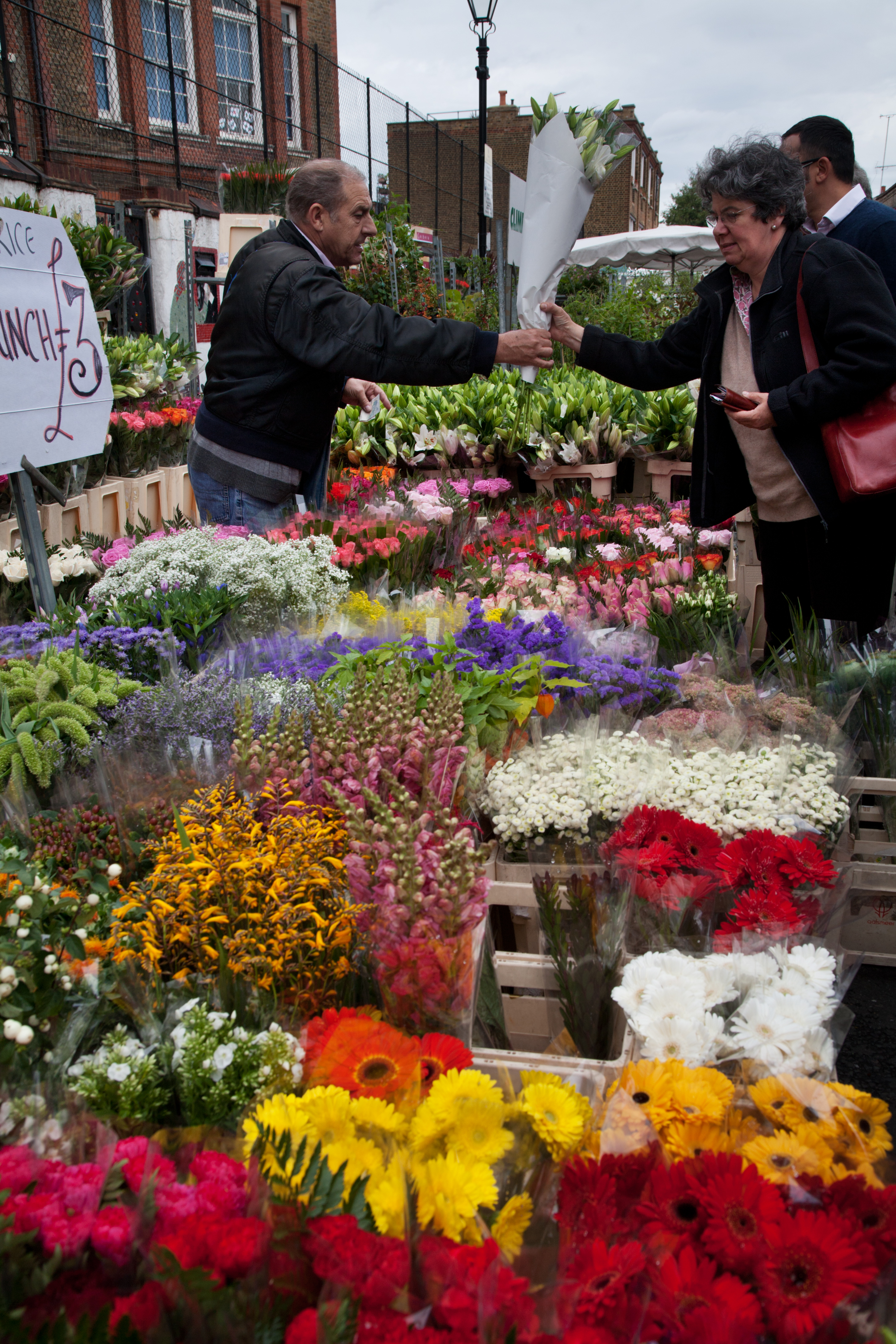
Columbia Road Flower Market
A Victorian-era flower market in Bethnal Green, founded as a philanthropic covered market in 1869 and now operating as a vibrant Sunday street market that has survived gentrification. The street is lined with independent shops and represents the creative, independent East End spirit at its heart.
Shoreditch isn't a museum of history—it's a living argument about reinvention. Over two hours, we're going to walk through layers of ambition, survival, and defiance stacked on top of each other like paint on a brick wall. We'll start where flowers prove that beauty and commerce can thrive in the same soil, then plunge into the street art that claimed these walls as territory. But here's the thing: the art wasn't made in a vacuum. It grew from the same impulse that brought garment workers here, then restaurants, then galleries. Every group that arrived in Shoreditch took what they found and made it theirs—sometimes with respect for what came before, sometimes by painting over it entirely. Today, we'll trace those layers forward and backward. You'll see a frozen Georgian townhouse, Victorian markets, a baroque church, and Brick Lane—where you can read a century of immigration in the storefronts alone. This walk asks you to hold two truths at once: that gentrification is real and troubling, and that Shoreditch's genius has always been its refusal to stay still.
Step onto Columbia Road on a Sunday morning and you'll understand why we're starting here. The air smells like earth and roses, the crowd is shoulder-to-shoulder, and you hear a dozen different accents haggling, laughing, asking for recommendations. This is colour. This is life. This is what the East End does best — it makes things, and it brings people together to celebrate them.
But the flower market didn't always look like this. In 1869, a woman called Angela Burdett-Coutts, who'd inherited £1.8 million — the equivalent of around £170 million today — decided to regenerate this neighbourhood. Before that money arrived, Columbia Road was a poverty-stricken slum. Burdett-Coutts built a covered market with 400 stalls, designed by architect Henry Darbishire. It was intended as a civic cathedral to commerce, a grand Victorian structure meant to lift the whole area up. You can still see the architectural ambition in the street around you, in the Victorian terraces and the painstaking detail of the shopfronts.
Here's what's interesting: the market only moved out onto the cobbled streets of Columbia Road itself in the late 19th century, and when it did, traders wanted to open on Sunday. But in those days, Sunday trading was literally illegal. It took an Act of Parliament — an actual law of the land — to change that, because the local Jewish traders needed the shop to operate on their day of rest. That's the kind of neighbourhood negotiation, community accommodation, and small acts of change that built the East End. It still happens here, just in different forms.
Look around at the shops you see. These are not chains. Flower stalls overflow onto the pavement, their buckets arranged by colour — reds bleeding into oranges, purples into blues. Independent shops flank the market: a vintage bookshop, a plant nursery, a cafe, a perfumery, independent fashion outlets. This is what gentrification looks like when the independent spirit fights back. These businesses haven't been swept away by property developers; they've adapted, survived, and become part of what makes the East End worth visiting.
The flower-selling tradition itself here goes back even further than Burdett-Coutts. Huguenot immigrants fleeing religious persecution in France after 1685 brought horticultural skills with them, and flower cultivation became an East End specialty. So when you're looking at these flowers today — the sunflowers, the dahlias, the seasonal blooms at five pounds a bunch — you're seeing the last thread of a 350-year immigrant heritage still alive on this street.
Notice how the market operates. It's a working market, not a museum. The traders know their stock. They'll tell you which roses will last longest in a vase, which ferns hate direct sunlight, whether those tulips will open or stay tight. There's no pretence here, no marketing waffle. It's commerce in its purest form: skill, judgment, and direct exchange between seller and buyer. This is what we mean when we say Shoreditch is a neighbourhood that makes things. It doesn't just sell flowers — it understands them. It doesn't just run a market — it's kept one alive through over a century of change.
As you move along the street, notice the conversation. People from this neighbourhood, tourists from other parts of London, international visitors, regulars who come every Sunday. The market is a gathering place, a social institution, and a working business all at once. It's chaotic, it's genuine, and it's the perfect entry point for understanding how the East End works: by keeping the old traditions alive while making space for new ones to grow alongside them.
When we get to Brick Lane in a few stops, you'll see another market, another kind of commerce, another layer of the East End's story. But here, at Columbia Road, you're seeing one of the oldest continuous traditions still operating — and that survival, against the odds, is the real art.
Whitby Street
That is stop one, in the walk itself. The remaining 8 stops, the map and the route between them open with one free account.
Continue the walkThe written walk is free.
Thank you! Your report has been submitted.
Report an issue
Help us improve by reporting any issues you notice.