St Katharine Docks
St Katharine Docks was built in 1828 by Thomas Telford as London's most innovative dock complex, demolishing 1,250 houses and a medieval hospital to create a basin for luxury goods like ivory, spices, and marble. Abandoned by the 1960s, its 1970s-80s regeneration into a marina and leisure space became the template for London's entire docklands transformation.
Welcome to St Katharine Docks, where we begin not with monuments, but with water. The Thames isn't just the river we'll follow today—it's the protagonist of London's story, a living character that has witnessed and shaped four centuries of human ambition. Where we stand now was once the beating heart of Victorian commerce: warehouses stacked with the empire's spoils, docks thrumming with industry and sweat. That era has been rewritten. What surrounds us is regeneration, not erasure—luxury apartments sit beside restored basins, glass and steel reflecting in water that once ran with coal dust.
Over the next two hours, we'll trace the Thames's autobiography through its most transformative miles. Medieval bridges, Elizabethan stages, Victorian engineering, modern galleries in converted power stations—the river has absorbed all of it, and carried it forward. By the time we reach our final stop, 135 metres above the water, you'll look back and see the entire walk suspended beneath you: the journey from industrial grit to cultural aspiration, all at once. The Thames doesn't forget its past. It simply keeps flowing.
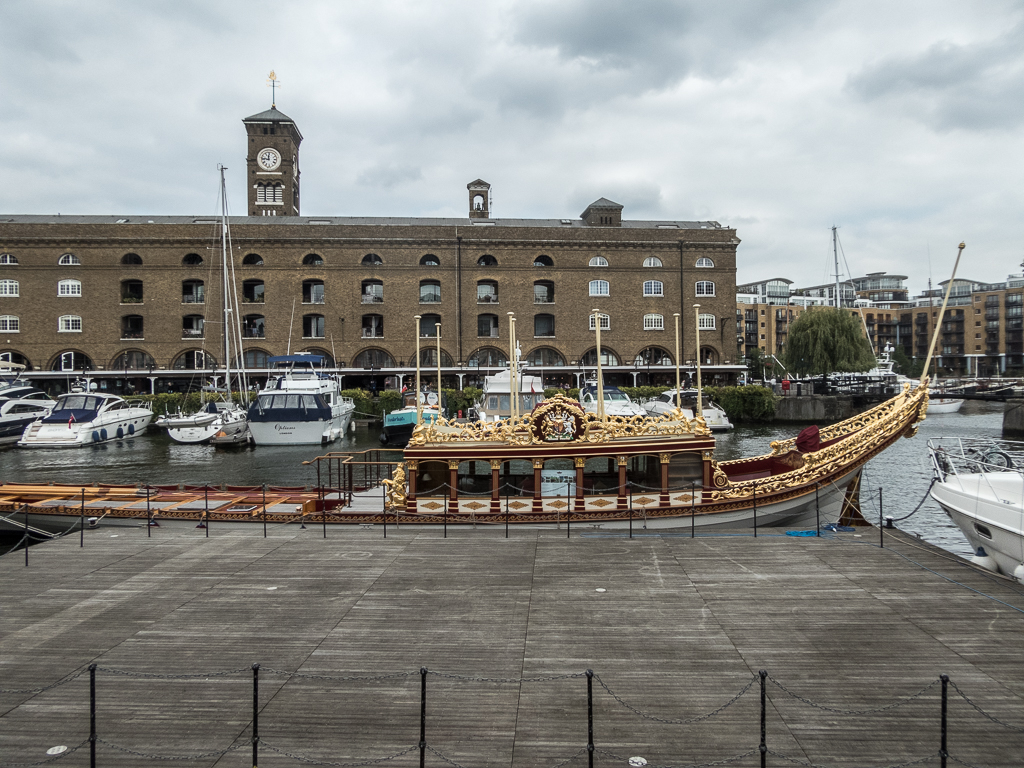
Stand here at the water's edge and you're looking at one of London's most elegant before-and-after stories. St Katharine Docks doesn't feel like a Victorian industrial site — it feels like someone's prize possession. The warehouses are red brick and limestone, their proportions generous, their windows tall and regular. The water itself is almost Mediterranean in character, with sailing boats tethered alongside cafés and restaurants. It's almost hard to square this genial scene with what you're actually looking at: the burial ground of an entire neighbourhood and the monument to one man's engineering ambition.
When Thomas Telford designed these docks in 1825, he was at the height of his powers. He'd built aqueducts in Wales, designed harbours in Scotland, and become the pre-eminent engineer of his age. But St Katharine Docks was his only major project in London, and he treated it like a problem to be solved with perfect logic. The problem was simple: how do you maximize quayside space in an impossibly cramped corner of London, right next to the Tower? How do you build a modern dock when every inch of land already belongs to someone?
His answer was radical. Instead of spreading the docks across acres, he concentrated them into two linked basins accessed by a single lock from the Thames. The warehouses — designed by the architect Philip Hardwick — were built right on the quayside itself, so goods could be unloaded directly from ship to storage. No cartage, no middlemen, no time wasted. It was efficient, it was elegant, and it required erasing an entire precinct to do it. Telford's design meant that spices from the East Indies could move from ship to warehouse in minutes. It was a system designed for speed and profit.
The cost in human terms was staggering. Around 11,300 people lived here, mostly port workers crammed into unsanitary slums. When the act of Parliament was passed in 1825, demolition began. The houses came down. The medieval hospital of St Katharine — the docks took its name — came down. The construction began in May 1827 and finished in October 1828. Less than two years to unmake a world. The displaced residents received nothing. Only property owners were compensated. For working families, this was simply erasure.
And here's the thing: despite being brilliantly designed, the docks never became the goldmine their backers expected. They couldn't accommodate the really large ships that began to dominate international trade in the later nineteenth century. By the 1960s, St Katharine Docks had become just another piece of derelict riverside — competition from newer, deeper docks downstream had rendered it obsolete. The warehouses stood empty. The basins stagnated. The vision of perfect efficiency had simply been superseded by bigger, faster progress.
But that obsolescence turned out to be a gift. In the 1970s and 80s, when London began rethinking its relationship with its own river, St Katharine Docks became the template for regeneration. The warehouses, instead of being demolished, were converted into offices, flats, and restaurants. The basins, instead of being filled in, became a marina. The space worked not because it was useful to commerce anymore, but because it was beautiful and accessible. It proved something that would transform London's whole relationship with water: a derelict dock could be reborn as an asset, not a liability. History could be preserved instead of erased.
Look at the boats reflected in the water. Look at the people sitting outside with coffee and newspapers. Look at the way the light catches the brick. This is what Telford couldn't have imagined when he was optimizing for spices and ivory. He built a machine for moving goods. We've inherited a plaza for living in. The warehouses still stand. The basins still hold water. But everything they mean has changed.
As you move forward on this tour, you'll see this pattern repeat. Tate Modern, downstream, started as a power station — another Victorian industrial monument that became irrelevant and then invaluable when London learned to see it differently. But St Katharine Docks came first. It's the story that made the others possible. And it happened because a neighbourhood that couldn't protect itself from being erased ended up accidentally protecting something far more valuable: the idea that the Thames doesn't belong to cargo anymore. It belongs to the city.
Tower Bridge
That is stop one, in the walk itself. The remaining 10 stops, the map and the route between them open with one free account.
Continue the walkThe written walk is free.
Thank you! Your report has been submitted.
Report an issue
Help us improve by reporting any issues you notice.