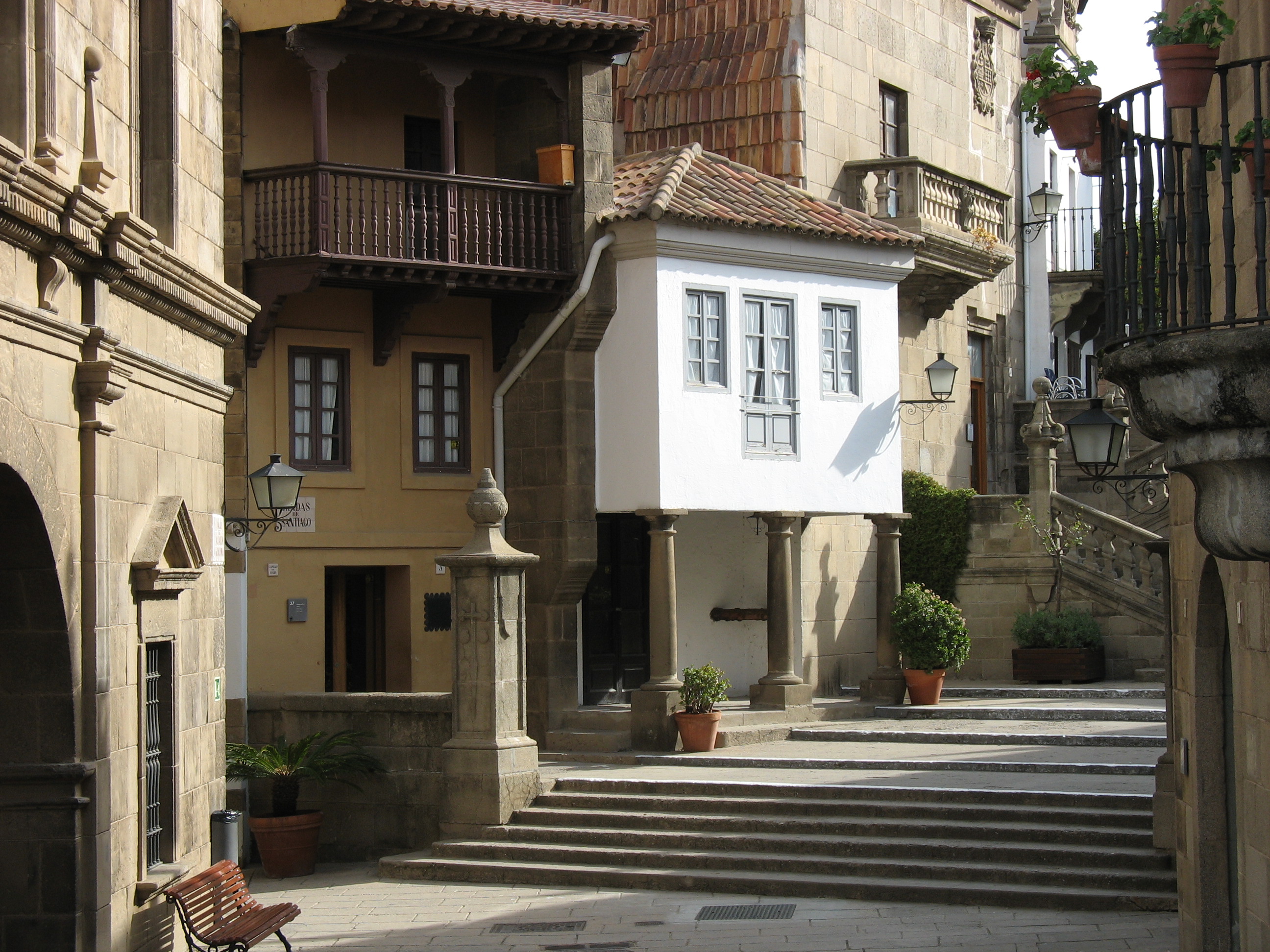
Poble Espanyol
A 1929 Exhibition set piece of 117 buildings representing Spanish regional architecture — designed to be temporary, still standing nearly 100 years later.
You're about to climb a mountain that contains everything Barcelona is — its vanity and its vision, its cruelty and its art, its need to perform for the world and its inability to face what it's done.
Montjuïc rises 173 metres above the port. It's not a big mountain. But what this hill holds is staggering. Two World Exhibitions, an Olympic Games, one of the greatest medieval art collections on Earth, a museum dedicated to Joan Miró, a Greek theatre carved from a quarry, a cactus garden that shouldn't exist at this latitude, and a fortress where the elected president of Catalonia was executed by firing squad.
All of that. On one hill.
We're going to walk from the base to the summit, starting with the spectacle — the 1929 Exhibition buildings that turned this hill into a stage — and climbing through art, sport, and theatre until we reach the castle at the top, where beauty and shame share the same view. Then we'll come back down through a garden that grows impossible things.
Montjuïc means different things to different people. For tourists, it's the view. For architects, it's Mies van der Rohe. For athletes, it's 1992. For Catalans, it's where Lluís Companys died. This tour holds all of those things together, because the mountain does.
Let's climb.
You're standing in front of something that was supposed to be demolished. In 1929, Francesc Folguera and Ramon Reventós designed this space as the Spanish village for the International Exhibition — a collection of 117 buildings reproducing architecture from every region of Spain. Not adapted, not interpreted: reproduced. The architects worked with the artists Xavier Nogués and Miquel Utrillo to get the details right, to make this fake village feel authentic.
Now, think about what that means. You have Catalan farmhouses next to Andalusian white-washed cortijos next to Galician granite buildings — all compressed into this hillside, all built simultaneously, all meant to disappear after the Exhibition closed. The audacity of it is staggering. This isn't a museum. This isn't even really architecture in the traditional sense. It's a stage set that became permanent.
Walk for a moment and look at the facades. The builders of Poble Espanyol weren't cutting corners. They brought authentic materials from across Spain — the limestone from one region, the slate from another. They studied the original buildings carefully. Folguera had already designed the main cathedral for the Exhibition, and Reventós understood how to create spatial coherence on a steep hillside. Together with Nogués and Utrillo, they were essentially curating a three-dimensional encyclopedia of Spanish building traditions, ordered by geography and roofline.
The Exhibition itself opened in May 1929, meant to celebrate Spain's modernity and cultural richness — right at the moment when that modernity was becoming increasingly fragile. Three weeks before the Exhibition opened, the stock market crashed in New York. Within seven years, the Civil War would begin. But by then, people had fallen in love with Poble Espanyol. It was unexpected, immersive, democratic in its own strange way. Everyone's region was here. Everyone could see themselves reflected in these reproduced facades.
So it stayed. The architects who were tasked with closing down the Exhibition after 1930 found themselves unable to demolish something that had become beloved. And it's never really stopped being what it was: a performance masquerading as a permanent place. Today you'll find artisan workshops inside these reproduced buildings — ceramicists, weavers, glassblowers — continuing the tradition of Poble Espanyol as a space where craft and spectacle intersect. The work inside is genuine craft. The buildings are real structures, even if they're copies. The distinction has become meaningless.
What Folguera and Reventós created was something that tourist guides usually avoid discussing too carefully. It's kitsch, yes — deliberately so. But it's also a preservation project. These reproductions document Spanish vernacular architecture the way it existed in 1929. Some of these original buildings would later be destroyed or radically altered. Poble Espanyol preserved them, frozen in amber, like insects in a museum case.
Notice as you walk through that these aren't cheap reproductions. The artisans understood their source material. The stone patterns match the originals. The proportions are correct. You're not looking at a theme park — you're looking at an architecture exhibition masquerading as a village, which then became a permanent fixture, and finally became real simply by virtue of remaining.
This is where Barcelona's Montjuïc begins to show you its essential character: a mountain where spectacle and substance, permanence and performance, have become indistinguishable.
Mies van der Rohe Pavilion
That is stop one, in the walk itself. The remaining 7 stops, the map and the route between them open with one free account.
Continue the walkThe written walk is free.
Thank you! Your report has been submitted.
Report an issue
Help us improve by reporting any issues you notice.