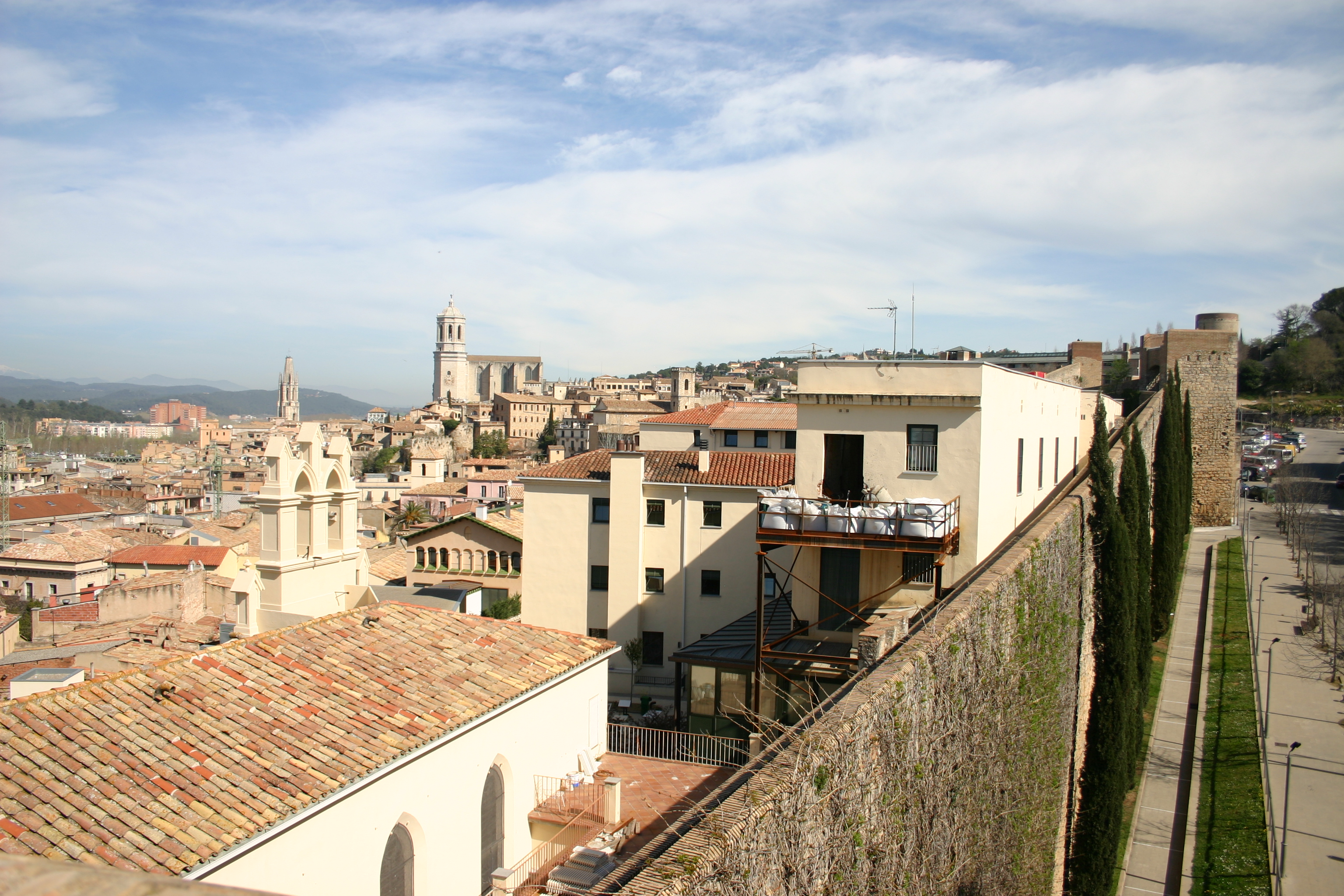
Cannon Scars — Passeig de la Muralla North
The medieval stone walls of Girona still bear the pockmarks and gouges of French cannon fire from the 1809 siege. Over seven months, 40 French gun batteries fired 20,000 explosive shells and 60,000 cannonballs at these fortifications, gouging the stone and exposing the vulnerability of walls that had not been modernized for a century.
Welcome to Girona in 1809. In a few moments, you'll stand where 5,700 defenders and 13,000 civilians faced down 35,000 of Napoleon's finest troops. For seven months, this small city refused to break. The Grande Armée—the most feared military force in Europe—laid siege to these walls, and Girona held. The cannons thundered. The walls crumbled. People starved. Yet the city never surrendered on its own terms.
Over the next 100 minutes, we'll walk 1.07 kilometers through Girona's old town, following the scars of that siege. You'll climb the walls, see where cannonballs struck stone, and stand at the places where ordinary people made extraordinary choices. The path is moderate—stairs and wall walking—but the story is unforgettable. The walls you're about to touch still carry their wounds. These aren't just stones. They're witnesses.
Put your hand on the stone. Feel it. The pocks and gouges you're touching are real damage — not painted reproductions, not artist's imaginings. This is what 20,000 explosive shells and 60,000 cannonballs do to medieval stone.
You are standing on the walls that held Napoleon's Grande Armée at bay for seven months. From May 1809 to December 1809, 35,000 French and Westphalian troops threw everything they had at this small city. Against them stood 5,700 Spanish soldiers and 13,000 civilians trapped inside. The numbers don't lie: Girona was mathematically, logistically, overwhelmingly outmatched. And yet it refused to surrender.
This wasn't Girona's first fight. The Peninsular War had already ravaged Spain for a year before the French general Louis-Gabriel Suchet brought his forces here in May 1809. Earlier sieges in 1808 had tested these walls, but the third siege — the one that scarred the stones beneath your fingers — was something else entirely. This was siege warfare at industrial scale. This was Napoleon's military machine at full, grinding intensity.
Commander Álvarez knew what he faced. He knew the walls around him were relics — they hadn't been seriously upgraded since the War of the Spanish Succession, more than a hundred years earlier. Medieval fortifications designed to withstand medieval siege engines. Against what? Against field artillery that could punch through stone from a quarter-mile away. Against a French army that didn't negotiate.
Saint-Cyr, the French commander, methodically arranged 40 gun batteries in an arc around the city. Forty. Not a handful of cannons — forty artillery positions, each one carefully sited to rake the walls with overlapping fire. Night and day, for seven months, those batteries hammered. The stone walls couldn't support heavy guns of their own — they were too thin, built for a different era of warfare. So Girona had to absorb punishment it could barely return.
Look at the damage pattern. See how some scars go deep? Those came from explosive shells — Saint-Cyr's artillery was modern, capable of lobbing shells that detonated on impact or after penetrating the stone. Other marks are shallower — cannonballs that ricocheted or hit at an angle. By August, the bombardment had succeeded in creating four separate breaches in the main walls. The defenders had to rush to repair them, knowing more fire was coming. Always more fire.
But look harder. Despite the scars, the walls still stand. These stones held. They're broken, yes. Wounded, absolutely. But still upright. That's what you need to understand standing here: the medieval walls that the French thought would crumble in weeks instead endured seven months of relentless artillery assault. The thin medieval stone that Álvarez knew was inadequate somehow — somehow — remained a barrier that could not be finally, fatally breached.
That tower you'll see just ahead took the worst of it. You'll recognize it by the damage. But first, understand this: what you're seeing here, these scars, they're not random. They represent strategy, calculation, desperation. French gunners knew exactly where to aim. Girona's defenders knew exactly what would happen if those walls came down. And the civilian population inside — the 13,000 men, women, and children — they lived with the sound of artillery day after day after day, watching the stones that kept them alive slowly disintegrate.
The walls didn't fall. And neither did the city. That story — how Girona held when it should have broken, why it mattered, and what it cost — that's what these scars are here to tell you.
Torre Gironella — The Key Fortification
That is stop one, in the walk itself. The remaining 6 stops, the map and the route between them open with one free account.
Continue the walkThe written walk is free.
Thank you! Your report has been submitted.
Report an issue
Help us improve by reporting any issues you notice.