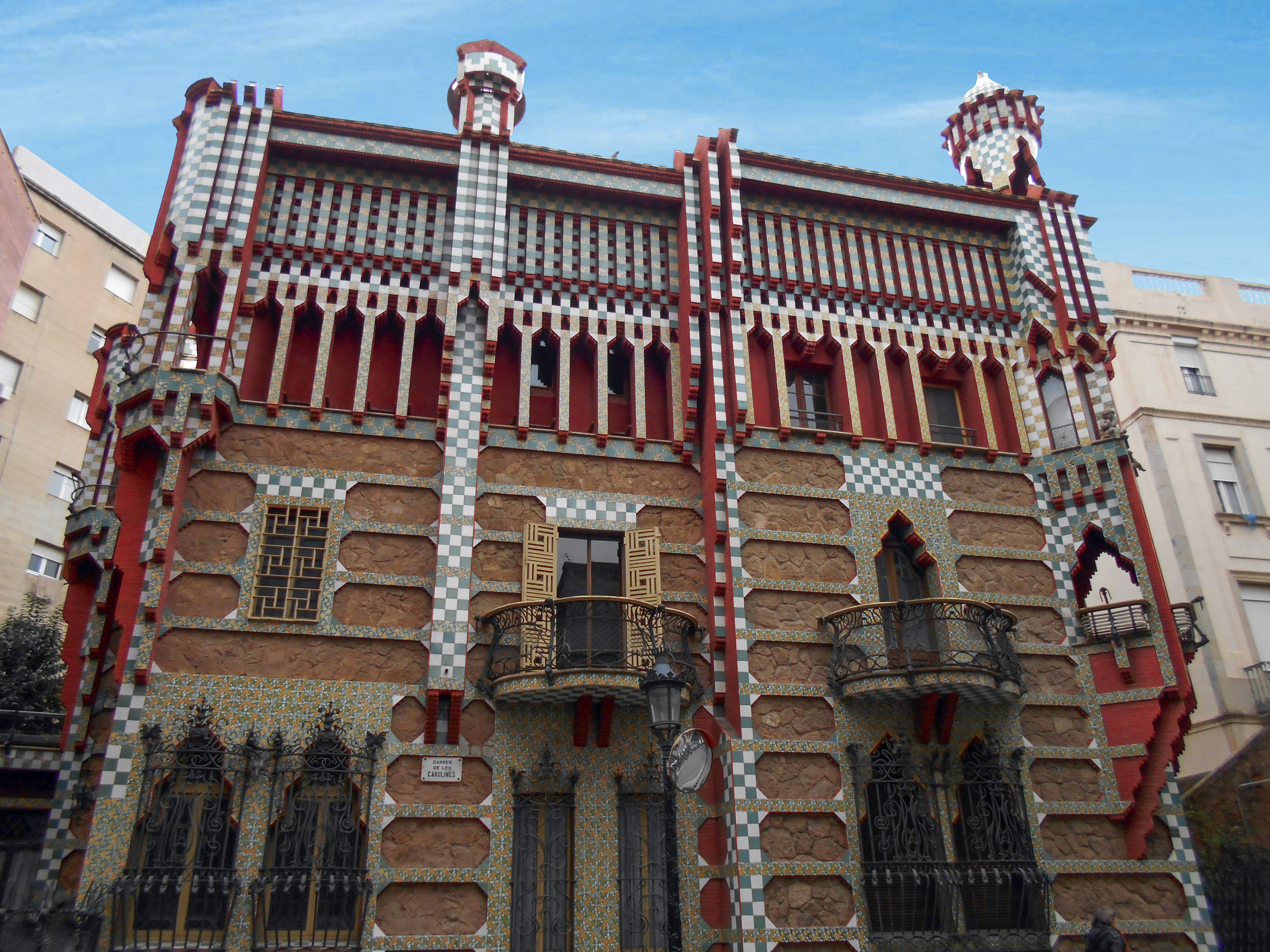
Casa Vicens
Gaudí's first major project (1883–1885) for Manuel Vicens, a summer house showcasing Moorish tiles, ironwork, and the architect's early genius.
I need to tell you something before we start. You're not in Barcelona right now. I know the map says Barcelona. I know you took the metro from Barcelona. But the neighbourhood you're standing in — Gràcia — is something different. Something older, prouder, and more stubborn than the city that swallowed it.
Until 1897, Gràcia was an independent town. Its own government, its own market, its own festivals, its own clock tower. Then Barcelona, expanding like a hungry amoeba, annexed it. Made it a district. Put it on the grid. And Gràcia said: fine. Call us whatever you want. We know who we are.
Over the next two hours, we're going to walk through a neighbourhood that still thinks of itself as a village. We'll start with a house that Gaudí built before anyone knew his name, wind through plazas where revolutions started and festivals still explode every August, pass a square made immortal by the greatest Catalan novel of the twentieth century, and climb to a park where a failed real estate project became one of the most visited places in Europe.
Gràcia is small, walkable, and full of opinions. Let's go.
Welcome to Casa Vicens. You're standing in front of Gaudí's first big commission—and it belongs to Gràcia, not Barcelona, no matter what the city centre claims.
Back in 1878, when Gràcia was still its own town, Manuel Vicens i Montaner—a stockbroker with good taste—asked a young Gaudí to design him a summer house. Gaudí was only 26. Nobody knew yet that he'd become famous. But look at what he created here between 1883 and 1885. This is the moment he found his voice.
See the chequered tiles? White and green ceramic. That's the Moorish influence—the orientalist style that nobody else was doing in Barcelona at that time. But here's what makes it distinctly Gaudí: those cast iron gates at the entrance. Look closely. Those aren't random decorations. They're palm leaves. Carnations. Gaudí didn't just copy Moorish patterns; he invented his own. He adapted natural forms into ornament. That's pure genius, and it happened right here in our neighbourhood.
The interior was revolutionary too. High ceilings, courtyards bringing in light, those decorative ceramic details continuing inside. When you tour the rooms—and you should—you'll see how he was already thinking about space and light in ways that would define his later masterpieces. Sagrada Familia, Park Güell, Casa Batlló... they all grew from ideas he tested here.
Here's what the rest of Barcelona conveniently forgets: when they built Eixample in the 1870s and 80s, they were making grids and straight lines. We in Gràcia? We were commissioning a 26-year-old genius to reimagine what a house could be. We recognised talent. We understood that architecture could be art.
Casa Vicens was declared a UNESCO World Heritage site in 1984. The building remained a private residence for 132 years—can you imagine?—until 2017, when it finally opened as a museum. Because even when Barcelona tried to absorb us into the city grid in 1897, this house stayed ours. It kept its character. It never compromised.
I don't live in Barcelona. I live in Gràcia. And Gràcia is where Gaudí's genius first bloomed.
Mercat de la Llibertat
That is stop one, in the walk itself. The remaining 8 stops, the map and the route between them open with one free account.
Continue the walkThe written walk is free.
Thank you! Your report has been submitted.
Report an issue
Help us improve by reporting any issues you notice.