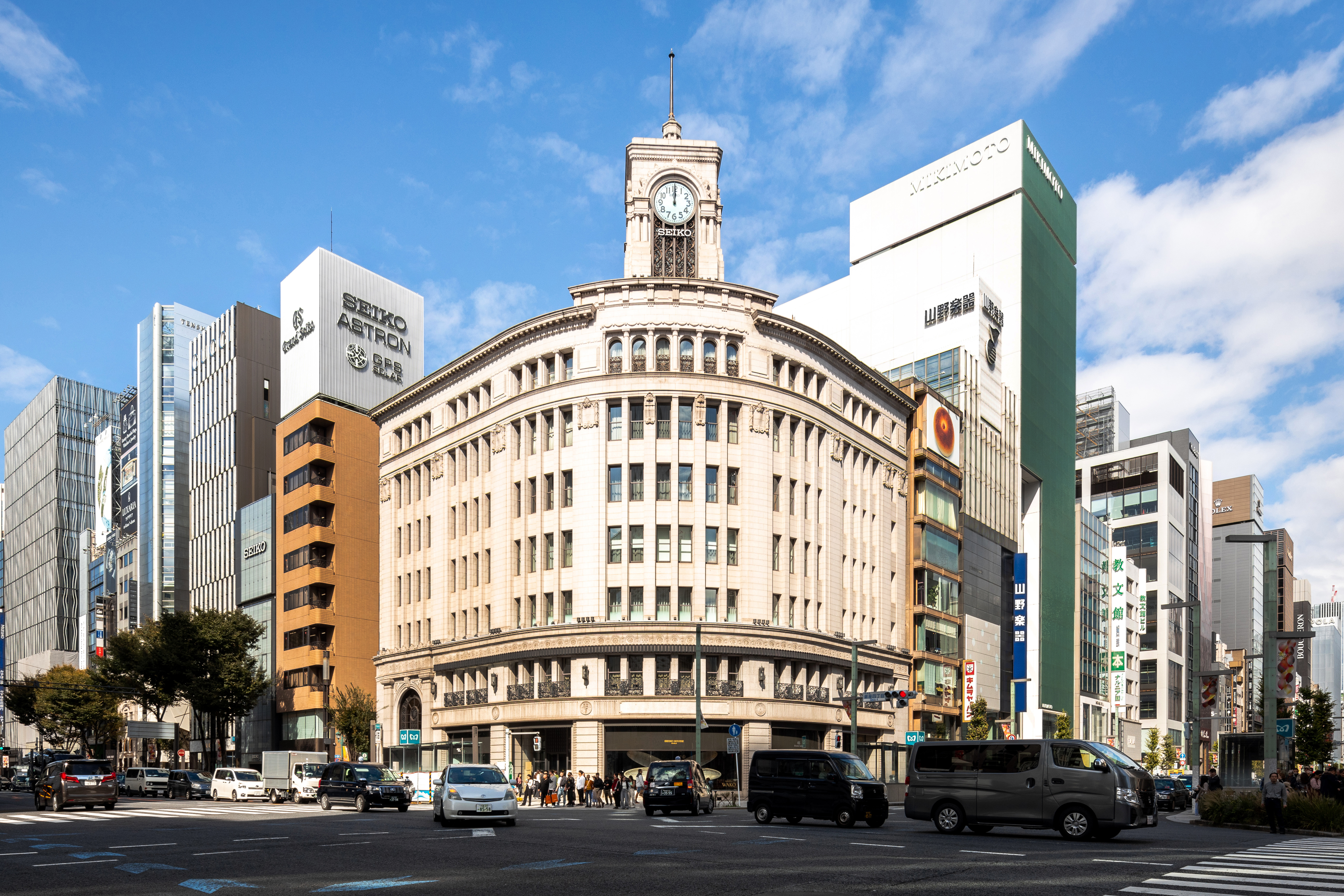
Ginza 4-chome Crossing & the Wako Clock Tower
A curved granite building on the Ginza 4-chome crossing carries a clock tower that has kept time here since 1894, survived the 1945 firebombing, and served as the US military's Tokyo PX during the Occupation before reopening as Wako in 1952.
You start where the money is. Ginza 4-chome is the crossing where two department-store corners face off across a junction that has spent more than a century being expensive, and you're about to walk it end to end at the pace of someone who isn't buying anything. That's the honest way to see a district built on the assumption that someone will. Give yourself about a hundred and ten minutes and four and a half kilometres, moving south and east, tracing how a strip of reclaimed shoreline turned into two completely different businesses that both live off the same harbour. One side sells scarcity: square metres priced like jewellery, brands that spend more on the shopfront than most companies spend on the product inside it. The other side gets up before dawn to move fish, in cash, at a scale that barely notices you watching. They read as opposites. They are closer to neighbours who stopped speaking. You'll end at a small railway relic in Shiodome, but the real destination is the gap between these two ways of pricing the same water. Start walking, and start counting.
Stand at the crossing and look up. The curved corner rising above the traffic belongs to Wako, and that clock has been telling Ginza what time it is for well over a century, in one form or another.
The first version went up in 1894. A watch-and-jewelry dealer named Kintaro Hattori had opened his shop on this exact corner, and rather than just sell clocks, he decided the neighbourhood needed one it could see from the street. He mounted a tower on the roof as a kind of civic gift, and for twenty-seven years, through the last of the Meiji era and into the Taisho years, that tower was how Ginza set its watches.
In 1921 Hattori tore it down to build something grander. It did not go smoothly. Two years into the rebuild, the Great Kanto earthquake flattened much of the surrounding city and the project stalled for the better part of a decade. The building you're looking at now, with its rounded facade and pale stone, wasn't finished until 1932, designed by the architect Jin Watanabe. By his own account the job nearly broke him — he kept a sketchbook by his pillow so he could draw the tower the moment he woke, unable to stop refining a model he'd already built a dozen times. Whatever it cost him, the chime that plays from up there every hour, the same Westminster pattern used on Big Ben, has been marking time on this corner ever since.
Except for seven years, when it wasn't a clock tower at all.
The building was one of the only structures left standing on this stretch after the air raids of 1945 burned most of central Tokyo to the ground — a fact that on its own would make this an unusual place to be standing. But when the Occupation authorities arrived, they didn't leave it as a monument. They requisitioned it outright and turned it into the Tokyo PX, the main department store for American servicemen and their families, stocked with goods most Japanese civilians couldn't buy anywhere else in the city. For seven years, Hattori's clock chimed over a shop selling Coca-Cola and cigarettes to soldiers, not watches to Ginza. The building wasn't handed back until April 1952, and it took until December of that year to reopen as a proper department store again, trading under the name it still carries: Wako.
That name is worth pausing on, because it's the last piece of the story and it explains a lot about what Ginza is. In 1947, in the reshuffling that followed the war, Hattori's company split its retail arm from its manufacturing arm. The shop under this clock became Wako. The workshops, which had been making movements under the Seikosha name since the 1890s, kept growing under a brand they'd launched in the 1920s: Seiko. Different companies now, but one bloodline — every Seiko watch sold anywhere in the world traces back to this corner, to a jeweller who thought his neighbourhood deserved a clock it could set its life by.
That's really the whole tour in miniature: this bay has always been about turning attention into money, one way or another. Here it's a clock tower and a watch brand. Ten stops from now, at the other end of this walk, you'll find people making a living off something much less abstract than a Swiss-style movement — a fish.
Chuo-dori — the Bricktown Street
That is stop one, in the walk itself. The remaining 9 stops, the map and the route between them open with one free account.
Continue the walkThe written walk is free.
Thank you! Your report has been submitted.
Report an issue
Help us improve by reporting any issues you notice.