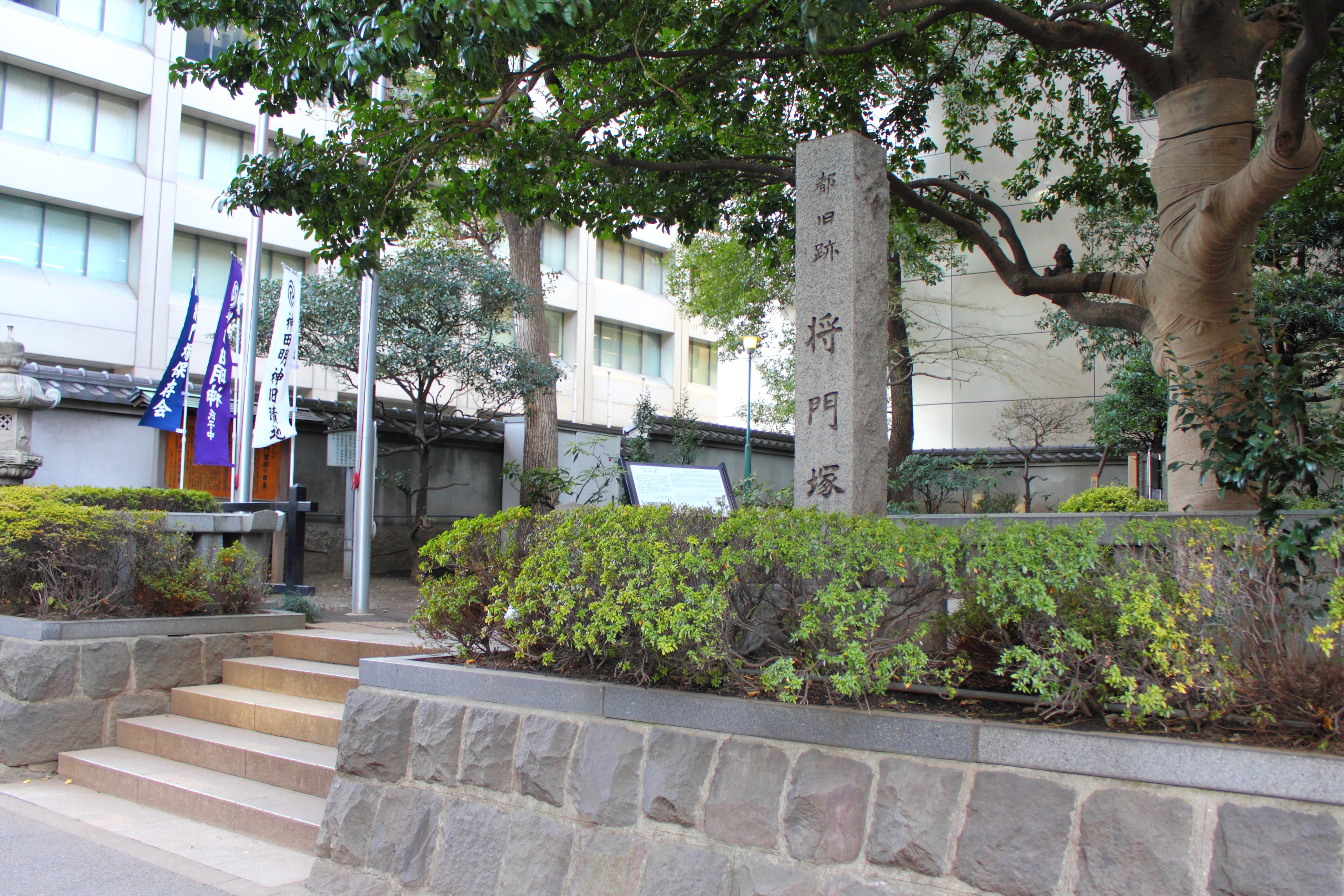
Masakado Kubizuka, the Head Mound
A small fenced grave in Otemachi's office district holds the head of Taira no Masakado, a tenth-century rebel lord, and has survived repeated 20th-century attempts to clear it.
Tokyo throws almost nothing away. Buildings, yes — the city rebuilds itself every generation, sometimes every decade. But certain things get kept, quietly, for centuries, wedged between office towers and train lines as if nobody quite dares to clear them out. This walk follows nine of them through Kanda, the district where the city's memory pools like water finding the low ground.
You start on the strangest piece of real estate in Tokyo — a patch of land so stubbornly untouchable that some of the country's biggest companies have built their headquarters around it rather than on it. You end, roughly two hours and four kilometers later, in the loudest district in the city, where neon, speaker announcements, and duty-free touts compete for your attention on every corner. The two places look like they belong to different planets. They don't. The connection between them is real, and you'll be able to trace it the whole way, through a university quarter, a mile of secondhand bookshops, and a black market that grew into an empire of electronics.
Bring headphones, comfortable shoes, and a willingness to believe this city remembers more than it lets on.
You're standing in front of one of the most expensive plots of ignored real estate in Japan. Land here in Otemachi trades for tens of millions of yen per square meter — bank headquarters, trading houses, a Four Seasons hotel all crowd around this fenced patch no bigger than a parking space. And in the middle of it: a grave, still here, because company after company that has tried to move it has regretted it.
The story starts nearly eleven hundred years ago, in the winter of 939 into 940. A regional lord named Taira no Masakado, angry at the abuses of the imperial court's tax collectors, did something almost nobody in Japanese history had dared: he crowned himself. He declared himself "shinno" — new emperor — carved out a breakaway state across the eastern provinces, and ruled it for about two months before the court's forces caught up with him. He was killed in battle near what's now Ibaraki in March 940, and his head was cut off and sent to Kyoto, where it was hung from a tree as a warning to the next man with ideas above his station.
Here's where the story stops being ordinary history. Legend says the head didn't rot the way a severed head should. After months on display, its eyes reportedly opened. It began cursing the men who killed it. Then — and this is the part every version agrees on, however you want to take it — it lifted off the tree and flew east, back toward home, glowing, trailing plague and misfortune wherever its shadow crossed. It came down here, in what was then a fishing hamlet called Shibasaki, centuries before anyone called this place Edo or Tokyo. The villagers who found it did what you'd do with a god's discarded anger: they washed it, and they buried it, carefully, under a mound.
For most of the centuries since, that would have been the end of it — just a local shrine mound, tended and mostly forgotten. What makes this stop worth five minutes of your walk isn't the legend. It's what's actually recorded happening to the people who tried to clear it.
In 1923, the Great Kanto earthquake cracked and scorched the mound. The Ministry of Finance, rebuilding the district, decided this was the moment to finally level it and put up a temporary office block instead. Within two years, fourteen people connected to that building were dead, including the finance minister himself, alongside a string of unexplained accidents and injuries among the staff. Nobody built there again. After the war, the American occupation authorities drew up plans to clear the same block for redevelopment. During the work, a bulldozer assigned to flatten the site flipped over; the driver was thrown out and killed. That project was abandoned too. Twice in the twentieth century — with modern equipment and no interest whatsoever in tenth-century curses — the job simply didn't get finished.
What you're looking at now is the sixth restoration of this mound since 1961, completed in 2021 as part of the office tower redevelopment right behind it — the developers this time built around the grave rather than through it. It's spare: a low stone marker, fresh gravel, a tidy fence, flowers replaced on a schedule by a preservation society funded by the surrounding companies. For decades, the more visible tenants here were stone frogs — kaeru, which in Japanese means both "frog" and "to return" — left by office workers transferred to failing branches or heading out on business trips, quietly asking to come home safely. Since the renovation, that offering custom has been retired along with the old signage; the frogs have been moved off-site to keep the mound uncluttered, though the pun, and the impulse behind it, is the whole reason they were ever here.
Which is really the thread of this entire walk: Kanda is the part of Tokyo that cannot bring itself to throw anything away — not books, not gods, not even a thousand-year-old grudge sitting on land worth more than the building around it. Keep that in mind, because the man buried under your feet gets worshipped as a full-fledged god about two kilometers from here, and that's where this walk is headed.
Kamakura-bashi Bullet Marks
That is stop one, in the walk itself. The remaining 8 stops, the map and the route between them open with one free account.
Continue the walkThe written walk is free.
Thank you! Your report has been submitted.
Report an issue
Help us improve by reporting any issues you notice.