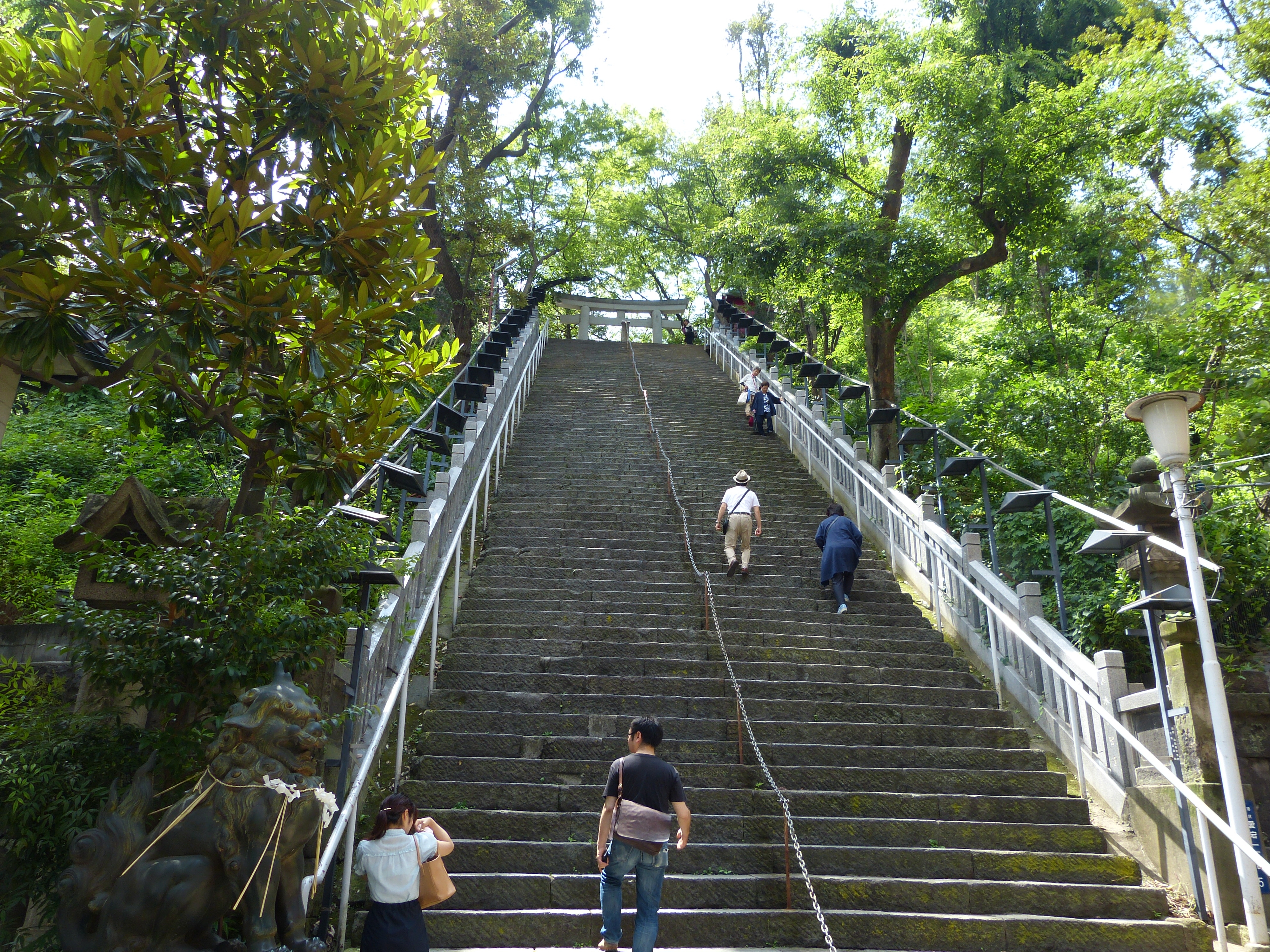
Atago Shrine's "Success Stairs" (Otoko-zaka)
The 86-step stone staircase up Atago Hill, pitched at roughly 40 degrees, which Tokyo has called the "Success Stairs" since a Marugame retainer named Magaki Heikuro is said to have ridden a horse up it in 1634 to fetch plum blossoms for the shogun Iemitsu. The gentler 109-step onna-zaka runs alongside it, and a free public elevator at the foot of the hill offers step-free access to shrine level.
Stand at the bottom and look up before you do anything else. Eighty-six stone steps, pitched at something close to forty degrees, rising about seventeen metres into a wall of green. Each step is only about twenty centimetres high, which sounds gentle until you notice how little room that leaves for the tread. From here the staircase does not look like architecture. It looks like a mistake somebody made and then decided to keep.
Tokyo has called it the Success Stairs for nearly four hundred years, and the reason is a horse.
The story goes like this. In 1634, the third shogun, Tokugawa Iemitsu, was passing below this hill on his way back from the family temple down the road. He looked up, saw the plum trees at the top in full white bloom, and did the thing powerful men do when they are pleased with a view: he asked for it. Someone should ride up, he said, and bring me a branch. His retainers looked at these steps. Then they looked at their horses. Then they looked at the ground. Nobody moved. And out of that silence rode a retainer of the Marugame domain in Shikoku named Magaki Heikuro, who went up, picked the plum, came back down, and handed it over. Iemitsu called him the finest horseman in Japan on the spot, and Heikuro, who had begun the morning as nobody in particular, ended it famous.
Be a little careful with that story. It reaches us mainly through kodan, Japan's tradition of professional storytelling, in a set piece called "Kan'ei Sanbajutsu" — the three horsemen of the Kan'ei era. Which is to say it has been polished by people whose job was to make you lean forward. Whether it happened exactly so, the steps in front of you are real, and generations of Japanese office workers have climbed them before a job interview on the theory that it cannot hurt.
Here is the part the legend leaves out, and it is my favourite part. Only three people are recorded as having repeated the feat since. A trick rider called Ishikawa Seima did it in the Meiji era. In 1925 an army groom named Iwaki Toshio rode a military horse up in about one minute. And in 1982 a stuntman, Watanabe Ryuma, went up in thirty-two seconds for a television programme. The ascent, in other words, is showy but survivable. The descent is the problem. Iwaki's horse, having gone up in a minute, needed roughly forty-five minutes to get back down. A horse can be persuaded to charge at something. It cannot be persuaded that a forty-degree drop is a floor. Anyone who has ever taken a promotion and then discovered what the job actually involves will recognise the shape of this.
Now look to your left. Running alongside is the onna-zaka, the women's slope — 109 steps, longer and considerably kinder, against this one, the otoko-zaka, the men's slope. The names are Edo-period habit rather than instruction; nobody is checking. The whole approach, both slopes included, is a registered cultural property of Minato City.
And if stairs are not happening today, they genuinely do not need to. At the foot of the hill, beside the road tunnel that runs underneath us, there is a free public elevator that takes you straight up to shrine level. No ticket, no asking permission. The paths at the top are gravel in places, so it is not flawless, but it is step-free, and you will arrive at exactly the same spot the rest of us arrive at, only without the sweating. Take it and rejoin us at the top. This is the only real climb on the whole walk — everything after this point descends, gently, toward the flat city.
Which is the thread of this tour, and it starts here. Down there, in the low city, Edo was burned and rebuilt and burned and rebuilt until almost nothing of it is legible. Up here on the hills, it survived in the three things that are hardest to move: slopes, gates and graves. You are standing on the first of them.
One more thing before you climb. This is a walk about what people will do to be remembered well — a man on a staircase, a dynasty in stone. It ends across the district with forty-seven men who took that question further than anyone should have to.
Atago Shrine Summit
That is stop one, in the walk itself. The remaining 7 stops, the map and the route between them open with one free account.
Continue the walkThe written walk is free.
Thank you! Your report has been submitted.
Report an issue
Help us improve by reporting any issues you notice.