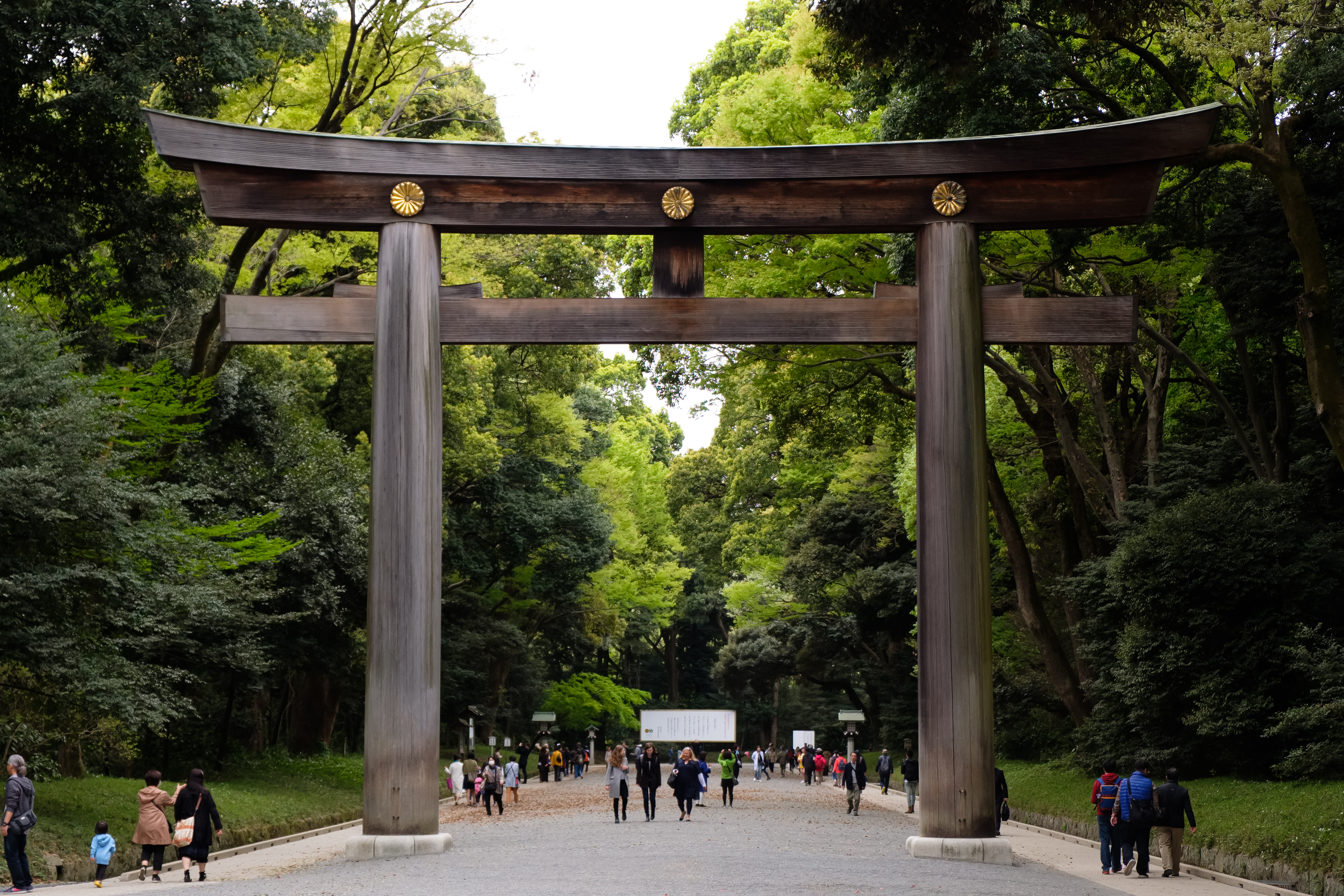
Meiji Jingu Otorii (Grand Torii)
The Otorii is the largest wooden myojin-style torii in Japan (the type with an upswept curved top beam), 12 metres tall and 17.1 metres wide, with cypress pillars 1.2 metres in diameter. Raised on 23 December 1975 after lightning struck the 1920 original in 1966, it was cut from a roughly 1,500-year-old cypress found on Mount Danda in Taiwan.
Stand back a few metres and look up. Twelve metres tall, seventeen metres across, two cypress pillars over a metre thick each, thirteen tonnes of timber standing on gravel. This is the Otorii, the largest wooden torii in Japan of the myojin type — the kind with a curved, upswept top beam rather than a straight one — and the first question worth asking is the one nobody asks: why is it exactly this big? Not bigger, not smaller. The answer is standing behind it, and it is not made of wood beams.
Notice first what is missing. No vermilion paint, no carving, no doors, no hinges, no lock. A torii is a threshold, not a gate you can close. It marks where ordinary ground stops and the shrine's ground begins, and because it has nothing to shut and nothing to decorate, the only thing it has to work with is scale. It has to feel like a change of register. Under a low canopy a small gate would do it. Here it takes twelve metres, and that is a measurement someone took off the trees.
The timber is the good story. The first Otorii went up in 1920 from a 1,200-year-old cypress felled in Taiwan's Alishan range. In July 1966 lightning hit it. Replacing it meant finding another tree of that class, and there was nothing left in Japan anywhere near big enough or old enough. The search moved to Taiwan and stalled for years, until a Tokyo timber merchant, who had vowed to help rebuild the gate in thanks for his own good fortune, went up Mount Danda, at around 3,300 metres, and found a cypress roughly 1,500 years old. The tree came into Tokyo Bay by ship in 1971, was trailered across the city, and was soaked in the shrine's north pond before anyone was allowed to cut it. The gate you are standing under was raised on 23 December 1975.
That errand cannot be repeated. Taiwan banned logging in its natural state forests in the 1990s, so when the shrine replaced its first torii in 2022, back down the path behind you, the wood came from Japanese cedar instead, two trunks of about 280 and 260 years. Old, but a fraction of the age. This gate is the last of its kind for reasons of supply, not taste.
So here is the thread for the next two hours, stated plainly once and then left to do its own work: on this walk, every structure is arguing with the trees. This one lost the argument politely, agreeing to be exactly as tall as something behind it demands and not a centimetre taller. And the very last building on the walk, the newest thing we will see, answers with wood and bamboo, which is to say it agrees with this gate.
Two practical things. There is an etiquette here that almost every visitor walks straight past: bow once, briefly, before you step through, and keep off the centre of the path. The middle lane is the kami's. Locals drift left or right without thinking about it.
And the approach is long. It is another five minutes or so of deep gravel from here to the main shrine, on top of the approach you have already walked, and it is slow going in thin soles. Eleven stops, close to five kilometres on the ground, roughly two hours, and best done in daylight, when the glass buildings later on are actually doing something. The whole of this walk is free and outdoors, so we skip the ticketed Inner Garden and Treasure Museum, and later we stop at the Nezu Museum's forecourt rather than paying in.
Meiji Jingu Main Shrine
That is stop one, in the walk itself. The remaining 10 stops, the map and the route between them open with one free account.
Continue the walkThe written walk is free.
Thank you! Your report has been submitted.
Report an issue
Help us improve by reporting any issues you notice.