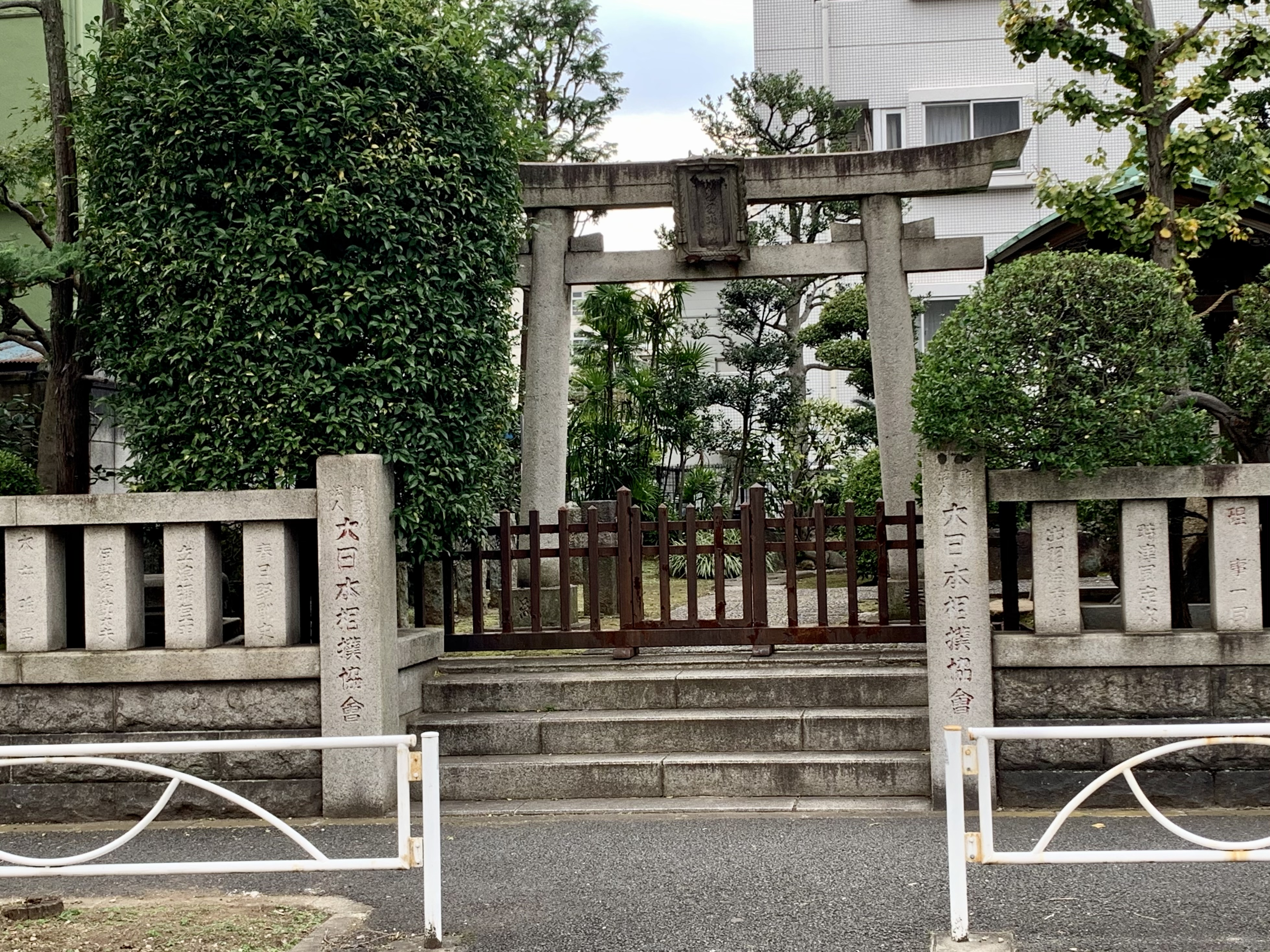
Nomi-no-Sukune Shrine
A small, unstaffed shrine to Nomi no Sukune, the legendary founder of sumo, founded in 1885 on the site of a former daimyo's Edo residence and still visited by the Japan Sumo Association before every Tokyo tournament.
Ryogoku sits on the east bank of the Sumida river, a district that has always done different work than the rest of Tokyo. This walk starts among sumo, in the streets where wrestlers still train each morning before most of the city is awake, and moves on through the old grid of Edo-era lanes. From there it turns to one of Japan's most famous stories of loyalty and revenge, a vendetta carried out patiently over years and settled not far from here. The walk stays flat throughout, about four kilometres over roughly a hundred minutes, nine stops in total, finishing on a bridge over the river.
One thing to know before you start: the second half of this route deals directly with two mass-casualty disasters in Tokyo's history, the 1923 earthquake and fire and the 1945 air raids, and it ends at a memorial that holds the dead of both. That isn't the tone of the whole walk, but it is where the walk ends, so it's worth knowing going in.
Start here, among the wrestlers, and let the district take you where it wants.
You're standing in front of a shrine you could walk past without noticing — no vermilion gate looming over the street, no crowd, just a modest enclosure set back behind a gate that's usually kept shut. That smallness is the point. This is Nomi-no-Sukune Shrine, and everyone who matters in professional sumo still comes here.
The story it keeps goes back to Japan's oldest written histories. In the Nihon Shoki, compiled in 720, Emperor Suinin heard that a strongman named Taima no Kehaya was boasting no one could beat him in a fight, so he sent for a man from Izumo, on the other side of the country, named Nomi no Sukune. The two grappled — kicking, striking, wrestling by whatever rules existed then, closer to a fight than a match — and Sukune broke Kehaya's ribs and hip, killing him. The emperor rewarded Sukune with Kehaya's land. Sumo has spent the fourteen centuries since treating that single brutal contest as its founding moment, and this is the only stop on this walk that tells it — everywhere else, you'll just hear Sukune's name in passing.
The shrine itself is far younger. It was founded in 1885, when the first Takasago Uragoro — head of a sumo stable that once stood right next door — obtained the site of a former daimyo's Edo residence, the Tsugaru family's, and set it aside to formalize sumo's link to its legendary ancestor. Look for the twin stone monuments standing in the small grounds: together they carry the name of every yokozuna sumo has ever promoted, from the very first, centuries ago, through to the wrestlers ranked today. The Japan Sumo Association keeps adding to them, which makes this modest patch of ground the sport's actual, physical record — more complete, in its narrow way, than any museum case could be.
It still functions, too, not just as history. When a wrestler is promoted to yokozuna, he performs a dedication ring-entering ceremony here before doing it in public. And before every Tokyo tournament begins, the Sumo Association's chairman and its head judges come to this shrine for a formal rite — not a photo opportunity, an actual ceremony, held at a site most tourists in Ryogoku never find.
That's the thread this whole walk is following: the east bank kept what the west bank paved over. Tokyo has torn itself down and rebuilt itself again and again, but sumo's governing body still treats this cramped, unstaffed shrine — not the enormous arena a few streets away — as the place where its authority actually starts.
Finding it takes a little attention. It sits along Hokusai-dori, set back with a parking gate that's normally closed, easy to walk straight past if you're not looking for it. From Exit A3 of the Oedo Line's Ryogoku Station, cross at the signal in front of the Edo-Tokyo Museum, continue straight, and it's on your right at the third traffic light.
From here, the Kokugikan — the arena itself — is about ten minutes on foot to the west, and that's where this walk goes next.
Ryogoku Kokugikan
That is stop one, in the walk itself. The remaining 8 stops, the map and the route between them open with one free account.
Continue the walkThe written walk is free.
Thank you! Your report has been submitted.
Report an issue
Help us improve by reporting any issues you notice.