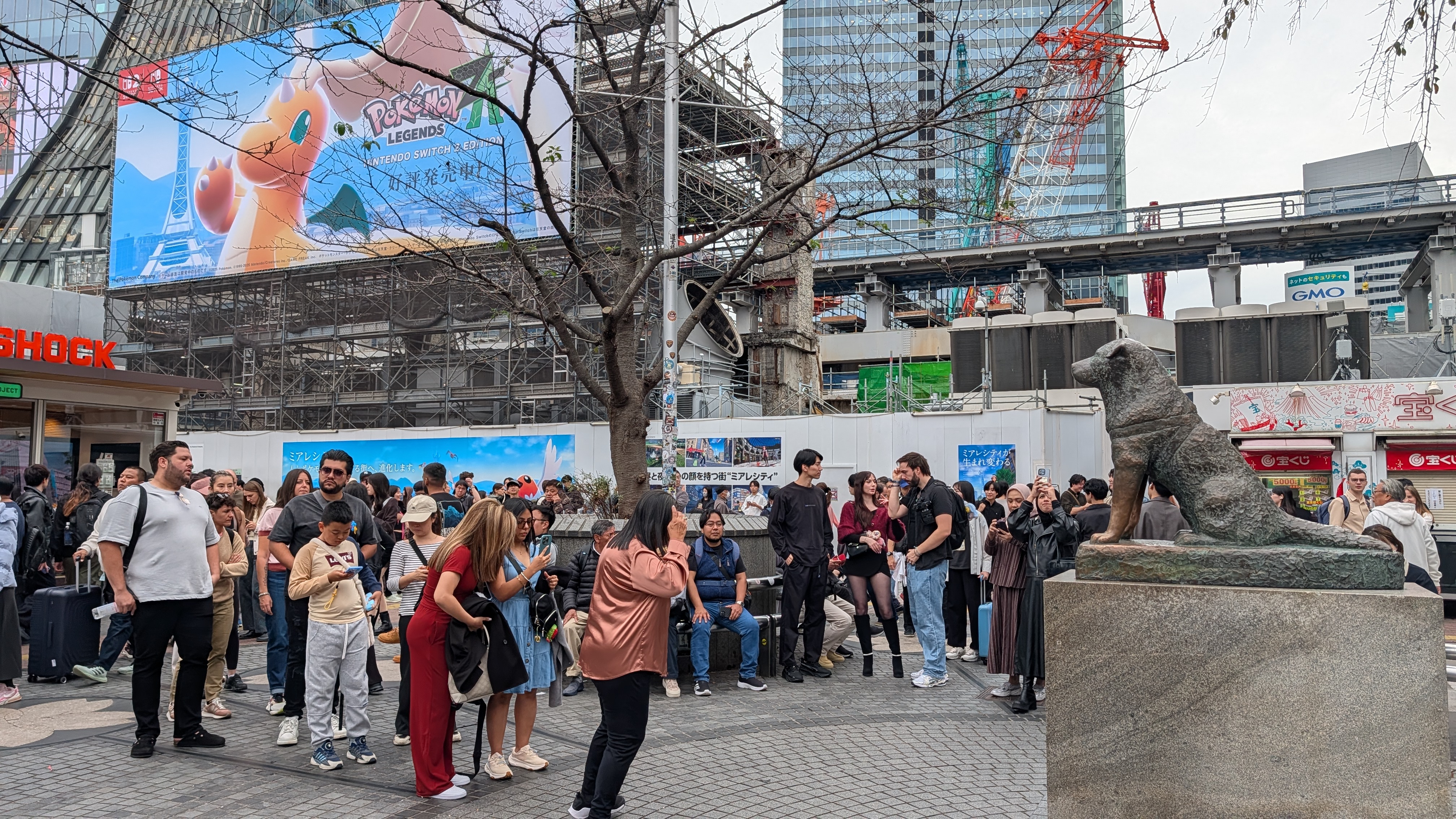
Hachiko Statue
The bronze Akita outside Shibuya Station's Hachiko exit, cast in 1948 to replace the 1934 original that Hachiko attended in person and that was melted down during the war. It stands at the low point of the plaza, where every street leaving the crossing runs uphill.
Before anything else, the shape of the day. Nine stops, about two kilometres, roughly seventy-five minutes. Every stop is free to reach and nothing needs booking. Two of them are indoors and upstairs — a rooftop park reached through a shopping centre, and a free eleventh-floor lobby with a lift — and the paid facilities up on that roof are optional and not part of this walk. Two short climbs, because this is a valley walk rather than a flat loop. All you need is shoes and a willingness to look at a very famous place sideways.
Now, the dog. There is almost certainly a queue for photographs, and that queue has been forming, in one shape or another, for ninety years.
Hachiko was an Akita, born near Odate in Akita Prefecture in November 1923 and brought to Tokyo as a puppy the following year by Hidesaburo Ueno, a professor of agricultural engineering at Tokyo Imperial University who lived a short walk from here. The routine was ordinary. Ueno went to work; Hachiko came down to the station in the evening to meet him. On the 21st of May 1925, Ueno had a cerebral haemorrhage at the university and died there. He never came home, and nobody could explain that to the dog.
Hachiko kept coming. Not for weeks, for nine years. He was passed around between relatives and former servants, shooed off by station staff, fed scraps by the yakitori sellers, and he kept turning up at the station around the hour the train came in. It only became a national story in October 1932, when Hirokichi Saito, founder of the Japanese dog preservation society, wrote him up in the Asahi Shimbun. Japan wept, and then Japan moved fast: a bronze was commissioned from the sculptor Teru Ando and unveiled on this spot in April 1934, with Hachiko himself present at his own unveiling, elderly and presumably baffled. He died on the 8th of March 1935. For decades people said a chicken skewer had killed him; a re-examination of his preserved organs in 2011 found terminal cancer and a heavy parasitic worm infection, plus four skewers in his stomach that had damaged nothing at all.
The statue you are looking at is not the one he attended. That bronze was stripped out and melted down for the war effort, and Teru Ando was killed in an air raid. In 1948 a society formed specifically to bring the dog back commissioned Ando's son, Takeshi, who rebuilt his father's work from photographs and memory. So the thing in front of you is a son's reconstruction of his father's portrait of a dog who waited. That is a lot of loyalty packed into one small bronze.
And now it functions as an address. Hachiko is where you tell someone to meet you when you cannot be bothered to explain anything further; the station exit behind you is officially the Hachiko exit; an entire city uses a dead Akita as a map coordinate.
Which brings us to why you are actually standing here. Turn slowly, all the way round, and look past the crowd at the streets leaving this plaza. Every one of them goes up. The road to the left climbs, the road opposite climbs, the lanes behind the station climb. You are standing at the bottom of a bowl, and bowls do not happen by accident in a city. Something carved this shape long before anyone laid a paving stone or bolted a screen to a building. That is the whole walk in one sentence: Shibuya is a valley pretending to be a city centre, and once you can see that, nothing about the district's shape is arbitrary. We finish, eight stops from here, at the one place in this district where you can stand and look straight at the thing it is built on.
Shibuya Scramble Crossing
That is stop one, in the walk itself. The remaining 8 stops, the map and the route between them open with one free account.
Continue the walkThe written walk is free.
Thank you! Your report has been submitted.
Report an issue
Help us improve by reporting any issues you notice.