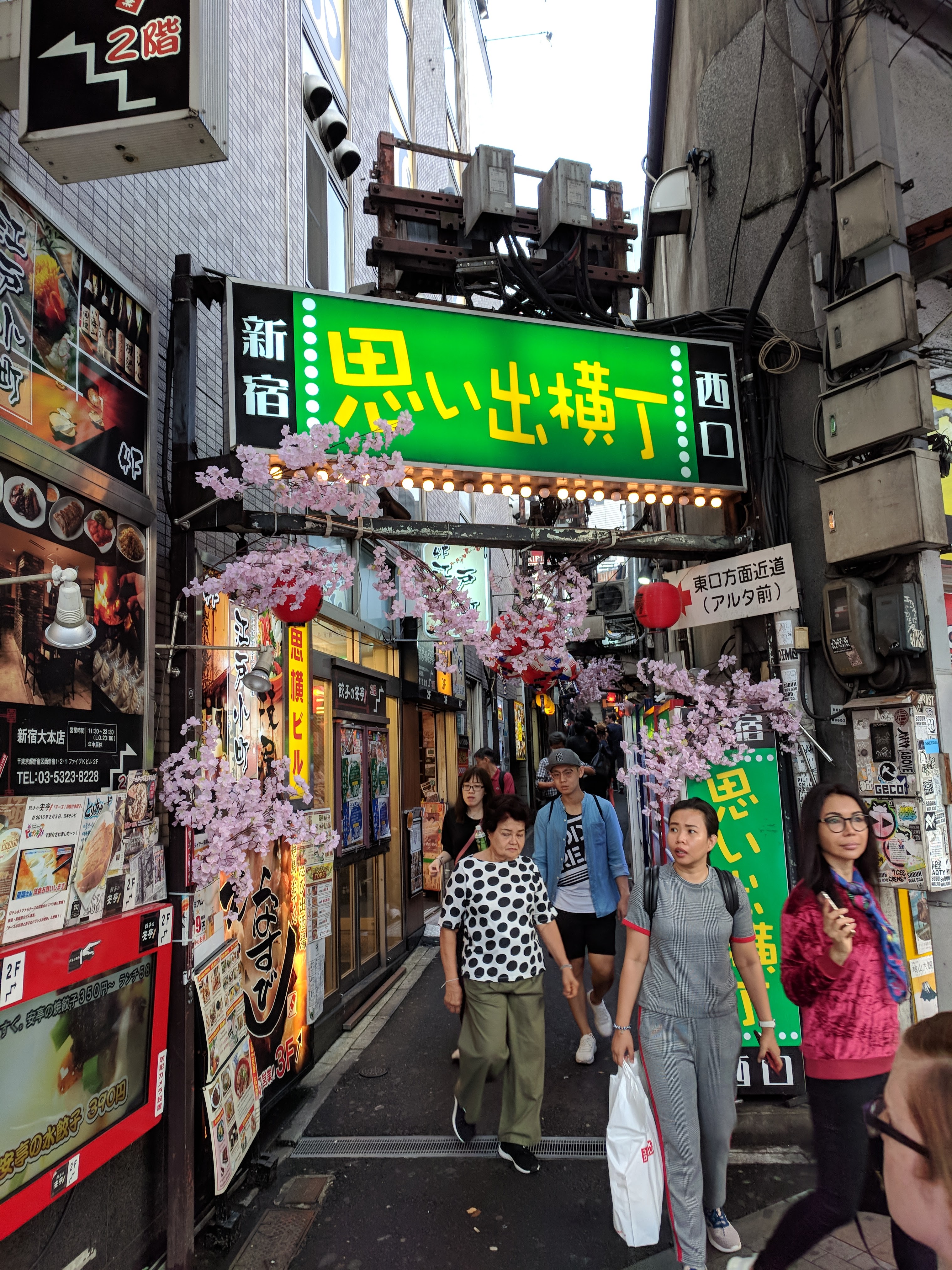
Omoide Yokocho
These narrow lanes of tiny bars beside the Shinjuku tracks descend directly from the open-air black market that formed here in 1946, and they are the one part of west Shinjuku that was never cleared away. Around seventy premises survive on a two-metre lane that a fire in 1999 burned twenty-eight shops out of.
Before you take a step, here is the shape of the next couple of hours. Close to five kilometres on the ground, ten stops, effectively flat — the only rise worth the name is a low mound in a park, and it is optional. It costs nothing: the only money you might spend is on food, and the one place we go up is a public observation deck 202 metres up that charges nothing. We cross Shinjuku Station exactly once, and we do it through a passage with no ticket gate, so you will not need a fare. And we are doing all of this in daylight, on purpose. Three of the places on this walk are famous for how they look after dark. In the dark you see lanterns. In daylight you see the ground they are standing on, which is the actual subject.
Look at where you are: the lanes are about two metres across, wide enough for two people if one of them turns sideways. Packed into them are around sixty restaurants and, counting ticket shops and other tenants, around seventy premises in total, on a plot of roughly 630 tsubo, a bit over two thousand square metres. That is a whole neighbourhood squeezed into the footprint of a supermarket. Most of the counters seat six to a dozen people, elbow to elbow, and the smell you are standing in is the smell of yakitori and motsu, grilled offal, going onto charcoal from mid-afternoon onwards. It has soaked into the wood.
That menu is not a style choice. It is a fossil of ration law. In 1946 this burnt-out patch beside the west exit had thirty or forty stalls on it selling oden and secondhand books, and after those burned down an open-air black market grew here, known as Lucky Street, its traders divided from one another by nothing more than propped-up door panels. By 1947 most food was still under government control and could not be legally traded. Beef and pork entrails were not controlled. So the stallholders sold offal, grilled it over coals, and eighty years later more than half the places along this lane are still yakitori or motsu-yaki shops. The alley is still selling what the rationing office forgot to regulate.
Here is the thread for the whole walk, and this is the only stop where I will say it flatly: everything in Shinjuku is standing on something that was cleared away. This lane is the exception that lets you see the rule. It used to run from the Koshu Kaido to the Ome Kaido, some three hundred shops of it. In 1959, with a subway extension and a redevelopment plan coming through, those shops were declared squatters and removed. What you are standing in is the stump they didn't get to, and it is where the temporary partitions hardened into fixed premises with addresses and leases. Ten minutes west of here, everything was flattened, and we will get to what went up instead.
The polite name on the signs, Omoide Yokocho, Memory Alley, is a retrofit. For decades everyone called it Shonben Yokocho. That means Piss Alley, and it means it literally: the stalls had no plumbing and drinkers used the embankment. The shopkeepers' association pushed the softer name and asked the press to stop printing the old one, which is why you will see one word on the lanterns and hear the other from anyone over sixty.
Then, at lunchtime on 24 November 1999, a fire started here. More than sixty engines came. It took until evening to put out, and twenty-eight of about seventy shops burned. Nobody died, largely because it happened at midday and not at midnight. Most of the alley was trading again within a year, and the association now marks 24 November every year as Omoide Yokocho Day. But here is the part that should surprise you: the burned central row could not simply be rebuilt as it stood. The lane is too narrow for what building law now requires, so the alley survives as a legal ghost, grandfathered in and essentially unrebuildable if you knocked it down. Landowners here have been circling redevelopment since the 1980s and were organising again within months of the fire. The tenants stayed anyway.
Practically: most places open from late afternoon, a handful do lunch, English menus are common now, and nobody minds if you just walk the length of it and look. There is a second alley of this kind on the far side of the station, and it survived for an entirely different reason.
Shinjuku Station west exit concourse
That is stop one, in the walk itself. The remaining 9 stops, the map and the route between them open with one free account.
Continue the walkThe written walk is free.
Thank you! Your report has been submitted.
Report an issue
Help us improve by reporting any issues you notice.