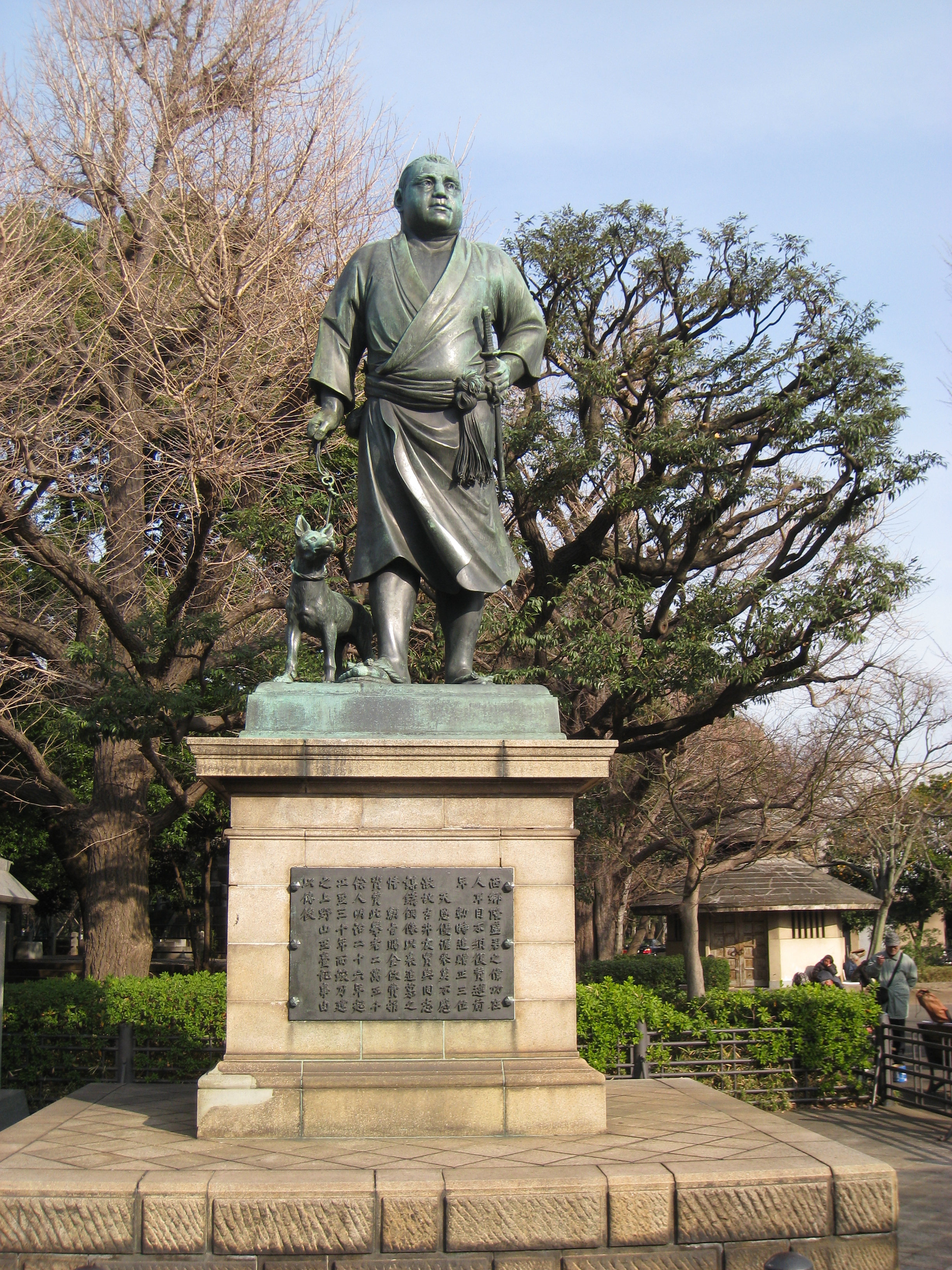
Saigo Takamori statue
Saigo Takamori led the Meiji army that took this hill in 1868, then died leading his own failed rebellion against that same government in 1877; the 1898 bronze by Takamura Koun deliberately shows him walking his dog in casual dress rather than in uniform.
You are standing on a hill that keeps losing, and every time it loses, the ground gets handed back to the public. Ueno does not look like a battlefield today — it looks like a park: trees, a pond, a museum queue, the unhurried traffic of a city on its day off. That is the trick of the place. What you are walking through was fought over, starved through, and rebuilt more than once, and each defeat got repurposed into something anyone could use — a park, a collection of art nobody agreed on, a market that grew out of nothing to eat. Over the next two hours you will drop about six kilometres, from this ridge down to the flat streets below, following that same pattern stop by stop: ground lost, then opened. It is not a solemn walk. The wreckage here has a way of turning into infrastructure, and infrastructure, eventually, into a street that sells uncannily convincing plastic food. Start here, at the top of the hill, and let it take you all the way down. The battlefield is under your feet.
Look at him: a stocky man in a loose kimono and straw sandals, sleeves rolled, walking a small dog on a leash. No sword raised, no horse, no uniform, no plinth of battle scenes. If you didn't know the name, you'd take him for someone's uncle out for an evening walk. That's exactly the effect the statue's backers wanted.
This is Saigo Takamori, and the casualness is doing real work. He commanded the imperial army that fought its way up this hill in a single day in 1868 — the men he beat are buried just a few steps behind you, and that story belongs to the next stop, not this one. Nine years after that victory, Saigo raised his own army against the government he had just helped build, lost, and died for it. A general who won on this exact ground, then a rebel who lost everywhere else: that's the shape of almost everyone this park remembers. It's also where the whole tour's pattern starts. Every time this hill loses a fight, somebody turns the ground into something the public can walk through instead — and the very first casualty of that pattern is the man standing on this plinth.
The bronze went up in 1898, twenty-one years after Saigo died, made by Takamura Koun, the leading wood-and-bronze sculptor of the Meiji court. Koun and the men financing the statue chose the kimono and the dog deliberately, over objections from people who wanted a general in uniform on a horse. A uniformed Saigo would have been a monument to the rebellion; a Saigo out walking his dog Tsun could be read as nothing more than a beloved local eccentric. The clothing is doing the political apologizing that the government itself never quite managed.
Even the face is a guess. No reliable photograph of Saigo survives — by most accounts, none was ever taken while he was alive, and he's said to have avoided sitting for one. So in 1883, six years after his death, the Italian engraver Edoardo Chiossone, who had never met the man, was asked to produce a definitive portrait for the state. Working from testimony rather than a photograph, he is said to have combined the upper half of the face of Saigo's younger brother with the lower half of his cousin, then revised the composite against family members' memories until they told him it looked right. That reconstruction became the template for this statue and for every schoolbook image of Saigo since — a face built by committee, one generation removed from anyone who'd actually seen it.
Which brings you to the story everyone tells about the unveiling. Saigo's widow, Itoko, is said to have looked up at the finished bronze and muttered that her husband never looked like that, before a relative hushed her. It's a good story, and it may even be true, though historians who've dug into it aren't sure she attended the ceremony at all, and some think her complaint — if she made it — was about the undignified dress, not the face; by their account Saigo was a stickler for proper appearance in public, nothing like this loafing figure in a bathrobe. Nobody left alive could really settle it either way, which is rather the point of a monument built from secondhand memory.
The politics behind the pardon matter too. After the rebellion collapsed, Saigo died a branded traitor, and stayed one for twelve years. In February 1889, as part of the amnesty marking Japan's new imperial constitution, the emperor posthumously restored his court rank and cleared his name. That reversal is the only reason a man who'd taken up arms against the state got a statue in a park the state itself had just built. Notice, walking on, how ordinary he looks against that history — a dog, a kimono, a hillside full of cherry trees behind him, and underneath all of it, a first loser the government eventually forgave enough to put on a pedestal.
Shogitai graves
That is stop one, in the walk itself. The remaining 9 stops, the map and the route between them open with one free account.
Continue the walkThe written walk is free.
Thank you! Your report has been submitted.
Report an issue
Help us improve by reporting any issues you notice.