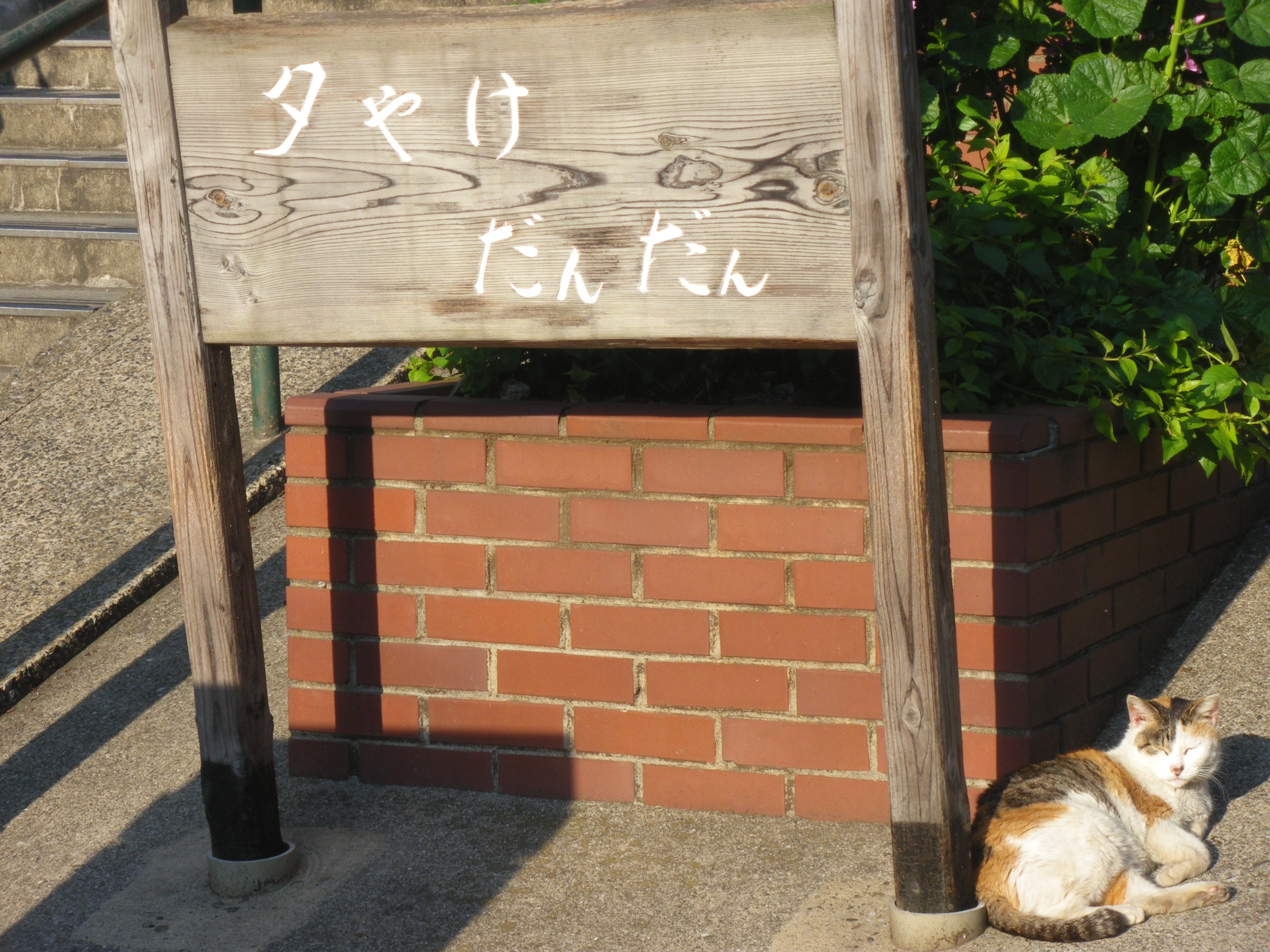
Yuyake Dandan
The tour opens at the top of the Yuyake Dandan, the "sunset steps" above Yanaka Ginza, named in a 1990 community newspaper contest, where the 10 March 1945 firebombing's targeting logic explains why this ridge of wood and tile still stands.
You are standing at the top of a long staircase, looking out over rooftops that belong to an older Tokyo than the one around them. Below you: tile roofs, temple walls, narrow lanes, laundry strung across balconies too tight for two people to pass side by side. This walk covers ten stops over about three kilometres, roughly a hundred and five minutes, tracing a ridge and then dropping down real staircases into the valley of Nezu. Yanaka is not a preserved district and it is not a museum. It is a neighborhood where people buy groceries, walk dogs, and complain about the heat, and it happens to be built mostly of the materials Tokyo used before concrete took over. That is unusual. Most of this city was rebuilt from scratch more than once in the twentieth century. This ridge sat outside the main burn zone on the night that decided which parts of Tokyo would need rebuilding and which would not, and the reasons are about ground and material, not luck or charm. You will have them by the time you reach Nezu. For now, just look at what is in front of you, and start walking down.
Stand at the top of the steps and look west, out over the rooftops. Grey tile, wood siding, the low jumble of a neighbourhood that never got tall. Somewhere down there is where you're headed. But first, the question this whole walk is built to answer: why does this stretch of Tokyo still look like this, when almost none of the city around it does?
These are the Yuyake Dandan, the "sunset steps," and the name is younger than you'd guess. It wasn't handed down from some Edo-period poet — it was picked in 1990, when the staircase was rebuilt and a local community newspaper ran a naming contest and printed the entries. "Yuyake Dandan" won because it does exactly what it says: sit here in the evening, facing west toward the shopping street below, and the sky over the rooftops turns the color the name promises. That's the whole origin story. A renovation, a newspaper contest, a good name that stuck.
Here's the harder history. On the night of 9–10 March 1945, waves of B-29s dropped incendiaries across Tokyo in what's now called the Great Tokyo Air Raid — the single deadliest bombing raid of the entire war, anywhere, worse than Hiroshima in lives lost in one night. The targeting was deliberate: American planners aimed at the densest, lowest-lying wooden districts, the crowded shitamachi neighbourhoods to the east and south, where fire could jump roof to roof and outrun anyone trying to escape it. This ridge — slightly higher ground, looser-packed with temple land and gardens breaking up the wood — sat outside that primary path. That's not the same as saying nothing here burned. Tokyo took more than one raid that spring, and I won't stand here and tell you this hillside came through every single night of 1945 without a scorch mark, because I can't prove that and it isn't the honest version. What's true, and what you can verify by simply comparing old maps to what's standing now, is that Yanaka was spared the wholesale erasure that flattened the low city. That's the beginning of an answer, not the end of one — the fuller physical reason why fire had a harder time taking hold here waits two stops from now.
Now, the cats. You'll see one before you reach the bottom of these steps, probably sitting on a wall like it owns the place, because in a sense it does. Yanaka's reputation as Tokyo's cat neighbourhood isn't folklore — it comes from an actual population of resident strays, fed for generations by temple caretakers with time and leftover rice, and by shopkeepers who found it was good for business to let a cat sleep in the doorway. Look for the carved wooden cats tucked along the street ahead: seven of them, made by art students in 2008, hidden in doorways and on rooflines rather than lined up for easy spotting. Local tradition says find all seven and you get good luck. I'll let you decide how seriously to take that; either way, it gives you a reason to look up and into corners instead of straight ahead.
One practical thing before you go down. This staircase isn't a viewing platform — it's how people who live past the shops get home, several times a day, with groceries and bicycles and children. Take your photo, take your look at that skyline, and then move to the side rather than parking yourself across the middle steps. It's a small courtesy, and it's the same one you'll want to keep in mind for the rest of this walk: everything ahead is a lived-in place first, a tour stop second.
So hold onto the question as you go down. The short version of the answer, the one this whole walk is going to spend an hour proving to you, is this: Yanaka survived because of what it was made of and where it sat. Not luck, not some special protection — a neighbourhood saved by geography, and then kept standing by the stubbornness of its own materials. You've just seen the geography part from up here. The materials part is two stops away. For now, head down toward the shopping street in front of you.
Yanaka Ginza
That is stop one, in the walk itself. The remaining 9 stops, the map and the route between them open with one free account.
Continue the walkThe written walk is free.
Thank you! Your report has been submitted.
Report an issue
Help us improve by reporting any issues you notice.